Juxtaposing Feldenkrais’s reasoning with contemporary biomechanical principles

I was browsing through the book, “The Elusive Obvious,“ by Moshé Feldenkrais, Chapter “Awareness Through Movement”, when this passage stood out to me:

“This seemed to me the real gist of my knee trouble. I could repeat a movement with my leg hundreds of times, I could walk for weeks with no inconvenience whatsoever and suddenly doing what I believed to be the identical movement just once more spoiled everything. Obviously, this one movement was done differently from the former ones, and so it seemed to me that how I did a movement was much more important than what the movement consisted of.”

From a biomechanics perspective we could call this motion and motor patterns. His reasoning sounds smooth, and certainly sounds like as if it could be the founding principle of the entire Feldenkrais Method.

However, his reasoning in that paragraph is also incomplete in the light of modern research. Why is that? Two explanations come to mind:

1. His argument might have been part of his greater reasoning process, and is only one step on the stairs that ultimately lead to the creation of his unique lessons.

2. Maybe we are lucky that Moshé Feldenkrais’s was more excited about exploring the subjective “how” rather than solely the observable mechanical details—as it lead to the creation of his unique lessons, and the discovery of this beautiful “Feldenkrais” movement quality, learning and experiencing.

Moshé Feldenkrais argued that one movement with his knee was done differently from the former ones, and thus lead to his trouble. But maybe that wasn’t the problem at all.

In modern research we know about perturbed motion and motor patterns, but also take into account tissue load, stress and cumulative damage. In this sense we distinguish between tolerance and capacity:

Capacity: In the context of the knees, capacity refers to the structural integrity and biomechanical properties of the joint and surrounding tissues. This includes factors such as bone density, ligament strength, cartilage health, and muscle function. An individual’s knee capacity determines the maximum load or stress that the joint can withstand without experiencing damage or dysfunction.

Tolerance: Knee tolerance, on the other hand, refers to the ability of the joint and surrounding tissues to adapt and withstand stress over time.

In this light, maybe the way Moshé Feldenkrais walked and used his knees was fine. Maybe his motion and motor patterns were completely ok. Maybe his way of walking was well within the capacity of his knees.

However, due to the severe, lasting damage from his accident playing soccer, where somebody jumped onto his extended leg and forced his knee to bend forwards (ouch), causing torn ligaments and muscles, his walking might have exceeded the tolerance of his knee. He might have been able to walk just fine for an hour, or an hour every day, but then the normal load and stress added up and the moment came where he exceeded his knee’s tolerance, and thus his knee failed again.

Therefore, his reasoning “Obviously, this one movement was done differently from the former ones” could just as well have been “Obviously, I exceeded the cumulative tolerance of my knee.” In which case the Feldenkrais Method might have become a series of strengthening exercises with weights and machines in the gym instead 😅😂

Furthermore, there’s the reality of healing. The body has a capacity to heal and repair itself to some degree. However, the wear and tear, the way and also the intensity that we make use of ourselves, as well as other lifestyle choices such as sleep, diet, smoking and drinking, etc, might impair healing; or maybe the cumulative stress we put on ourselves exceeds our capacity for healing. To take the time to lie down and to do small, gentle, slow, intelligently crafted and sequenced movements, became certainly one of the most iconic features of Feldenkrais’s lessons.

To end this blog post, a quote comes to mind, by Ludwig Wittgenstein:

“If someone is merely ahead of his time, it will catch up to him one day.” 

For the longest time I was trying to make sense of this quote. Now, with today’s blog post, I finally have an example that helps me with understanding this quote. Chronic pain and movement problems might be a motivation to start exploring Feldenkrais lessons, but Moshé Feldenkrais wasn’t merely ahead of his time. Instead, he made a substantial contribution to humanity. His lessons do not only help to improve function and provide means for recovery in a humane way, but they ultimately lead to a better understanding of ourselves, our possibilities in live, and our well-being.

Page-flipping through the books of Moshé Feldenkrais

To me, Moshé Feldenkrais is one of the most hilarious old school writers in the library. His books are spiked with knee-slappers. For example, I quote from “Body And Mature Behaviour,” chapter “Localisation Of Function And Maturity”:

“Psychoanalysis, in Freud’s writings at least, deals solely with psychic life. Only very rarely is there any allusion to the fact that psychic life does take place in a physical body. [..] Any such treatment is therefore bound to spend its usefulness rapidly, as it did.” – 

There’s plenty of critique about Freud nowadays, especially with the rise of fields like Somatic Psychology, Neuroscience, Psychosomatic Medicine, and Mind-Body Practices. But who else writes as snippy and is elbow-ing down everyone else in order to promote his own method as much as Moshé Feldenkrais did? Reading, I feel like watching an old school, American Coca Cola vs Pepsi comparative advertisement TV-Spot .. 🤣 LOL

Moshé Feldenkrais truly had a knack for promoting his own method amidst the backdrop of other psychological theories and practices. Let me drop another quote, for example, from his book “The Potent Self”:

“The person must now return to the initial lying position and learn what it feels like to act correctly. [..] Now a word of warning. The incompetent person [..] may think, like a yogi, that special powers are attached to this position, in which he may feel for the first time the sense of well-being [..]”

It’s hilarious. He’s dissing Yoga and at the same time saying that people will experience his exercises as something that has special powers, feeling a sense of well-being like never before.

But then, I can’t deny that, really. As you yourself might be able to confirm.

Postural recession: I simply can’t afford to slouch anymore

Ah good heavens, metaphors of language, transfer of meaning, what a tool. Postural recession is my new word now, really? You too, Brutus?

I always liked to afford 😉 myself a bit of individual style and variety in my posture—I mean the way in which I hold my body when I stand, sit, or walk. A bit of slouching in my shoulders, a bit of depression of my chest, and a bit less of pulling my shoulders backwards than all the brave men all around me who are so good at following all the rules and jumping through all the hoops and believing all and everything that is on the News… including the ads… to exaggerate my bitter exaggeration.

Actually that last bit about the ads is about diet, and not my original thought. It’s from a well researched book, hence my disappointment and slight bitterness. I quote: “In her book »Food Politics,« Marion Nestle exposes a startling reality: despite the belief in individualized and conscious dietary choices, the majority of people actually consume diets that very closely resemble what is promoted in large media campaigns.” Which would still be sad, but at least emotionally acceptable for me, if large media was all about what’s best for the people, their health, and the environment.

Therefore: a bit of slouching as a mildly rebellious act and me saying “I’m not ok with all of that.” I mean, why not? In this Fin-de-siècle revival, or maybe now they call it “general end of the world sentiment,” an Angst of doom for human life on earth shared by every good soul, so why not slouch a bit? Into the face of it all! 😅

However, I think my body ran out of postural currency. I can’t afford to slouch anymore. Is it the unresolvable, chronic inflammation and neuro-inflammation? The slow poisoning through PFAS forever chemicals, and methylmercury that was injected into my body and was not swiftly disposed as promised but is now in my brain, and aluminium, lead, etc? Or was it decades of slowly and consistently grinding down intervertebral-discs and facet-joints? What is it that made me go posturally bankrupt?

Maybe the human body has tighter postural limits than I thought. Maybe the many possibilities for variety in posture are not there to be used as permanent, artistic installations of personal sentiment. Maybe we need to hold ourselves quite tightly aligned to our biological design if we want to live pain free?

And maybe this holds true for many more areas, not just posture? But that would be another thought that should be explored another time.

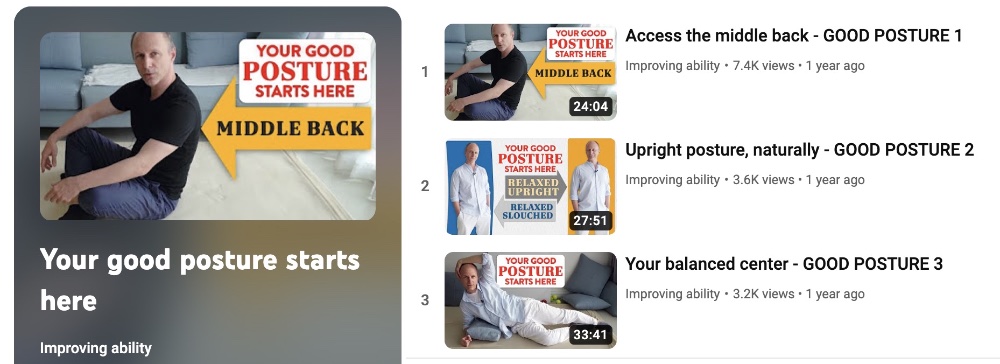
Your good posture starts here – 3 videos free to watch on Youtube by Alfons @ImprovingAbility Link Click Here

How to stand straight? What does “standing straight” even mean? How to correct posture? How to change old habits, how to establish new ones? Luckily I’ve been exploring these questions for the past 2 decades professionally. I simply need to apply my expertise a bit more myself, increase the dosage of my own medicine, so to speak. How about you, are we into this together?

The blurry line between figure posing and somatic learning

Perhaps I can tackle this question through writing. Just the other day (as so often) I found myself pondering the idea of learning figure drawing… but then, I quickly dismissed the notion, as per usual. Lack of talent and time, being my reasoning.

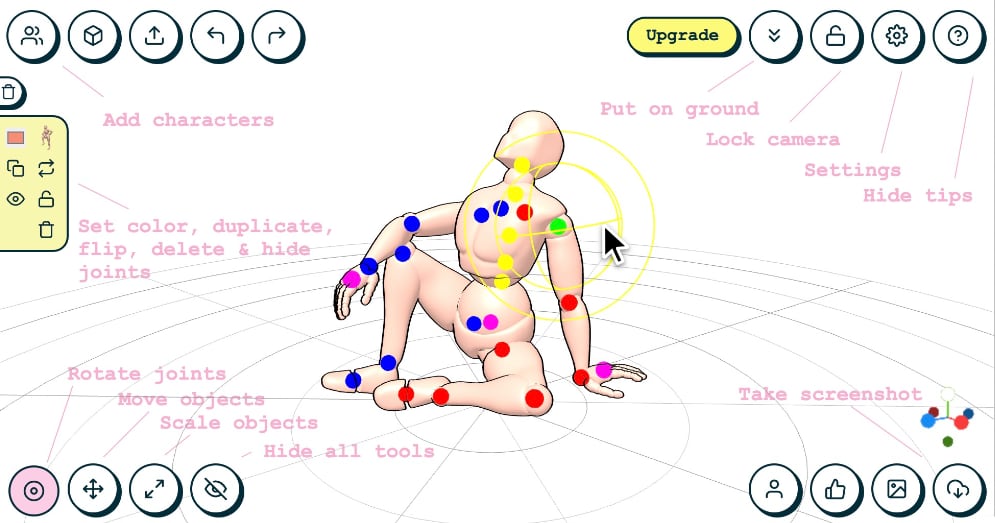
How about digital figure posing then? As an alternative route (my usual go-to thought after dismissing the thought of learning figure drawing), I googled afresh and opened a couple of figure posing apps. However, even now, in the year 2024, I find the available figure posing apps painstakingly cumbersome. It takes me, “like,” forever, to pick and move each joint around, each in its 3 planes, until a pose begins to come together.

Digital Figure Posing

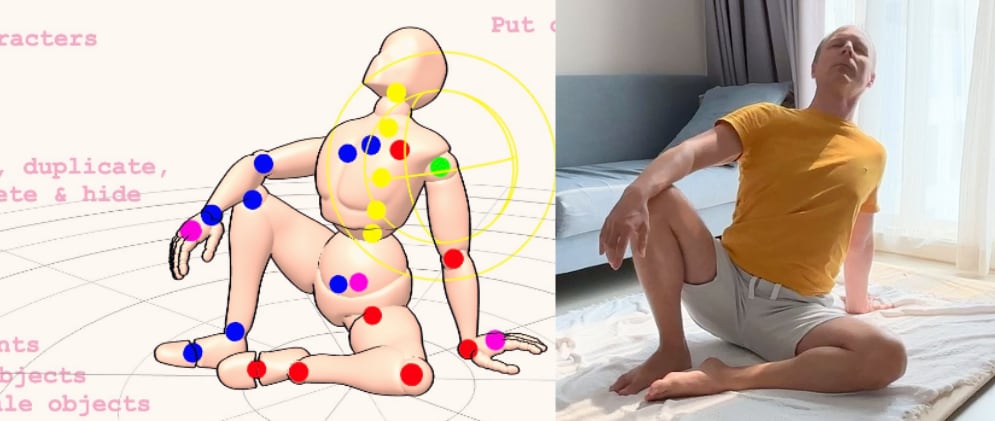
This got me thinking: no matter how many hours I will spend on posing that digital, posable figure, THAT figure will learn nothing. Nothing. No-thing. Naught. Despite me carefully and thoughtfully moving it around, despite that figure having its limbs rotated into all sorts of meaningful angles, my posing it will not touch upon who this figure is, at its core.

However, I, as the person who does the posing, I will learn something. I will get better at posing that figure. I will get better at using the software, at overcoming obstacles. I will improve my workflow, and I will learn some things about myself too, maybe… how clumsy I am, or how patient with software I am … what else?

Digital Figure Posing vs Somatic Education

Question: What is the difference between posing a digital figure, and posing oneself, one’s own body? As in assuming an Instagram or Yoga pose? Through posing one’s own body there’s an added richness and depth, a real-time engagement with one’s body and environment, as opposed to doing the manipulations to a digital figure on a screen.

Somatic Education

Well, you might not have noticed, but in total I’ve spent a bit more than 6 hours on writing this blog post. And I had a night of thinking, too. It seems like I tackled this question well.

In this blog post I’ve identified two very dissimilar, two distinct pathways. These two pathways are

a. Figure posing, whether it involves posing a digital figure, one’s own body, or someone else (e.g. a Yoga student, or an art model for painting), where the main purpose is to pose a figure, and focuses on achieving a specific configuration of limbs and orientation,

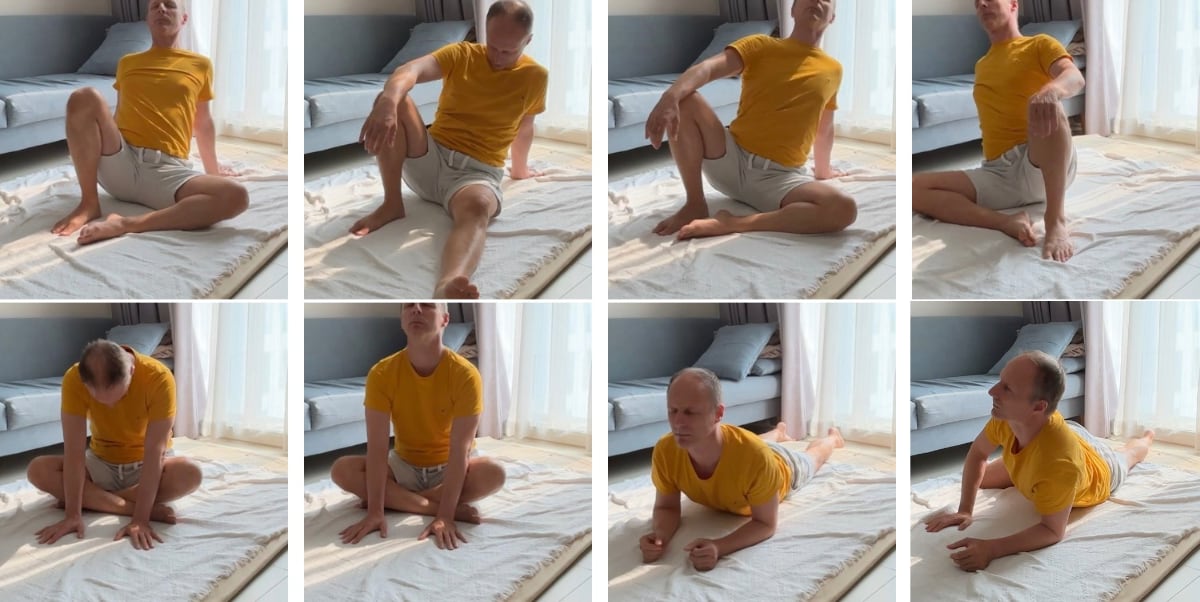
b. Learning through movement, as it is experienced in Feldenkrais-inspired classes, or Somatic Education in general, which involves simulating or evoking genuine learning experiences.

Like all art and craftsmanship, both approaches offer deep and enriching experiences, yet they differ from each other greatly. Figure posing aims to achieve a particular pose to the best of one’s abilities, while learning through movement is about self-exploration and improvement, with poses merely being a practical necessity, emerging as a natural consequence of the learning process.

The distinction between figure posing and learning through movement can be as clear as night and day, or the lines can be blurred, with one practice fading into the other. Ultimately, it’s up to you what you want to focus on in each respective session. To paraphrase Moshé Feldenkrais: “If you know what you’re doing, you can do what you want.”

There’s just no time for learning a new skill

I’ve never started to seriously learn figure drawing, because I think it’s too big of a task for me. It might take me years of daily drawing before I see decent results, and I just don’t have the time for that.

Yet- I keep entertaining the idea of being able to quickly sketch down a figure for reference. And immediately after I discard the idea, because the journey would be too long, too time consuming.

Yet- I think it would be a skill that matches my profession as a teacher in Somatics. But then, it just seems too difficult, too much of a commitment to even start.

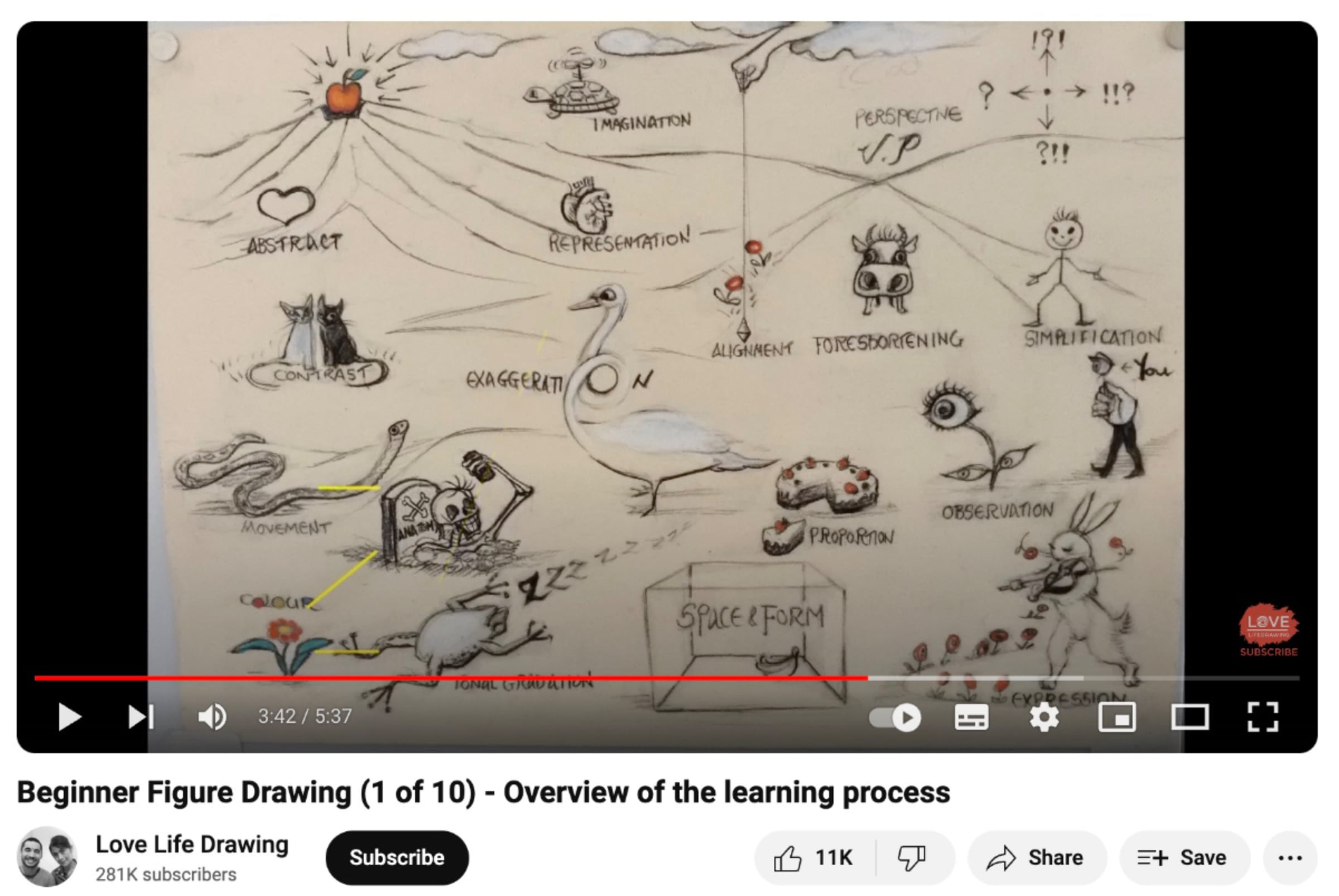
I googled “how to learn figure drawing not boring,” and read through some blog posts, and skipped through some videos. “Overview of the learning process,” one of the videos said. I looked at a picture that had categories like

  • Exaggeration,
  • Abstract,
  • Imagination,
  • Simplification,
  • Observation,
  • Contrast,
  • Perspective

I like that. In my profession we also use these kind of categories to look at movement and movement learning. I imagine this would be helpful to my own beginner students, too, who just start out on learning Somatics, or strive to become scholars of the work of Moshe Feldenkrais, Thomas Hanna, Mia Segal or other masters of the art.

It’s interesting to see online how vastly successful some of these art teachers have become, teachers that teach drawing, illustration and figure drawing classes. There seem to be hundreds of millions of students interested in these arts.

In this sense, I wonder when Somatics will catch on, and when will more people start to become interested in the art of movement learning?

Rush slowly: The bending of the head

There’s this lesson by Moshé Feldenkrais for improving the bending of the head to the right and left. It’s called, “AY#1 Bending the head to the side when sitting.”

By all means, a great lesson. I myself I can touch my right ear to my right shoulder, easily. On the other side, my left ear to my left shoulder? Not so much. If I were a little bit more concerned about this, or if I would see the promise of substantial gains in wellbeing or chronic pain issues, I would quite surely try to improve the side-bending of my neck with more determination.

The main focus of this lesson, however, is not just on the bending the neck, but on the involvement of the hips and the entirety of the spine, and how these movements ultimately improve the movements of the neck.

But wait. The bending?

What is the bending? Don’t we tilt our heads to the right and to the left, rather than bend it? Let’s look at these two different motions:

Bending refers to the act of curving or flexing something, usually along a specific axis, or at a joint. For example, bending a metal rod, bending an elbow, bending a wire back and forth in the same spot until material fatigue occurs and it breaks.

Tilting refers to the act of inclining something from its current position, often without a pronounced curvature. For example, tilting a container to pour its contents, tilting a camera for a different angle, or tilting the head to one side.

Now I have two different ideas of the neck:

A stiff neck, it can only bend at a point in between the shoulders, and at one point in between the ears. This neck feels like as if it was made from one big, sturdy bone, with a ball joint on each end. It can tilt, and it can turn a bit.

A flexible neck, it’s made from the segments of a spine. Each segment can bend a little bit, and in sum total the neck can bend along its spine, beautifully, proportionally, a well distributed bending that can extend further down the spine and even involve the torso, lumbar area, and the hips.

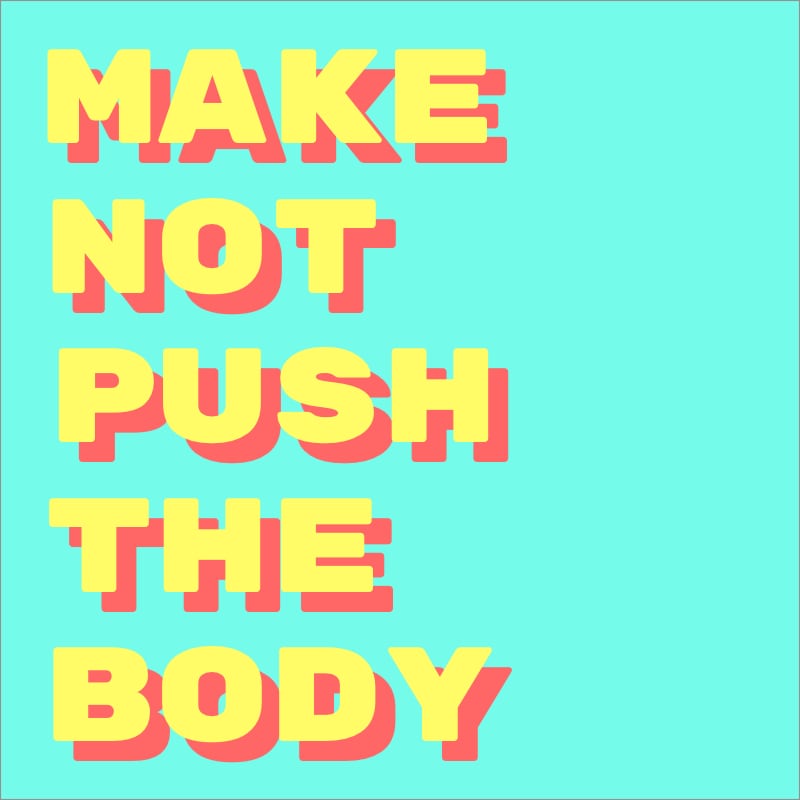
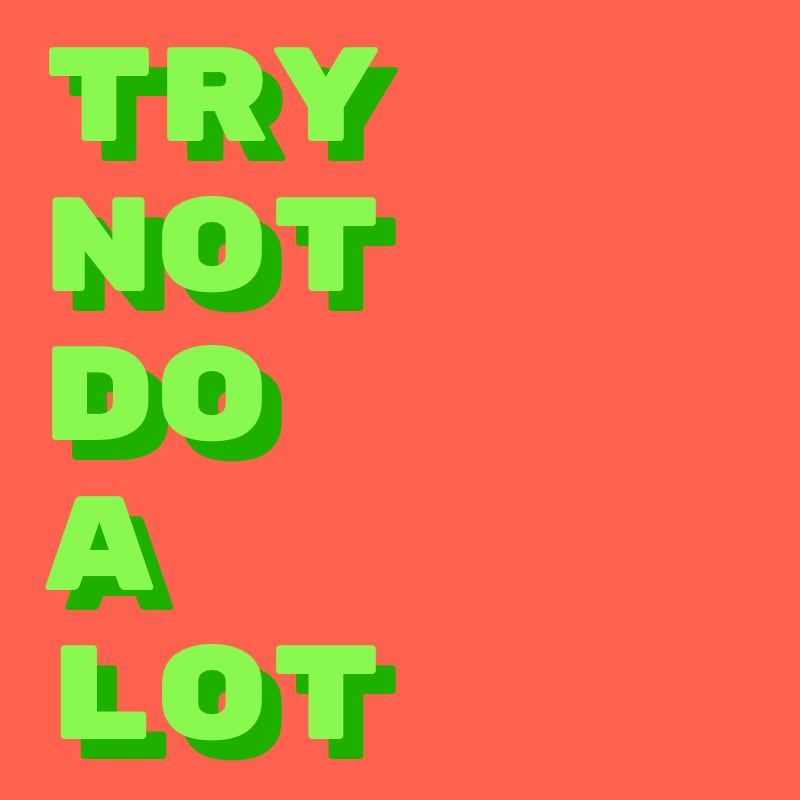
In the English translation of Moshé Feldenkrais’s lesson there’s these funny sounding instructions concerning movement quality: “Do not rush. Do very light movements. Make not push the body and try to do a lot.” When I stumbled on these rare, raw, golden nuggets, they dug into my brain like a stuck tune. Thus I decided to spend a day (or two) to turn these words into word graphics, and to write this blog post.

In this Feldenkrais lesson you don’t force your stiff neck to bend. Instead, you invite it to participate, you invite it to join in with the bending of your torso, the movements of your ribs, the vertebrae and joints of your spine, and your pelvis. You don’t crack your joints, you don’t apply force, but you act as if your whole body was one structure that’s all connected, and can gently be brought to move harmoniously and proportionally well distributed, as one, at once, as a whole person.

You are actively creating very light movements, a perceivable lightness, you apply a sense of agency to consciously produce movements that are light in nature. Like this, the bending will come easily, gracefully, safely, in its own time but soon enough, don’t rush.

You suggest rather than demand, you explore rather than direct, you enjoy rather than suffer. With a mode of easiness you lead yourself to greater enjoyment of the process, that is your life, and to the light of a better day. Rush slowly, my friend.

The language of instant noodles and ready made meals in movement lessons

The way you say something—does it matter? I mean, is there a difference between, for example, “take on a supine position,” and “take a rest on your back?”

  • Does it matter how you say something?
  • The way you say something—does it matter?

Yes or no? When? To what extend? And why?

When teaching movement lessons, Yoga, or animal movement, or physical therapy, or somatic education… whenever you give movement instructions, is there any significance regarding how you phrase sentences? Is it important or not? Does it have consequences, does the way you voice your intention influence the movements and learning of your students?

  • “… is there any significance in how you phrase sentences?”
  • “… is there any significance to how you phrase sentences?”

As a teacher of somatic education, or to some extend even as a certified FELDENKRAIS® teacher, if you will, I ask questions—rather than hose you down with rules and regulations.

This is unusual, and might sound a bit odd in today’s world. Especially considering that most GCFP® “Guild Certified Feldenkrais Teachers” were as eager as anyone to follow the even most non-sensical and most damaging pandemic rules and regulations since April 2020, to the point, and beyond. Like a slightly moist sponge is ready to soak up water they were ready to soak up whatever guideline, ruling or regulation was thrown at them. And they condemned everyone who did not. How long has this been going on?? Doesn’t this turn the main purpose of The Feldenkrais Method—as intended by Moshé Feldenkrais—upside down?

But I’m getting off topic. Let me start again:

I was reviewing some of my videos, when I stumbled upon an online teaching session I gave a few years ago, to Chinese students in China. Everything I said was translated into Mandarin Chinese by a translator. Here’s a screenshot for your visual entertainment (I blurred out the students for privacy):

My first instruction in this lesson was “Please lie down on your back,” which the translator translated to 请仰卧 (qǐng yǎng wò), rather concisely. 请 (qǐng) meaning “Please” and 仰卧 (yǎng wò) being the noun phrase of interest, meaning “lie down in supine position.”

Now, as a Non-Chinese speaker I can’t write about linguistic aspects of Mandarin Chinese. But I can fool around a bit (or make a fool of myself, more likely). Let’s break down the individual words of this short sentence, via a bullet list:

  • 请 (qǐng) means “please”
  • 仰 (yǎng) means “to face upwards”
  • 卧 (wò) means “to lie down”

And, of course, the last two words are glued together, which is called a “noun phrase” in grammar speak, and thus becomes “仰卧” (yǎng wò).

Easy enough.

And where’s my beef? The beef I have with this, as a teacher of somatic education, is that “Lie down in a supine position”… I mean… let me phrase this as a question. What do you reckon is the difference between saying:

  • “Please lie down in a supine position.” and
  • “Please come to rest on your back.” ?

I want to end this post with sharing my personal point of view. If I were to teach a class in Mandarin Chinese myself, I would go with the longer phrase “请平躺在你的背上。(Qǐng píng tǎng zài nǐ de bèi shàng.)” Meaning, “Please lie down on your back.” For three reasons:

1. “Supine position” is a complete concept, like a ready made meal. However, I want students to cook for themselves, to put things together starting from raw ingredients. “Do this, this, and this, and see what it is, and how it tastes like.” Metaphorically speaking.

2. By addressing everyone with the singular “you” 你 (nǐ) rather than the plural “you” 你们 (nǐmen), I can make it sound like as if I’m talking to every person in the room personally, directly, even if there’s 60 people in the room. In my mind lessons of somatic education (as intended by Moshé Feldenkrais) are a personal experience, and are to foster personal learning; and certainly not to turn the movements of individuals into a group choreography, or critical thinking into the lockstep of an indoctrinated hive mind.

  • Please rest on your backs.
  • Please rest on your back.

3. Furthermore, this phrase includes a tactile cue, “your back.” I might double down on that with another sentence, “Sense how you rest on the floor.” Therefore, the instruction “Please lie down on your back” served as a preparation, a lead-up to the next sentence, in the congruent, continuous flow and progression that is the lesson.

Oh, one last thought: my last paragraph reminds me of the song, The Moldau, by Bedřich Smetana. Like a movement-based lesson in the original spirit of Moshé Feldenkrais, the song starts out by telling the story of a small, gentle, light little water running down the mountains of the Bohemian Forest, which then flows through rural Czechoslovakia, and finally becomes this beautiful, majestic, big river, as it reaches Prague. Home.