Five years ago—as of today—I made a little video with ideas for fall prevention [Youtube: A great exercise for fall prevention]. No, it didn’t go viral. No, it wasn’t picked up by the Good Morning America TV Show. No, it didn’t buy me a house and a Ferrari. But I always liked to think back to this video, I really liked the ideas in it. And, have you looked at pictures of yourself from 5 years ago? You looked amazing! And so did I.
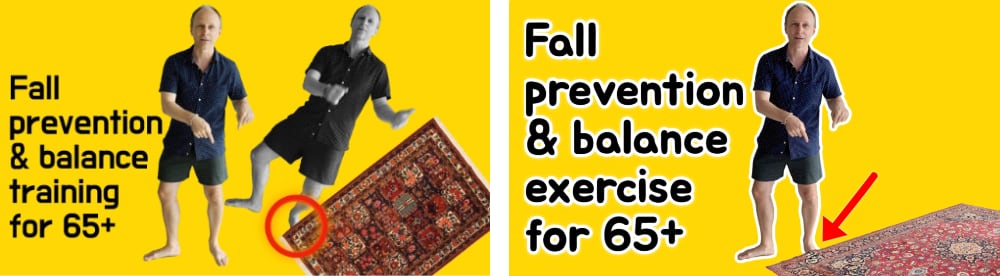
So- yesterday I went ahead and did a new version of this [Youtube: Fall prevention & balance training for 65+] and I think it turned out pretty well. Oh- and I just now spend one more hour on the thumbnail. Would that I knew if it got better though. Have a look-see, which one is more appealing, in a clickedy-click on that thumbnail kind-of way? I tend to like the first one more. But the second one kind-of looks cleaner and more modern. Yes no?
The journey continues- this morning I was going through the movements again, since I really like them. And I figured this is not just for seniors, but for everyone. Maybe most of all for myself. My legs lost a lot of power since I was 17, and I need to build up again.
Maybe with music, or with a song. However, for the non-musical self inside of me I built it a bit more systematically:
- Imagine a clock face on the floor, with 12 o’clock in your front, 3 o’clock to yo’ right, 6 o’clock at your back, and 9 o’clock you-know-where.
- Stand with your feet (kind-of) parallel, your feet next to each other, that’s our starting position. Keep your right foot standing where it is, don’t move it. And then take a step with your left foot onto 12 o’clock and back to the starting position.
- Then a step to 11 o’clock, and back to start, and then to 10 and to 9, to 8… all the way to 6 (and maybe even 5), and so forth.
- And then the same thing, but turn your left foot, together with your leg and shoulders and head and pelvis. But always keep your right foot planted in the starting position. Stay with your right foot in the same position. Bend your knees. Bend your knees a lot. And so forth. And so forth.
- For a more Patrick-Step (The kneesovertoesguy) kind-of variation you could stand with your right foot on a wedge, or on a wedge shaped shoe, a women’s comfort slipper with a high heel, of all fashion items. And so forth. And so forth. And then walk like a crab in a circle.
I might make one more video of it. It’s fun! Or at least- not as boring as single-motion exercises, the ones that fitness professionals and fitness victims all alike perform in the gyms. Single-motion repetition drills really fry my brain, like, braindead and all. What good are muscles without a well functioning brain? People pumping iron with big headphones on and loud heavy-metal music, people trying to tickle some neurons while they starve them to death at the same time.