This month

A. For many days I’ve wanted to write a blog post. And now the plumber has to clear out the buildup in the sink trap – a chunky, irksome, rode-like bundle of what once was beautiful thoughts.

B. In the Feldenkrais Method of Somatic Education, we go: movement experiment → observation → non-judgmental interpretation → suggested variations. However, most people seem to expect: problem → action → result → reward. I might need to adjust. Do I need to adjust?

C. In comes a teacher into the classroom… and starts to lay out random topics, of which some might be on the test. How many people live out their entire lives in a burned-in afterimage of those 10,000+ hours of schooling?

D. Someone wrote, “There’s more poetry written than ever, yet, nobody reads poetry anymore.” 500k views, 30k likes, 1,250 comments. Me thinks: THIS IS our modern poetry. Swipe up.

E. “But keep in mind that in the United States almost nobody who reads, writes, or does arithmetic gets much respect. We are a land of talkers; we pay talkers the most and admire talkers the most, following the public models of television and schoolteachers.” – John Taylor Gatto, Essay: The Psychopathic School, Book: Dumbing Us Down

F. Yet, I keep writing. When I should be talking. When should I be talking?

G. “And I say this to you tonight, let us not forget. There is hope!” – The Crystal Method, Song: Keep Hope Alive, Album: Keep Hope Alive

H. On my homepage I don’t have any user tracking. The skies are clear and I feel merry. But on Substack I can see that last month 2 out of 108 subscribers unsubscribed. Who abandoned me? I want to know. Unease keeps creeping into my thoughts.

I. I feel very optimistic about the horse in this Year of the Horse.

J. Thank you for reading. There’s nothing quite like walking into a clean kitchen in the morning.

How to reason something out

I want to think about this here (that much I have figured out already):

What is the difference between movement learning and regular movement?

And so I was thinking: first I need to find out how to think about things, in this day and age.

You know, when I was a kid, I always had to walk from school back to our house. I was used to walk alone, which took anywhere from half an hour to several hours, and led me over poorly paved streets, passing by meadows, eerie houses and farmland, and through a good stretch of then beautiful forest, with a creek trickling down the mountain. In the first year of my walks there was even a few fish in that creek (I kept looking for them, but sadly, they seem to have disappeared forever.) At that time there was no mobile phones or iPod or such things. I had a bulky, plastic-y SONY Walkman, but this thing was notoriously out of battery, the headphones didn’t fit that great, and I had nothing to listen to anyways.

So I was walking six days a week, alone, submerged in nature, and my own thinking. That was a pretty good setup.

Language grows with metaphors: Three types of rolling

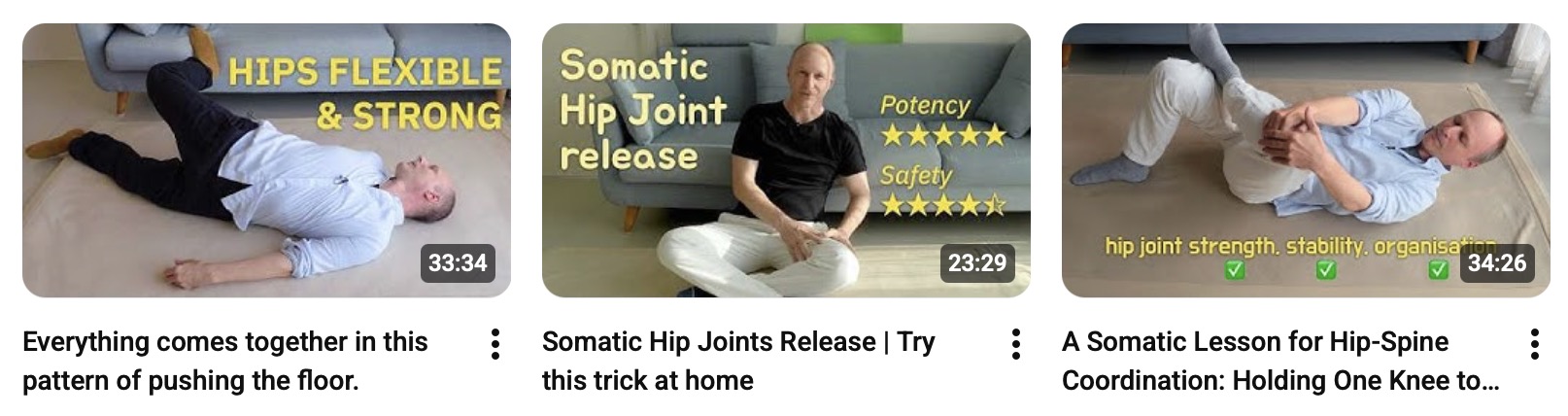
Looking back, I have designed three Feldenkrais-inspired rolling lessons in the past month:

All start in side-lying, and end in rolling, the third has yet to be filmed:

  • Rolling by pushing-off/pressing against the floor.
  • Rolling by curling-flexing/extending — curly rolls.
  • Rolling by twisting upper/lower body — twisty rolls.

The challenge is naming the first variant. “Pushy rolls” would match, the image of thrusting, pushing-off, which is biomechanically accurate… but it feels off due to the negative social connotation of “being pushy.” I explore further:

  • “Pressy rolls” is softer, but the metaphor of press (printing press, olive oil press, T-Shirt press) doesn’t match the thrust-off dynamic.
  • “Rooty” from “rooting” is a recognisable word and often used in Yoga, but implies sinking/planting rather than pushing off.

Then I shifted toward everyday metaphors, like using a handrail of a chair to push oneself out of a chair. When this didn’t yield any results, I asked ChatGPT for material I could use for brainstorming: Scooty, Boosty, Nudgy, Hoisty, Prop-y.

  • Scoot – feels rushed.
  • Boost – appears in the word booster which is politically loaded.
  • Prop-y – from propel. My thesaurus said: push/move forwards, move, set in motion, get moving; the action of driving or pushing forward.

Propel seems to fit the biomechanical reality, and it avoids the connotation of being “pushy.” And, when abbreviated, it even sounds a little bit like “proper.”

In conclusion, and to conclude the brainstorming coffee shop session from this morning, the emerging trio is:

  • Prop-ly rolls (propel, push-off)
  • Curly rolls (flex/extend)
  • Twisty rolls (rotation/spiral)

In reality, I guess, “pushy rolls” might be the one that sticks… because it’s the most easy on the tongue — duh!

Here’s to definitions

Yoga
mastering poses, breathwork, meditation, and philosophical systems

Pilates
cultivating control, strength, mat work, and equipment-based levels

Somatics
discovering spatial and sensory landmarks and their relationships

— or —

Yoga
practice of poses, breathwork, meditation, and philosophy

Pilates
practice of control, strength, mat and equipment progressions

Somatics
practice of sensing and mapping internal landmarks and relationships

with a 😊 by Alfons, YT@ImprovingAbility

p.s.: Somatics encompasses Feldenkrais, Hanna Somatics, Alexander Technique, Body-Mind Centering, and related practices that explore movement and sensory awareness.

The sensation of effort

I’ve just spent two hours on working a paragraph of Moshé Feldenkrais’s into something I could use for a Youtube Short. The text mingling felt rather effortless, annoying at times, but smooth sailing with a dictionary, a thesaurus, and a computer, but was quite some work nonetheless.

And thanks for nothing to GPT-5, which proofed to be useful only for grammar checking.

Title: The sensation of effort

1st slide:

  • That light feeling when your hands glide like rays of light over piano keys.
  • When your running stride flows.
  • That crisp, perfect ping when you hit a golf ball just right.
  • That feeling when your gear shift clicks perfectly into place.
  • When your basketball shot rolls out perfectly, with no hesitation.
  • When your singing voice hits the perfect resonance.

2nd slide:

  • In truly skillful movement, work is being done, but the sensation of effort is absent.

3rd slide:

  • In contrast, a sensation of effort signals that a movement is working against your body’s design;
  • that a movement is inefficient enough to trigger a warning;
  • is poorly distributed, badly timed, and wasting energy.

4th slide:

  • Effort is a helpful signal if you act on it — and a troublesome one if you ignore it.

Source

Here’s the original text, Moshé Feldenkrais, The Potent Self, Chapter 12, Correct Posture, Section “Absence of effort”:

In good action, the sensation of effort is absent no matter what the actual expenditure of energy is. Much of our action is so poor that this assertion sounds utterly preposterous. It suffices, however, to observe a good judo man, an expert weight lifter, a figure-skating champion, a first-class acrobat, a great diva, an Arabian horseman, a skillful porter—in fact, anybody who has learned to perform correctly mental or bodily actions—in order to convince oneself that the sensation of effort is the subjective feeling of wasted movement. All inefficient action is accompanied by this sensation; it is a sign of incompetence. 


Turning the head, with a bit of side-bending

turn
bend
tilt

  • Where?
  • In the neck?
  • At the base of the neck?
  • In the chest?
  • How much of the spine is involved?
  • What is the spine?
  • The shoulder-blades, what do they do?
  • The clavicles?
  • The ribs? Closer to each other on one side, wider on the other side.

twist
shift

A shift of weight – more onto one foot?
Less so on the other?

  1. What do we look at?
  2. What can we look at?

discover
explore
feel
sense
label
give names to movements, feelings, areas
compare

compare left to right,
one spinal vertebra to the next,
breathing,
tension,
ease,
availability.

verb-alise
adverb-alise
noun-alise
adjective-alise.

learn
invent
improve

Differentiate, divide it apart, let go, allow it to come together again…

It might be much better than before, it might feel great! :)

Why trying harder might not work well for chronic pain

Some notes (while working on my new Youtube video):

Why willpower and conscious effort do not change posture

Technically, for the human brain, willpower and attention operate primarily through the cortical areas.

These cortical areas are primarily involved in higher-order brain functions.

However, posture, muscle tone, and movement patterns, are mostly governed by subcortical systems. These are not readily accessible to willpower. Yet, it’s unfavourable settings in there that will lead to chronic, stubborn pain.

“Trying harder” will likely result in overusing the same old movement patterns, governed by subcortical systems, instead of leading to improved function.

A bad downward spiral

When posture becomes distorted, people tend to rely more on the eyes and conscious effort to control movement. This however, makes every action slower, more exhausting, and mentally draining. Constant effort leads to constant tiredness.

AI language for humans: pre-training and inference mode

Artificial Intelligence “Pre-training mode” fits remarkably well with how Feldenkrais saw the process of learning. Also, it matches well to contemporary neurocognitive models.

Pre-Training Mode ≈ Feldenkrais Learning Mode

Pre-training involves unsupervised exposure to data, allowing a system to form internal representations, find and apply labels, associations, and probabilities without needing to perform a specific task. This is similar to what we’re doing during Feldenkrais lessons.

This contrasts sharply with inference mode, where we act based on existing models (habitual patterns, posture, movement quality). Here the system is goal-oriented, uses known pathways to produce expected outputs. This is similar to daily life, or classic stretching and exercising.

Learning must happen in a space that resembles AI pre-training, where there is no pressure to achieve, because the conditions of pre-training (learning) and the conditions of inference (execution) are not the same.

Does any of this make sense?

ChatGPT says: “Your framing — pre-training mode vs. inference mode — is not just useful, it’s potentially revolutionary as a way to communicate Feldenkrais to a modern, tech-literate audience.”

We’ll see about that, but as a Feldenkrais teacher (now somatics) and former software engineer (now vibe coder) I like these new AI terminology a lot.