Maria Montessori – My System Of Education

Was it this year—or already a while ago—that Maria Montessori’s books entered the public domain? Well, I just read about it this year, and found a library scan of a weathered 1915 reprint of her 1915 lecture titled, “My System Of Education.”

» Link to the library scan (Click to open)

Maria Montessori – a scheme to concentrate the attention of a child

“When you have solved the problem of controlling the attention of the child, you have solved the entire problem of its education.” — Maria Montessori

I then discussed the lecture with ChatGPT, and ChatGPT summarised our discussion like this:

Initially, you raised concerns about the Montessori Method potentially being abused as a method of indoctrination, due to passages referencing attention control and the reference to William James. However, as we delved deeper into the lecture, it became evident that Montessori’s approach was more about nurturing a child’s natural development rather than enforcing societal conditioning.

Furthermore, we discussed how within the Montessori framework children transition away from educational activities (using frames and colours), without showing signs of fatigue, but being carried along by new energy and a mind capable of abstraction – which is in contrast to potential negative effects like tiredness and moodiness after mobile device screen time (an analogy to frames and colours) in modern children. We also addressed challenges of how individualised learning experiences can be recreated in group settings.

Well, I don’t have a personal verdict on Maria Montessori’s teachings just yet, I’m still reading and exploring. I have volunteered in a Montessori Kindergarten several times myself, and in fact, I might discuss the topic a bit more with my mother, with whom I’ve grown up and who has been a certified Montessori teacher for decades. I feel that many of Maria Montessori’s principles can also be used in Somatic Education, and for learning in an environment of structured movement sequences that are to a part inspired by Moshé Feldenkrais.

One thing that struck me as very important is that the name Montessori is not guarded under trademarks and copyrights… unlike the term Feldenkrais, and much of the legacy of Moshé Feldenkrais, which is trademarked and copyrighted and unpublished and heavily guarded, and thus likely to forever stay removed from the public domain; and thus—ultimately and very likely—destined to be buried and forgotten.

As Maria Montessori’s 1915 lecture is in the public domain, I reckon it’s legal to share the transcript of her lecture as an ebook, for your easy reading:

» Maria Montessori – My System Of Education, 1915 (Click to download)

Happy New Year 2024 – A little goes a long way

I can’t think of a word that would ultimately describe the movement quality that Moshé Feldenkrais proposed almost 80 years ago… I mean the way to move, think, feel, sense, to hold our inner selves, in this type of lessons. The manner of which we continue to benefit so much from. What is the word?

Smoothness, maybe? Grace? Tranquil elegance? Mindful gentleness?

What makes our lessons so marvellous is not just the clever exercises themselves, the applied bio-mechanical knowledge and pedagogical principles; the secret sauce is not just the sequencing, and pacing, the pauses; but, above all towers the movement quality.

To lie down on purpose,
or before getting up anyways,
to move a finger like that,
a slight bending,
unbending,
the head might roll,
a deep breath,
another finger,
then the wrist, all fingers, the hand,
in unison and harmony.
The elbow lifts,
or slides,
or rolls as well.
Then a rest.

During a lesson it might seem like nothing, almost like nothing, but then, surprise, this extraordinary movement quality caries over into the day, in a sense of wellbeing, smoothness, inner serenity, happiness.

Let’s cherish this more, have more of this, this year.
Happy New Year 2024 everyone! 🎉🍀⭐️❤️🐦

The word INTEGRATION in the context of human learning

“Comprehension and learning are inseparable. I shall refer to this continual process of relating the unfamiliar to what is already known as: making sense of the world.” – from Comprehension and Learning, by Frank Smith

In human learning, comprehension is deeply intertwined with the learning process. Comprehension means to understand the meaning, context, and nuances of information. When we learn we do so by making connections between the new information and existing knowledge and experiences. Comprehension involves more than just memorising or processing data; more than just learning flights of text by heart, copying words into one’s notebook, or imitating movements; it involves understanding concepts, context, relationships, and meaning.

Next to the term comprehension, integration could be terms with similar meaning. All these terms not only refer to contextual understanding, but to the process of melding, blending or mixing various new pieces of information, ideas, experiences, movements or knowledge with existing ones.

In human learning, comprehension or integration involve not just memorising or understanding isolated pieces of information but connecting them to one’s existing… body… framework… mental framework; drawing relationships, forming interconnectedness, creating a deeper and more holistic, unified, cohesive and interconnected whole self.

Ok, ChatGPT, what do you think about my blog post? ChatGPT:

Your blog post is thoughtfully crafted and presents a clear exploration of the interconnectedness between comprehension, learning, and the integration of new information into existing knowledge. However, there are a few areas where you might consider refining or expanding upon your ideas for clarity and depth:

  1. Transition Phrases: Consider using transition phrases to smoothly connect ideas between sentences and paragraphs. This aids in maintaining the flow and coherence of the content.
  2. Clarification: In the last sentence, it seems there might be an incomplete thought or a hesitation. You mentioned “whole self” or “whole” without fully explaining or integrating it into the previous discussion. It could benefit from further elaboration or clarification.
  3. Elaboration: You might want to expand on how comprehension, amalgamation, or integration contribute to the formation of a “whole self.” This concept could be intriguing to readers, but it might need further explanation to tie it back to the overarching theme of learning and understanding.
  4. Consistency: Ensure consistency in terminology and expressions throughout the post. For instance, choosing between “mental framework,” “body,” or “whole self” should be aligned with the overall context and message.
  5. Engagement: Consider engaging the reader by posing questions, providing examples, or using anecdotes to further illustrate the points being discussed.

This can create a more interactive and relatable reading experience.
Overall, your post delves into essential aspects of learning, comprehension, and the integration of knowledge. By refining some areas for clarity and coherence, you can further enhance the depth and impact of your message.

Alfons here again:

Yeah, the whole post is kind of unreadable and has no clear message. From my point of view it lacks purpose, mojo, punch and charm. With mojo and charm being the same thing I suppose. It started as a ChatGPT chat, and ended up being a sorry looking semi-intellectual mess. I will post it anyways.

Journeys in Somatic Education: Tales of Delight and Healing

I love to read from my viewers and their experiences. Last week I received two comments that showcase in particular not only why I love my work, but what delights me about my work and my self-practice, again and again:

From Shayna Formity

Facebook just reminded me of a post I made in April 2020, it still applies, and I thought you might enjoy it: “In times of isolation, Alfons leads me on fascinating journeys of inner exploration. The landscape is ever-changing, bringing joy and delight, and relief from worry and stress.”

From Tracy

Feldenkrais. Is. Magic. I’m recovering from an ankle injury and most of my movement and exercise sessions these days focus on my ankle recovery, but today I just wanted to have nice movement experience focusing on something else. This seemed like the perfect lesson for today.

All my conscious thought was on my upper body – exploring different ways to use my hands to help lift my head, different ways to place my arms when lifting one shoulder toward the opposite knee to change how it felt to roll across my shoulder blade and upper back. As my torso became more and more pliable, I felt more and more relaxed and balanced as the lesson progressed.

But when we stood up?! Wait…what?! My weight was beautifully distributed between both feet. I don’t need to tell you after a long injury that my body has learned to compensate and I always find myself standing on my “good” leg. But there I was, standing evenly on both feet, feeling light and lifted, *with effortlessly perfect shin and ankle alignment*.

Thank you so much Alfons, for reminding me to trust my brain to place me in good alignment – I just need to get out of the way and allow that to happen. What a beautiful experience.

Learning the midline

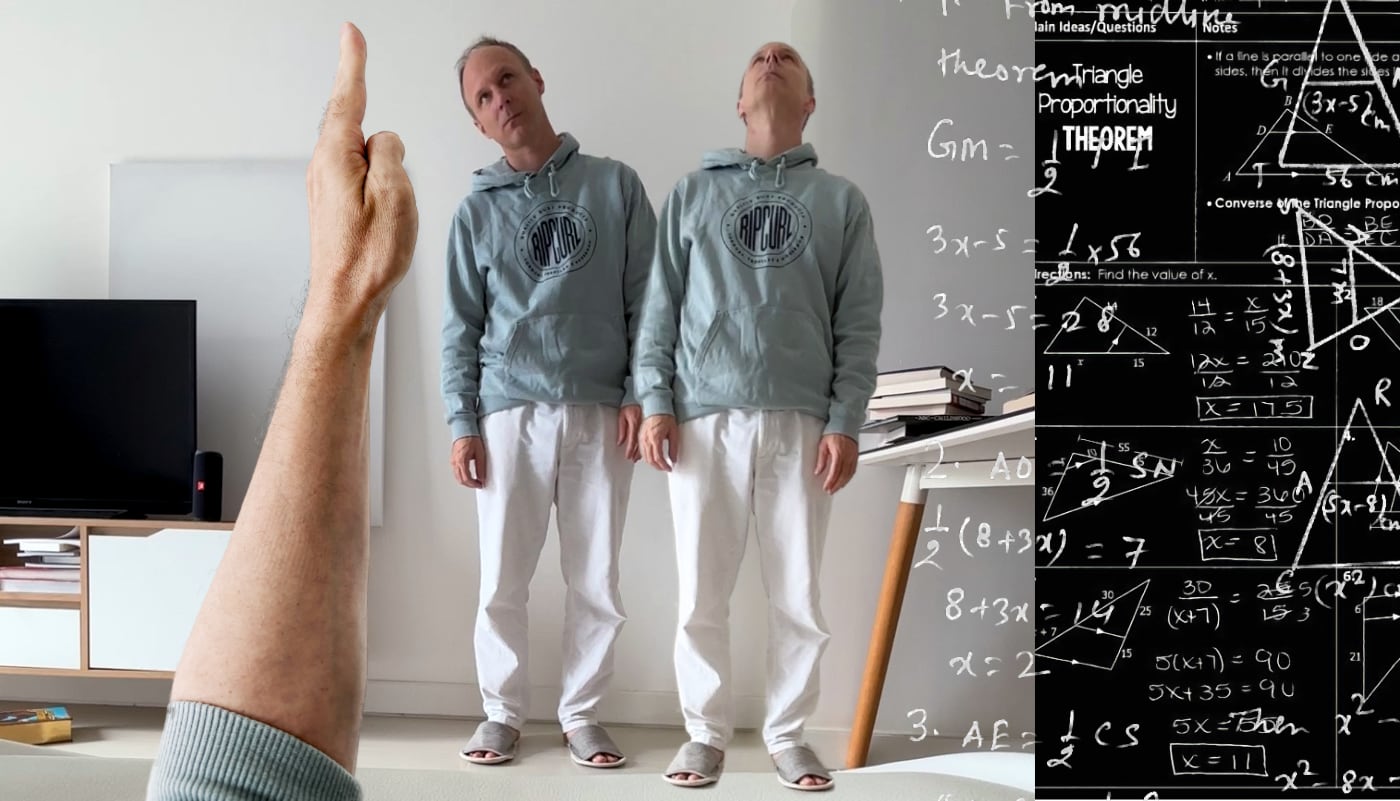
Yesterday I started a class with the words, “My plan for today is to learn the midline”. I always loved this phrase, “To learn the midline.” To me it sounds perfectly odd, but at the same time kind of makes sense.

Becoming aware of the perceived midline… whatever that is

It’s for the student to become aware of the midline of the body—which probably isn’t the same as the symmetrical middle, mathematically speaking. It’s for the student to improve

  • proprioception, for example, “Where is your left shoulder blade in relation to the spine, compared to your right shoulder blade? And where do you sense the extreme of the kyphosis of your thoracic spine?”, and
  • the sense for inner tensions aka biotensegrity, and
  • gravitational pull, and

at the same time improve the alignment and position of the midline… whatever that is— the thing to be learned.

If it works out then learning the midline improves posture, the carriage of the head, ease of movement and elegance. It’s wonderful, a small miracle in itself. In my opinion. So I claim.

For the choice of movement sequence… I guess any works just as well as any other. The teaching goal here is learning the midline, and not the movements themselves. These movements are like auxiliary materials…

In factories the use of auxiliary materials are crucial to the manufacturing process but are either removed, consumed, or serve as supportive elements without becoming part of the final product; such as lubricants and oils, cleaning and solvent agents, packaging materials, etc.

In other words- whatever movements fit the class setup… my class was in sitting, therefore I used head and shoulder movements in combination with breathing. A twist of the chest, a glance to the ceiling.

The reason why I’m writing this: This morning I saw an ad on Instagram for a course to learn a movement commonly found in Capoeira, “The Macaco”. An athletic movement resembling a back handspring. You basically go from squatting through a handstand to standing on both feet. I thought the course is very well done and the teaching profound, empathic and passionate… but at the same time I was thinking: Teacher Aaron could have used the Macaco to teach the midline.”

I think teacher Aaron is one of the pioneers in softacrobatics (as he calls it) who blurs the line between having a) the athletic performance and b) a transcendent experience as the ultimate endpoint. Transcendent in the sense of learning something useful about ourselves, that can transcend into daily life and ultimately improve everything we do… from standing to walking to how we see the world, and everyone else.

I, for myself, I have a clear standpoint on the transcendent endpoint (if any.) I am certain that learning the midline is more valuable to more people than learning the Macaco. But I guess seeing someone doing a Macaco (or advertise to learn it) is more appealing than a blog post titled “Learning the midline.” That’s something for me to ponder.

Your immediate vs distant experience

Today I was finally trying to work on my introductory speech for my next video. “Trying to”, grammar point here. Can it get any more abstract?

ChatGPT says, “a grammar point is not an abstract concept in itself, but rather a concrete idea.” For sure, ChatGPT, for sure. But only for you, as someone who doesn’t have to brush his teeth and do a hundred other things to maintain basic physical health.

My intro speech. No progress. And obsolete nowadays, especially on social media. And what’s not counted as social media nowadays? I couldn’t phrase it. I was walking around, turning the sentences in my head. Sitting at the coffee shop, looking through the window at the nearby park, thinking up and down. I thought: first, I should write it down.

But the File > New… stayed empty. I can stare at the trees in a park, but I refuse to stare at a blank sheet of paper. I will turn it around then. I will START with the class right away. And THEN, after filming the class, while my experience is still running hot—through me neurons, bones and muscles—I’ll talk about the benefits and my reasoning. And put that in post in front of the movement sequence. In this way I will talk about my immediate experience, rather than my distant experience. So, let’s see how this will pan out. No last thoughts.

Thou shalt not be aware – traumatised and dissociated

A Somatics class. Position: Lie on your back, have your feet standing.

Instruction: Lift your head with the help of both hands.

Beginner’s reaction: Done. Too easy. What muscles does this exercise target? Can this help me lose weight? This is a good stretching exercise. Will this get me more views on Instagram? My neck is hurting. How can I make this exercise harder?

Solution: Let’s unpack this one movement, together. After about 45 minutes you will see the world with a pair of fresh eyes, and feel inspired, liberated, confident and at ease, like someone who has just embarked on the most marvellous journey. I’m here to help, to guide you, to give you ideas that are key, to invite you to move ever so gently. Let’s begin. Please rest on your back, with your legs extended [..]