The ways of the reference movement

Somebody came up with the idea of doing a select movement as a first movement in a Feldenkrais-inspired movement class. And then do it again in between the class, or at least at the end of the class. See how it has changed, improved. Nowadays this is called a reference movement.

Now, in my latest Youtube video [link], titled: Looser, bigger, more relaxed – anatomy with mindful attention *New Neck Series Ep. 2*, I state that there are (at least) two ways to feel, to sense, the structures of the shoulders with the hands:

  1. Either move the fingers over the skin and palpate, sense, feel what you find.
  2. Or place the fingers on the skin, gently, listen, but don’t move the fingers, move the shoulder instead. The bones are moving under the skin and under the hand, and feel, sense, what you find.

This led me to notice something else: we can feel in movement, like for example in a reference movement, or we can feel in resting, for example in lying quietly, in supine position, on the back. How are we resting (as a whole, not just the hand)? What is moving inside? And maybe both are reference movements. Or to invent a new word combo, the latter being a reference rest. Something like that.

(Some) movements of the shoulder (blades)

The shoulders and the spine are allies. Partners in crime. Masters of disasters. When the shoulder blades can move, the spine can, too. I guess. And if they can’t, it can’t. I suppose.

How to explore some of the movements of the shoulder blades, and in turn of course, improve those movements, reach a better understanding, awareness, and well-feeling for the whole self? Show pictures from an anatomy book? Say, “it should be like this, it should be like that?”

My next lesson will have two distinct movements to explore:

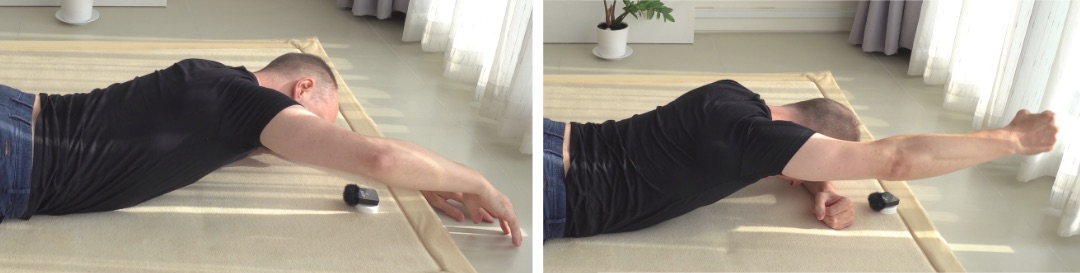
  1. lift the elbow with the hand relaxed, the hand hanging from the relaxed wrist, the index finger is leaving the floor last
  2. lift the arm with the elbow straight, with a fist, the base of the thumb towards the ceiling

Both movements lift the arm, but the way the arm is lifted results in very different actions for the shoulder blade. “One hand loves the other.” – Björk, lyrics from the song Unison, from the album Vespertine. One movement loves the other.

What do we do in Feldenkrais-inspired somatic movement classes?

I sent a quite elaborate and lengthy class description to Priscilla, my marvellous organiser for my upcoming online class, my contribution to her series, “Live with LULU”.

The class is free and open to the public upon RSVPing, the date is Thursday, March 31st, 2022, 6:00pm-7:30pm EST / 3:00pm-4:30pm PST, the RSVP sign-up form is here, you’re welcome: https://forms.gle/Xt1pT3XKiH9y9pSL8

And while I was thinking about my elaborate and lengthy class description this morning, I was thinking that I might have served them a stack of recipes rather than the menu. Therefore, I was thinking about what I could say what we actually be doing. And since thinking is one thing, and writing down thoughts another thing, please hear… er… read… the thing… it is what it is (says love):

What do we try to experience?

  • Improvements in our movements, in terms of smoother, easier, lighter, less painful, more pleasurable, warmer, more relaxed, better coordinated, better distributed and load balanced, better connected, using less effort, …
  • Becoming more aware of our physical selves, one’s parts/areas (e.g. the shape of the shoulder blade), and how they move, and connect and influence each other
  • Afterwards, feeling better than when we started

So, after having described some of the experiences we try to experience, or at least I try to help you to experience, I thought it would also make sense to describe what I do not consider when I plan classes:

What is not the primary purpose of my classes?

  • They are not designed for entertainment purposes, and thus might not work well to entertain a general audience
  • They do not work well for cardio or building muscle mass, even though they might help to improve your Calisthenics, Weight-Lifting, Pilates, Yoga, Gyrotonic, etc. practice

How do we achieve these experiences?

Here’s where I often stumble or confuse myself in my explanations. I try to supplement the first point (What do we try to experience) with explanations. Maybe to make my point, or to prove my point, heaven knows why.

There’s many things we will do, for example, introduce non-habitual movements, make differentiations, experiment with the reversal of proximal and distal, shift our attention in movement initiation, shorten chronically contracted muscles to release them, use reference movements and rests to make comparisons, …

How do I not teach?

I don’t use instructions on how to do something “correctly”, rather I create learning situations to allow the before mentioned experiences to appear.

What’s new?

The question I discovered recently is something about the theme of a lesson, as a movement teacher would call it, or the story, as a storyteller would call it. How do single events, or single movements, match together? How do we create a consistent narrative, where every new movement contributes to the development of the story, er, theme? What is an embellishment, what a distraction, what a relevant contribution?

How do I pick movements? What kind of movements qualify? Which movements qualify, which don’t? Which movements do relate to each other? Which movements do relate to each other closely enough? Which movements do relate to each other closely enough to… to… to achieve these experiences?

And how do I find movements that I didn’t know in the first place? Well, here we have the art and craft of storytelling. Here we solve this last question through writing, or speaking. An author is only an author if he writes, and the successful ones would add: daily. If he writes daily. And in movement? Through moving, if we move, if we move daily, I suppose.

What’s the difference?

With the frontside facing the floor, lifting the right elbow, but in one case—we’re working on a case now, Dr. Watson—the legs are long and spread out, and in the other case a kind of kneeling or sitting on the heels.

What’s the difference with these two movements? What do they mean? Where do they lead to? Where do they belong? Flexion? Extension? Coming from kneeling to standing? Turning maybe? Do they affect the nerves in the back? The sacrum? The legs? The neck? What are those movements for?

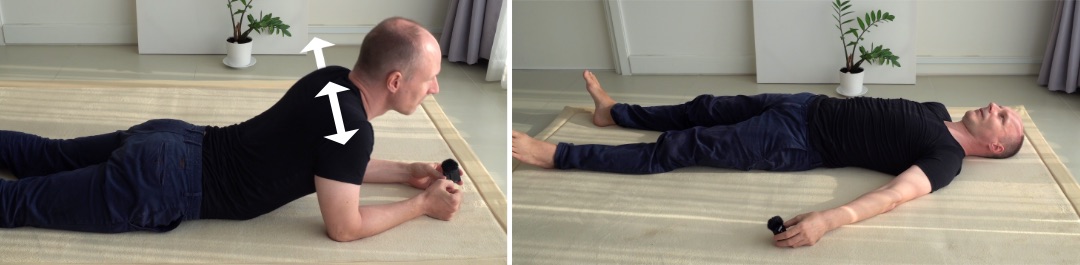
And the same question again. Leaning on the elbows. Lifting and lowering the head. Or sinking and lifting the spine in between the shoulder blades. Exhibit A: in kneeling—there’s documentary evidence now, Dr. Watson—Exhibit B: in kneeling on the heels. What’s the difference?

Can I try one more? Or is your brain already fried? Mine is mush!

Leaning on the elbows, or leaning on the hands. What’s the difference, what’s the difference? I need to know, what is it, what is it?

This is how you lengthen your psoas

Alternative title: Powerful differentiations initiated from the neck and shoulders … or the other way round

27.5.2022 4am to 5am session. Instead of early morning meditation I seem to do “moving” now, as in “writing” or “drawing”.

Starting position: on the belly, propped up on the elbows, legs spread long

let the head hang, relax
then: strings, like the voice of an angel
lift and lower the tip of your nose, a little bit, very slowly, tiny movements

bigger bigger lift and lower

eyes look up – lift head
eyes look down – lower head
eyes look up – lower head
eyes look down – lift head

raise spine – lift head
sink spine – lower head
raise spine – lower head
sink spine – lift head

rest on the back, feel the middle of your back

right eye open, left eye closed, left knee drawn up on the floor to the side
look towards floor, trace midline with right eye
eye leads movement, lift head, lower head

left eye open right eye closed, right knee drawn up on the floor to the side
look towards floor trace midline with left eye
eye lead movement, lift head, lower head

rest on the back, feel middle of the back

Magnificent

As a next step I’ll turn this into study cards, and into a video. No need to try to decipher the rudimentary notes.

A blog post

I don’t know if you guys remember, but before the monetisation of the Internet, before everything was about money, politics and influence, personal blogs were different.

For example, in the times before Geocities, a blog post was, well… there was no blogs. I created a blogging platform on a Linux server that we (a shared-apartment community of 4 friends) kept in a cupboard (mainly to be able to play “computer games” together over wired LAN, wire-less did not yet exist for home entertainment). I used Python and Apache, and published on my domain travelsheep.com, long before WordPress or Blogger came to be. And on there, at that time, a blog post was like a page of a diary you would read to a friend. Or like a letter Wolfgang Amadeus Mozart would have written to his wife Maria Constanze Mozart. And maybe there were stars flying from left to right in the background, and everything was in Times New Roman. Something like this. The Internet was different, blogs were different, everything was different.

So. Here’s to the old times.

ONE. I just had my first dentist appointment in over a year. Here in Vietnam I can finally see the dentist again without having to produce one of these new passports they want us to have. And gladly everything is fine. I got a good cleaning, x-rays, and a chat with the doctor. I just wish I already knew as a kid what I know about tooth health and maintenance today.

TWO. I was thinking about the sequence of lessons. I just finished the shorter than 5 minutes, power-assisted head turning lesson for Youtube, and I really want to do a longer version, one without cuts and zooms and time pressure. I want to have a relaxed, long version where I’m free to think and act and talk. Therefore, I think I’m going to film such a version next, as the last lesson to my “Tight neck? Here’s hope!” series. But then, I still have another lesson in the pipeline (so to speak), I was planing to do one more progression of the “Sinking the spine” lesson, the one I wrote about in the previous post (“This is how you lengthen your psoas”).

And this conflict made me think of lessons in general. How long do we spend time with one lesson? A day, a week, several years? Do you have a favourite one? How long do your favourites stay your favourites before you discover and move on to a new one? And do you ever go back to your past favourites? Isn’t it a bit like looking at a book you’ve already read? I mean, great, fine, good memories, flipping through the pages brings back some moments we had, but it’s not the same blazing fire anymore. Innit?

THREE. Something like two years ago I’ve seen a speech by Adam Andrzejewski on Youtube, titled “The Depth of the Swamp”. This speech impressed me on several levels, one being how well he could recall all these numbers from the top of this head. I would guess twisting just one of these numbers would get him in serious trouble. Therefore, deep respect for his memorisation skills. And of course the catchy title impressed me as well, a title that totally lived up to the speech.

I was thinking of Adam’s speech this morning, as a sort of aftermath to my power-assisted neck turning lesson (there’s a longer story to that.) And because I’ve seen an advertisement for a popular influencer who goes by the name, “Sadhguru”. The swamp in terms of consciousness, perception and meditation is just as deep, if not deeper. There’s a reason why a movie like “The Matrix” or books like “The Alchemist”, “The Teachings of Don Juan: A Yaqui Way of Knowledge”, or just for example, “Journeys Out of the Body” hit a nerve with people. People who are still able to feel, and to think, and who know, they know, there’s something going on, something is missing, terribly so, and those books, those speeches remind them of it. But what is it, what is it, them gurus are not telling, because they’re stuck deep in the swamp themselves, deeply, deeply, they don’t know, they don’t know themselves. And how could they?

But as long as there’s money to be made the feet are stuck and people keep losing their shoes. So, maybe that could be something I could write about in an article, or in an article-like blog post.

Now, I just finished my tea. It’s time to lift my head up and away from this blog post, click Publish and continue to move through the eternal summer of South Vietnam.
Sinking the spine in supine position

I love when students give good feedback I can work with. Here’s the latest one from my Youtube channel »Improving ability«

Ok, it seems like my way of putting together 20-30 minutes lessons seems to work. Here’s some more comments:

Yes, indeed, I myself I also do feel I’m getting the hang of it! I’ll do one more progression for the neck series, because I’m so excited about the movements, and “you just have to see this”. Know this. Feel this. Benefit from this. I think I have a complete set of movements now. My first written draft reads like this:

Sinking the spine in supine position

On the back, propped up on the elbows, front side towards the ceiling

– lift and lower the spine in between the shoulder blades (now this shows if you can bring your shoulder blades together, the medial borders, if you have what it takes to square your shoulders)
– slower, faster
– (rest)
– with right palm reach for outside of left knee
– turn head left, right with the previous movement
– (rest)
– other side
– (rest)
– lift head to point nose to feet, lower head to bring back of the head to floor
– (rest)
– during the movement eyes hold the horizon (nauseating)
– lead with eyes from horizon (below) to horizon (overhead)
– (rest)

That’s all I have for today. Wish you well!