Yoga Language and the Search for Meaningorpheus

I set out again on Google and DuckDuckGo to find something about writing and movement. Writing not just for the sake of getting across a row of instructions – but writing to inquire about movement, to solve problems of language, communication, and learning. I’m looking for people who have thought of that before. There must be.

After some searching and sifting through scientific articles I found the relatively new field of Contemplative Pedagogy, „A Quiet Revolution in Higher Education”, as Arthur Zajonc put it, a physicist and the author of several books related to science, mind, and spirit, professor emeritus at Amherst College, and former president of the Mind and Life Institute.

However, I was disappointed about the omission of Somatic Education in Zajonc’s list of classroom practices. It only lists practices such as Mindfulness, Concentration Training, Yoga postures, Pranayama, Sitting in Silence, etc, which all have one thing in common: the absence of movement learning – and acquisition – in the sense of Somatic Education.

Considering the „unreformable” nature of the schooling system (to quote John Taylor Gatto) I can’t help but wonder about Arthur Zajonc’s et al attempts to shine some light into the schooling system; their attempts to change it from inside. The schooling system with its „short-answer tests, bells, uniform time blocks, age grading, standardization, and all the rest of the school religion punishing our nation”, to quote John Taylor Gatto again, from his book „The Underground History of American Education: A School Teacher’s Intimate Investigation Into the Problem of Modern Schooling”.

Instead of „Contemplative Pedagogy”, wouldn’t „Time Scheduled Focus Drills” have been a more descriptive name? Another brick in the wall? Another attempt at getting students to finally be quiet, fit in, and „shut up”? (to quote John Taylor Gatto’s prologue „Bianca, You Animal, Shut Up!”) Or are we indeed witnessing „A Quiet Revolution in Higher Education”? One might still dare to hope.

In Christy I. Wenger’s book, „Yoga Minds, Writing Bodies: Contemplative Writing Pedagogy”, due to its academic nature, I found plenty of references, and also a single 2-page example of contemplative writing about movement, in „Interchapter Three: The Writer’s Breath”, of all chapter titles. I quote:

„»Alright, everyone knows what to do,« I say. »Be sure to sit up straight in your chair and plant your feet firmly on the ground, letting that connection give you a sense of stability and rootedness, like how you feel in tree pose.« Some students shift with these words, but many remain still, already practicing the attentiveness we’ve been cultivating over the past few weeks. They have learned that being relaxed and being attentive are not separate states but can be coupled for greater awareness, and they are using their bodies to achieve this harmony.” – Christy I. Wenger, from „Yoga Minds, Writing Bodies”

This is an interesting find because it’s not a book written by a movement professional, but by Dr. Christy I. Wenger, „Associate Professor of English, Rhetoric and Composition, Director of Rhetoric and Composition” at Shepherd University, Shepherdstown, West Virginia, Department of English and Modern Languages. Therefore, it’s an insight into academia and the state of affairs as of 2015, when this book was published.

Professor Wenger chose to use what I might call „Yoga language”. I have no better name for it, but it seems like most Yoga teachers express themselves like this. It’s a kind of Directive Language, spoken from an expert and authoritative point of view, with very floral metaphors, exaggerations, and claims that would put any vitamins seller to shame if taken at face value.

„Yoga language” might be somewhat the opposite of objective descriptions. To paint a picture: in Realism (arts) we would not „plant” the feet firmly on the ground, and that „connection” would not give you „a sense of stability and rootedness”, considering the facts that the feet bear less than a third of the body’s weight in sitting, and that (in the above quoted exercise) a considerable part of the nervous system would be occupied with trying to wilfully sit up straight. This is not a criticism. I would guess that at the beginning of the 20th century many people welcomed Expressionism, and the appreciation of the individuals’ emotions. Where there is light, there is shadow. And even today such floral language might be the counter-weight to, an escape from, the cold and uncompassionate language of scientific studies on movement, range of motion, and biomechanical functioning.
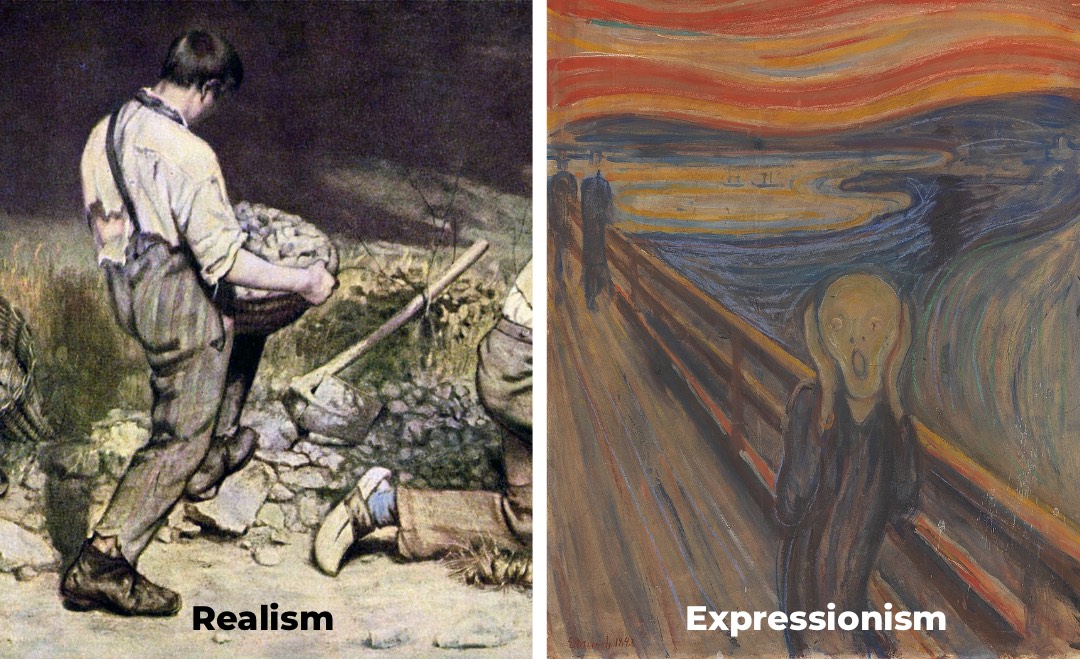
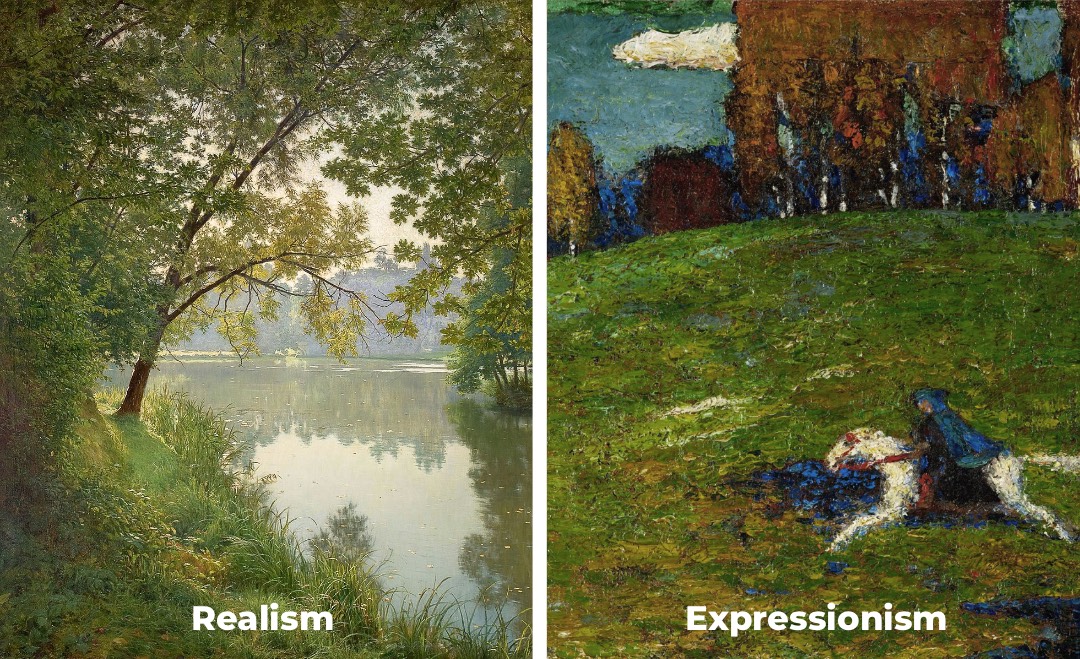
”Realism, sometimes called naturalism, in the arts is generally the attempt to represent subject matter truthfully, without artificiality and avoiding speculative fiction and supernatural elements.” – Wikipedia, on Realism

„Expressionism is a modernist movement. Its typical trait is to present the world solely from a subjective perspective, distorting it radically for emotional effect in order to evoke moods or ideas. Expressionist artists have sought to express the meaning of emotional experience rather than physical reality.” – Wikipedia, on Expressionism

Paintings: 1. Gustave Courbet, 1849, Les casseurs de pierres (The Stone Breakers) 2. Edvard Munch, 1893, The Scream 3. Henri Biva, ca 1905, Matin à Villeneuve (From Waters Edge) 4. Wassily Kandinsky, 1903, The Blue Rider (Der Blaue Reiter)

I would like to be able to quote Wikipedia on „Yoga language”, but there’s no page for that… yet. I do believe that writing about movement, and to put movement learning – and the experiences thereof – into words, could be something of interest to more than just a few; more than just a few out of the 7.9 billion people that move about on planet Earth as of 2021. After all, all of them, each and every one of them, without exception, had to learn how to roll, turn, sit, twist, stand, walk… move in the way they do.
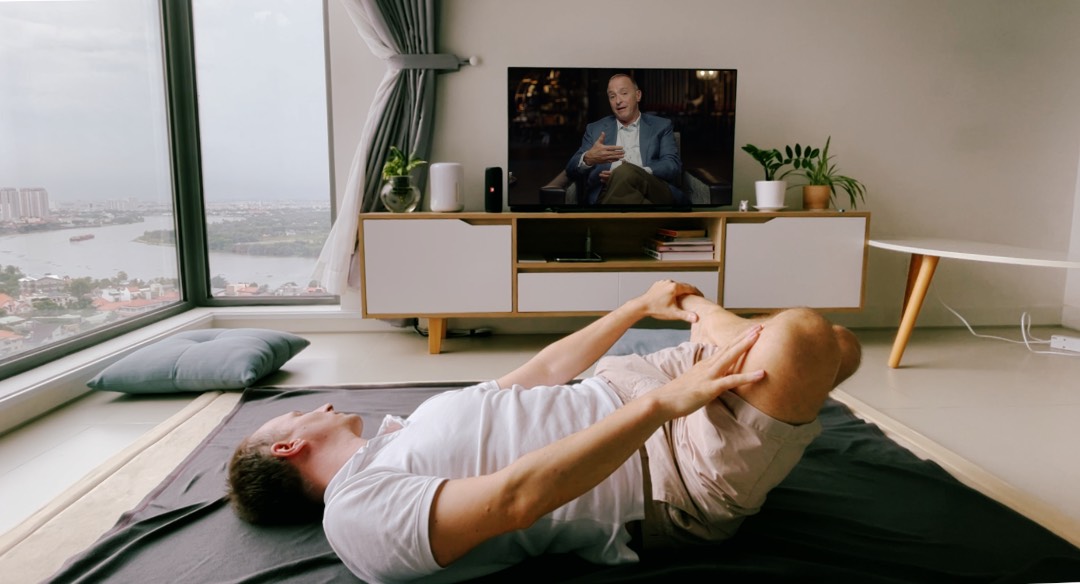
After my movement class

The subtle, surprising, and delicious feeling
of a freshly integrated area,
for example the upper chest
above the part where the thoracic spine meets the lumbar spine.
This can move?
I didn’t know this can move!
This can transmit?
I didn’t know this can transmit!
This can help?
I didn’t know this feeling of support!
It feels wonderful.

A refreshed feeling of trust,
in how everything works together,
the feet with the knees,
the legs with the chest,
the shoulders with the neck.

A refreshed feeling of trust, again,
being present, being aware, being healthy, enough.
I’m doing good. I’m doing well.
I trust in life itself.

A refreshed feeling of emotional security.
Feeling safe, feeling confident.
Right now
nobody is out there to get me.
I am safe. I am loved.
I am complete.

I am breathing freely,
as if a stone was taken off
from a long burdened chest.
The weight was in front,
it was in the back,
it was on both sides,
it was on top and below,
and now it is gone,
replaced with something better.
Now breathing is long,
and calm,
and shallow,
and full,
and nurturing,
and cleansing.
I might just become friends with the wind.

All that is easy to forget.
And easy to restore.

Lay down

Lay down on your belly and wait,
for a moment,
for your breath,
for your heart.

And when all has come together,
when you are one,
when you are the one,
lift your head,
and see if you stick your neck out, or not.

Lay down on your belly and wait,
for your eyelids to fall,
for your shoulders to drop,
for the floor to catch you.

And when all has come together,
when you are at peace,
lift your head,
and feel the length of your neck,
the length of your spine, be long, belong.

What is physical strength?

13 years ago, when I first walked the streets of Shanghai, China, I stopped at a construction site. In fact, the whole city of Shanghai was one giant construction site.

There must have been a good three dozen workers where I stood, building a subway station. Right in front of me three workers worked a manhole in the middle of the street. They lifted rusty, sizeable iron bars, and heavy cables from a large cable roll. Although they didn’t wear shirts they didn’t have big arms. They were not swole. Their bodies didn’t say “gym membership on steroids.” In fact, they didn’t look anything like Influencer strongmen or Olympic-style weightlifters. Their upper arms looked rather small in comparison, and their torsos lean and compact, just like the steel pillars they were driving into the ground everywhere. And I’m pretty sure they didn’t spend an hour every morning grooming themselves in the bathroom.

They looked like how I imagine wild tigers looked like in the jungle. Pure power, strength, agility, flexibility. These are the people who build 5 lane roads complete with bridges, underground tunnels, and all the tech involved; railroads, the canalisation, shopping malls, parks, and skyscrapers. These are the people who build megacities in record time with their bare hands and a few machines. They lift big weight under the most challenging conditions below minimum wages every day from early morning to late night, and also all through the nights, except for a few weeks holidays in early February, with a smile.

The original lessons of Moshé Feldenkrais (pun intended)

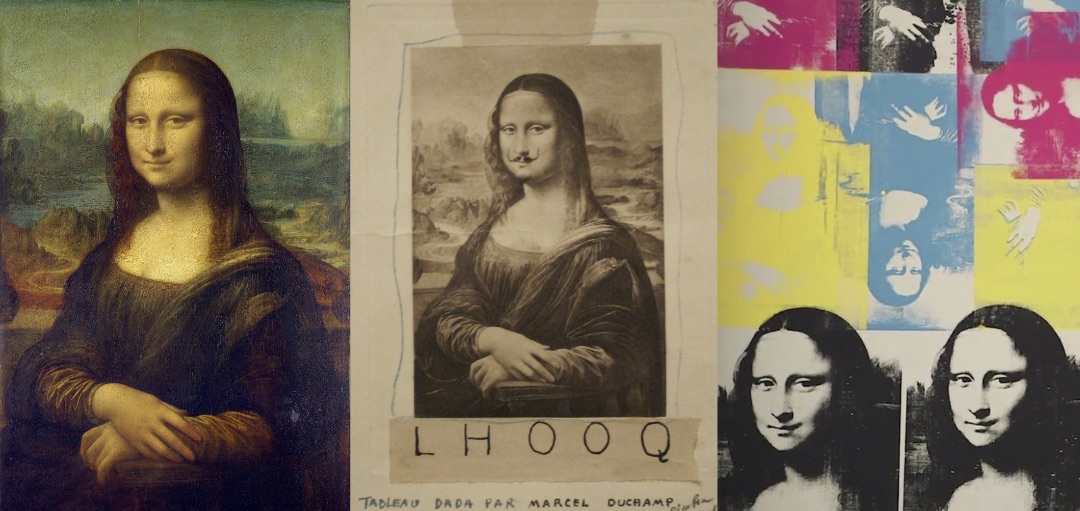
Which one is the original Mona Lisa? And which one is the most original Mona Lisa? Can you tell one apart from the other, at a glance? Which one do you enjoy looking at the most? Which one is the most inspiring to you? Which one has the freshest look? Which one makes you think, engage, and want to investigate, do more? Which one reflects the art and thinking of its time? And, would you say that it’s ok for all of them to exist? Is only the first version the real, the great, the valuable one – or do all of them have value?

Credits, left to right: Mona Lisa by Leonardo da Vinci in 1503, Mona Lisa L.H.O.O.Q. by Marcel Duchamp in 1919, Mona Lisa by Andy Warhol in 1963

Consent form for comments

In the early days of Youtube, the Youtube comment section was a bottomless pit, a cesspool of darkness, emotional rage put into words. Things got a lot better since then. Youtube viewers noticed: even in writing we are socialising with sentient, fellow beings. We not only have the capacity to be aware of feelings, but we actually do live through our feelings.

I thought of a list for your own comment section, to let others know what you’re comfortable with and not. Of course, tongue in cheek. But I like my idea of it. It came to me after watching a Youtube video where an author – after his book presentation – was verbally attacked by a person from the audience. Q&A is not a feedback session. A comment section underneath another person’s work is not a place to vent. Here’s the form:

– – – – – – – – – – – – – – – – – – – – –
I welcome you to point out the following in a disapproving, critical voice:

☐ my spelling and grammar
☐ the way I express myself, my choice of metaphors, adjectives, and figures of speech
☐ my findings, opinions, and conclusions
☐ me as a person
☐ my gender, name, family, or culture as a whole
☑︎ NONE OF THE ABOVE
– – – – – – – – – – – – – – – – – – – – –

Turning the head in prone position – Starting position

Please come to lie on your front side. In this position the floor is directly in front of you, and the ceiling is in the back of you. The orientation is obvious, but these things might go unnoticed if not mentioned explicitly. Or maybe I’m just giving it a double stitch so to speak. In this way these light and elusive things hold together much better. Being wide aware of your orientation is part of the lesson and learning. 

Your shoulder girdle and your pelvic girdle are parallel to the floor, and at the same time they are parallel to the ceiling. If you are in a squared room, that is.

Extend your left arm downwards, alongside your torso. Park your left arm like this. Then stand your right hand next to your shoulder, so that your right elbow is pointing backwards, towards the ceiling. Your right hand should stand somewhat like in a push-up, the fitness exercise.

Then turn your head to the right, at least a little bit. I know that’s not comfortable for everyone. There’s no need to have your left ear fully flush on the ground, just turn your head to the right as far as it’s comfortable.

Place both your legs on the floor, extended, straight downwards, more or less, let them fall into place, and rest them too, relaxed.

So that’s the starting position.