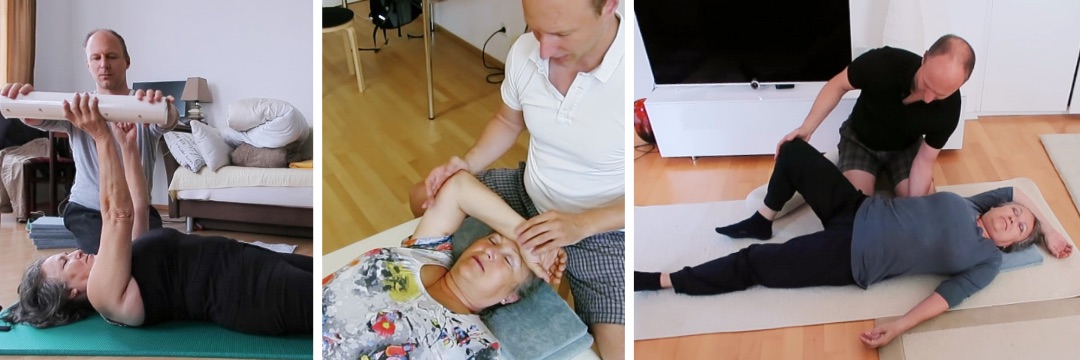
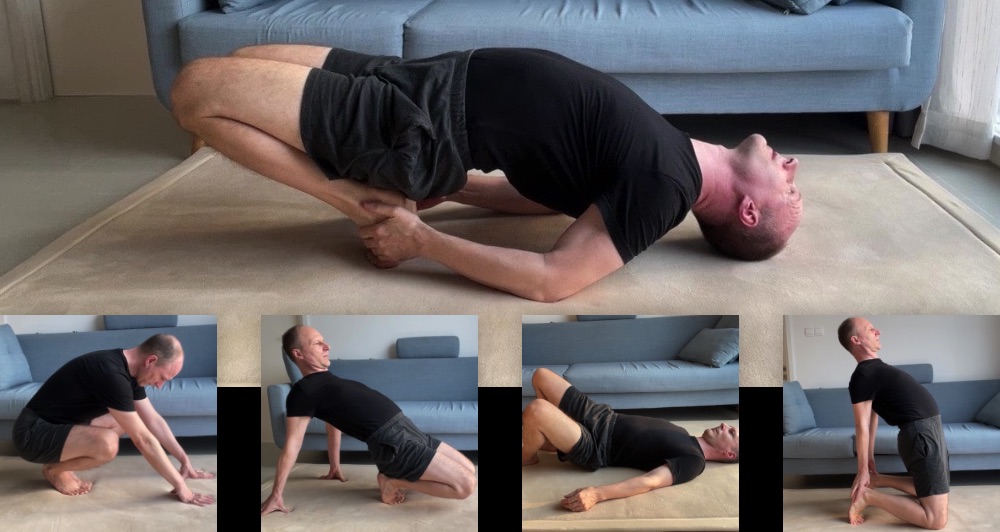
„Specialisation in a limited range of acts is the most difficult adjustment for humans to make.” – Moshé Feldenkrais
Summary: with my new series „From The Ground Up”, I fell freshly in love with the lessons inspired by Moshé Feldenkrais. However, I overworked my knees and felt some instability and discomfort. Therefore, I tried stability and strengthening exercises from the world of fitness. Turns out, in the light of my new series, I enjoy doing isolated exercises such as Tibialis Toe Raises, Hamstring Curls or Triceps Push Ups. In fact, with the background of Feldenkrais lessons these strengthening exercises make me feel quite excited about exercising. My knees, legs and spine are on a road to recovery. As a result, my next video in this series will be a Somatic strengthening workout.
Allow me to bring your attention to three distinct ways to squat down. They look kind of similar, but are bio-mechanically distinct from each other.
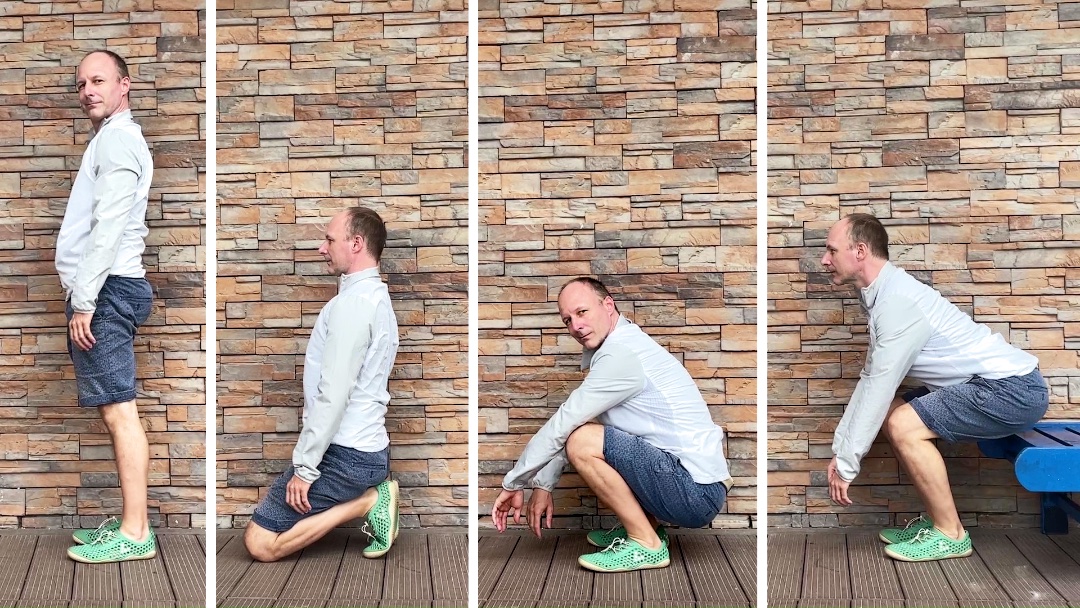
Each of the squats start out in standing. Then the legs are bent in the knees, ankles and hip joints to lower the pelvis downwards.
In the first variant, the sit-bones are lowered to target the mid-foot, and the knees are driven forwards all the way to lean on the floor.
In the second variant, the sit-bones are lowered to target the back of the heels, while the knees are driven forward. This is the Asian squat (to the best of my ability as of now).
In the third variant, the sit-bones are lowered backwards to sit on the platform of a chair. The knees do not pass over the toes.
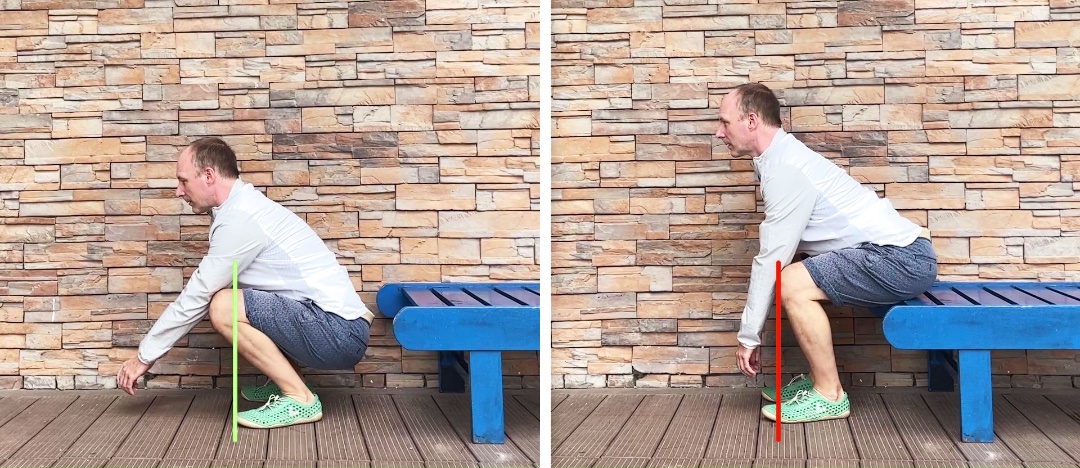
When I first opened my studio in Austria, in 2013, many of my clients presented with difficulties to sit down on a chair gracefully—and even more to come back up to standing again. Therefore, I focused mainly on this type of squat, where the head is the counter balance to the behind, and the behind searches for the chair, and the knees don’t travel forwards much. This is a movement that can be done even if the space between a table and a chair is very narrow. I also created a couple of Youtube videos about this type of squat-to-sit down and backwards on a chair.
So to speak, I focused solely and exclusively on this one way to squat down and back up, the squat to sit on a chair, and I focused all of my research and teaching on this.
However, slowly, over the years, and without me even noticing, I forgot about the other ways to squat down.
As a dire consequence, over the years, I felt stiffness creep into my back and knees and hip joints and toes… but I never thought much of it. Strangely enough, with stiffness in-and-around my joints came not only discomfort, but also instability. While one would think that stiffness inherently would make a joint more stable.
A passage written by Moshé Feldenkrais, from his book Body And Mature Behaviour, comes to mind. I paraphrase:
Specialisation in a limited range of acts is the most difficult adjustment for humans to make. For example, a strong teenager with perfect feet will find it difficult to stand still for long periods of time, whereas a flat-footed, old guard might find it easy. But the former can jump and run, while the latter suffers aches and pains in doing so.
In his book Moshé Feldenkrais added a second example to drive home his point. I paraphrase again:
If someone uses his eyes as people did in the past, for example to look at the horizon, at people in the distance, at the immediate environment, at his body and at his work, his eyes did go through the complete range of their capacity, and occasional ignorance of the proper use of his eyes had no chance to cause real harm.
However, when someone uses his eyes as we do nowadays, to focus on a smartphone or computer screen for hours on end, day after day, it puts an extreme demand on the eyes by excluding all functioning in favour of a particular act. Some muscles, as well as nerves and cells in the higher centres of the nervous system, are overworked, while others must be constantly inhibited. Only a few people who make such specialised use of their eyes will succeed in preserving good overall functioning, while most people will be unable to get normal service from their eyes in any other use.
We might hear people say that their incapacity is due to lack of exercise. But with this example we see that any training may be worse than no training at all; for the eyes that stare at screens do not lack exercise, yet the eyesight deteriorates steadily. The way we use our eyes to stare at screens adapts them most perfectly to this particular use only, but renders them almost useless for other purposes.
Butt back to the topic of squatting:
 Kenneth Williams Interviews Stephen Fry
Just recently, in response to one of my dear patrons, I started a new Youtube series, which I called „From The Ground Up”. This series is comprised of lessons not often seen in public Feldenkrais classes. They are somewhat a bit more advanced, more demanding, a bit more exotic than what is usually taught to the general public. Or maybe, they are just stronger, like fruit sirup is stronger than fruit juice.
Historical note: the original theme that inspired me for this series is called „heels-under-pelvis” (not „knees-over-toes” as I mistakenly wrote in my last post), and has been taught and recorded by Moshé Feldenkrais around 1955, in his studio in Alexander Yanai Street in Israel, lesson numbers 190-197.
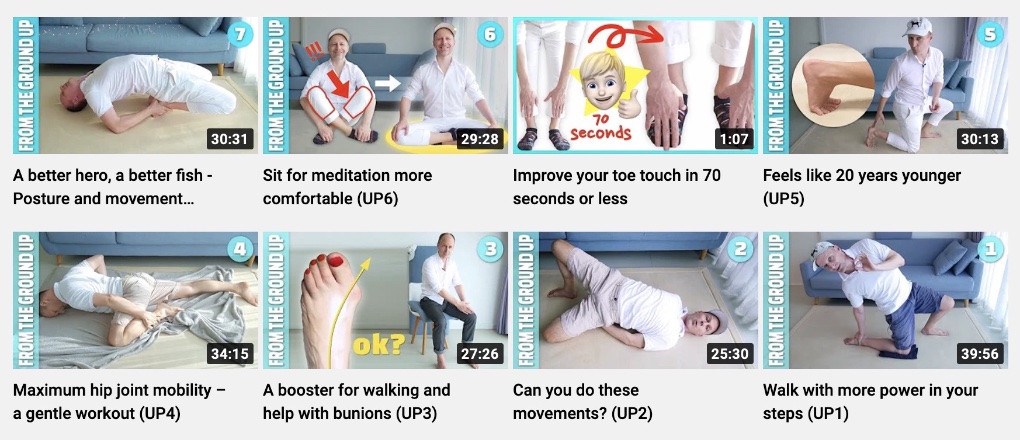 Link to the „From the Ground Up” series on Youtube
Much to my own surprise, with this new series I started to see all the things I’ve not been doing with my knees, my feet, my hip joints, and with my spine.
It was only with this new Youtube series „From The Ground Up”, that I remembered. And at the same time I came to realise in what a bad condition my knees, my toes, my hip joints, and my spine actually are.
I indeed think it was my limited and strongly specialised use of self, that led to my discomfort and limited range of motion. I always only squatted backwards, to sit on a chair, and almost never squatted down, to an Asian squat, or forwards, to kneel and sit on my heels. Unknowingly, I chose to limit my movements to particular patterns, and forgot about all the other options.
But this has changed now, thanks to my new series.
I think most of all, this new series gave me an inroad to myself again. It opened me up to work on myself again. It gave me a handle, a grip.
This series is the ear of a sticker that serves as the bit I can grab to peel the sticker off the sheet its stuck to.
This series is the spark that made me look around to see what others are doing. It is my encouragement to explore and to include strength training again. To do fitness exercises such as Hamstring Curls in the gym, or to do daily Tibialis Toe Raises, like I briefly did in my „Healthy Happy Feet” series, or Triceps Push Ups in between two chairs, or Nordic Curls and Reverse Nordic Curls at home with my feet stuck under my couch.
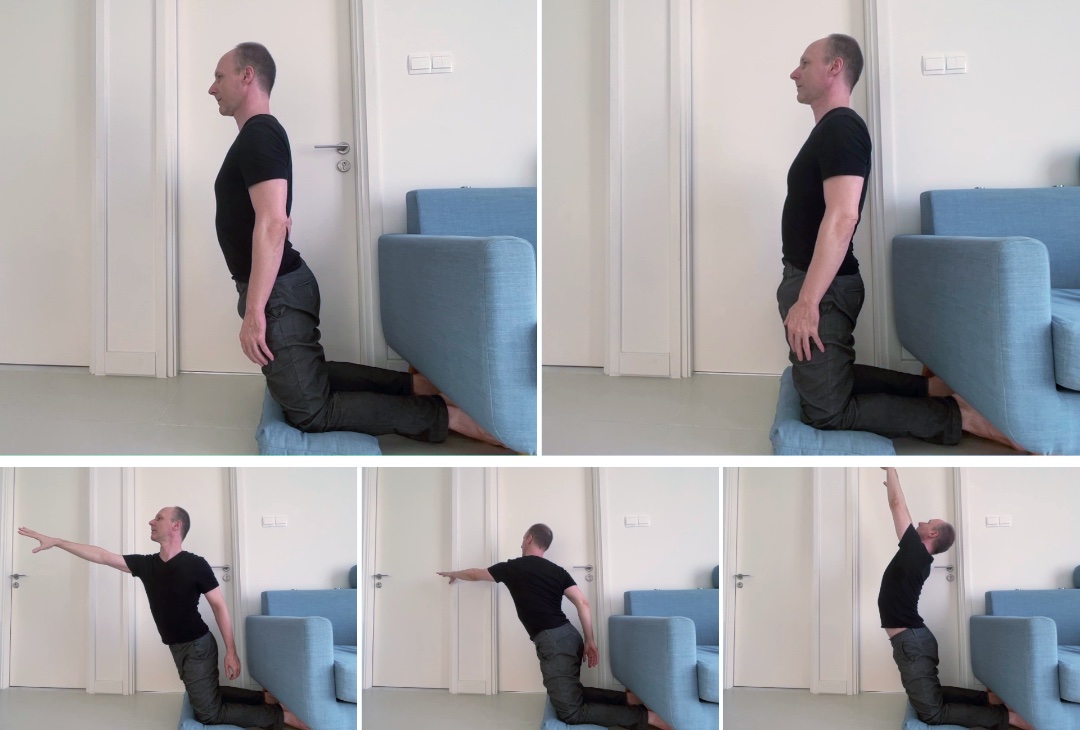
My new series leads me to try new things, and to move in ways I haven’t moved in years. It made the difference between lying down, sitting, standing, and walking smaller again.
It is the box of a puzzle that doesn’t miss single pieces. It is my red thread of Ariadne that leads me through the maze. It is my joy, my map, and with your ongoing support it is my calling.
I guess I’m in love with this new series.
p.s. The pelvis can not only go down, but also up. That would be Heel Raises in standing. It can be jumping. But the pelvis can also go left and right, and twist, and side bend, and we can do all that standing on one leg, or sitting on one butt-cheek, or while being upside-down in a headstand… and here we have the story of the thousands of lessons of Moshé Feldenkrais.
This post originally aired as a patron-only post on patreon.com – Support your teacher, become a patron.