Teaching with audio descriptions switched on or off?

„Please sit and have your two legs spread long. Bend your right knee and place your right foot on your left thigh. Your left leg remains long. Pull your right foot toward your body using your left hand. Lean on your right hand [..]”

This is a quote from Moshé Feldenkrais, from the very beginning of a class he was teaching in his Studio in Tel Aviv, presumably around the year 1950 (lesson title „AY 4 Sitting Indian fashion”). He’s 46 years old at the time, has already published two books with movement instructions „Hadaka Jime (1942)” and „Judo (1944)” and was already working on another book with very precisely worded movement instructions „Higher Judo (1952)”. I love the clarity of him teaching at that time, the very straight forward instructions with bare bones suggestions (and comparably little insulting and belittling of students and other teachers). At that time he still seemed to have high aspirations and great expectations, his passion and purpose are almost tangible.

Let’s step through this short stride step by step:

Starting position

„Please sit and have your two legs spread long. Bend your right knee and place your right foot on your left thigh. Your left leg remains long.”

He prepares the starting position, in story mode. Instead of taking a shortcut with , „Sit with your left leg long and your right foot on your left thigh”, he walks you through a few steps that will lead up to this position. I see it as a lead into pacing, to create trust, and to reduce stress as well as overeagerness to perform. 

„There’s enough time. Do not rush. Just sit. Please sit. Take your time. Then extend both legs, out in front of you. Spread them out casually. Yes, that’s good. Ok. Then bend your right knee, and place your right foot onto your left thigh. Your left leg remains long. Nice!”, my treat.

The instructions of Moshé Feldenkrais, the engineer, are densely structured. I admire that. It’s the work of a mathematician, who can safely skip several steps in calculus without confusing an x for an y, and without losing his audience.

„Have your two legs spread long”, means to extend both legs out in front of you, but also to spread them out, as opposed to have them tightly held together. So simple, and yet so precise!

Adjustments and prerequisites

„Pull your right foot toward your body using your left hand.”

As the main movement — which is not revealed yet — will gradually become better, the right foot will move up closer to your left groin, the junction between the torso and leg. That’s going to happen naturally as the movement improves and the lesson progresses. Vice-versa, by pulling your right foot towards your left groin, the movement will become better. One hand loves the other. But there’s limits to the flexibility of your right knee and your right hip, so it’s best if it happens gradually, without coercion. And actually there’s no need to mention all that, because it will happen on its own anyways, as long as you keep going.

„Lean on your right hand [..]”

Leaning on your right hand will help to free up your pelvis, so it will be able to roll better. Also, your torso will be able to side-bend better to the right, which will take off pressure from your right knee, which in turn will create more movement possibilities and wellbeing for your right knee.

But again, why mention all this? Who watches movies with „English with Audio Description” turned on, so that everything you see is explained, instead of „English [Original]”?

Conclusion

No conclusion. I hope my musings are of inspiration to you. Alfons to Starbase One, clear skies today, end of blog post, talk to you later! 😅😎❤️

A people stored away

Even after 18 years of schooling
I was still not alarmed at how easy it was to be stuck there.
Contrariwise, for a while I was considering to stay even longer,
for a doctoral degree.

„Year after year
running over the same old ground
what have we found?”

Only two decades later did I become fully aware of that
schools are like mould-infested storage boxes
in which good seeds go bad,
living out their lives
numbed, crippled, throttled.

Do not fall asleep in there.
Get out while your spark is still ablaze inside of you,
no matter how scary it might look like outside of the box.

I yearn to hear a—
I made it out alive, I’m back!
„Wish you were here.”
Wish I was here.

The path of an ant

After 4 long months of quarantine, which was mandated for all 9 million or so common citizens of Ho Chi Minh City, Vietnam, and which didn’t even make a hint of an impression on the coronavirus situation—after the lockdown was before the lockdown, and after another month of regular lockdown, I was finally enjoying a good cup of coffee in my favourite coffee shop again.

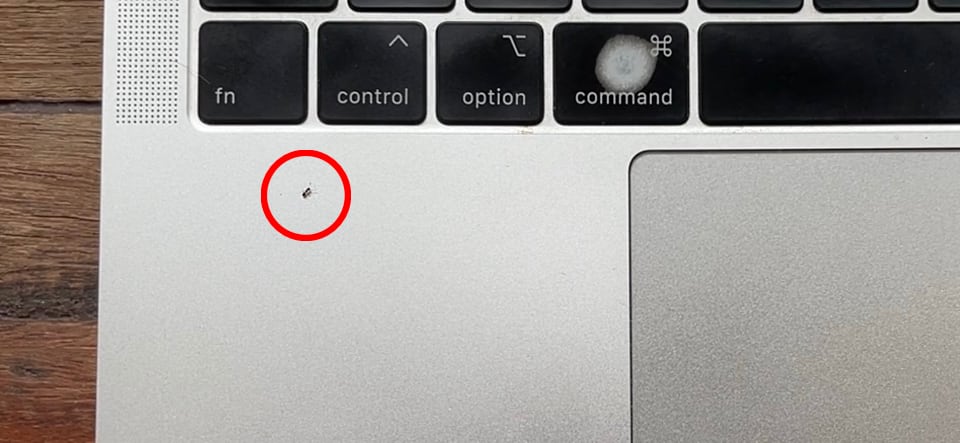
And as I was reading the News of my own country, Austria, where they obviously didn’t read the News about the nil efficacy of lockdowns, I observed a tiny little ant walking all over my MacBook.

„Hey there little explorer”, I subvocalised. As I leaned back to observe the ant roaming about I observed it walking fairly quickly and erratically. But then I also saw how well it bent its little body to each side, and how it twisted and lifted and lowered its antennas, and how it looked around, stopped and started, back-traced even, compared its position to its scouted-out landmarks. I had the impression that its – at a first glance – rather erratic looking path is actually a quite well considered one.

I recalled a quote from Derek Jarman’s movie Wittgenstein, „If a lion could speak, we would not be able to understand what he said. I can’t understand the lion’s language, because I don’t know what his world is like. How can I know the world a lion inhabits?”

When ants walk alone, they run in adventurous looking meanders, I imagine the shapes of natural rivers and creeks… very distinct from how they walk when they walk in groups of thousands… which appears to be more straight, more stressed, and less playful in comparison… even though there’s always the occasional break-away ant, meandering out and away from the busy ant highway.

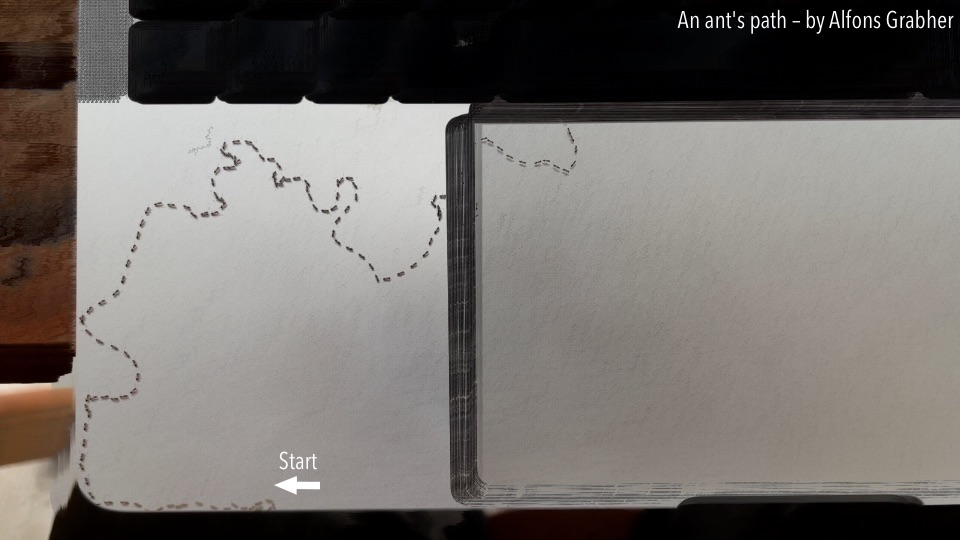
Since years I was wondering how a single ant’s path would look like. And while I watched the little explorer, I realised that this was my chance to find out. I pulled out my iPhone, waited patiently for Ant vs. Wild to cross over my MacBook one more time, and recorded a little video. Then I tried to trace the ant’s path on my iPhone for an hour or so, in which I failed miserably. Improvise, Adapt, Overcome. Finally I succeeded on my MacBook with Apple Compressor (export OpenEXR Image Sequence with 10 fps) and Pixelmator Pro (import into layers with Opacity on „Darken”).

So finally, I got my answer.

I failed to hold my iPhone completely steady during the recording, that’s why you see multiple layers of my MacBook’s outlines on this image, a composition of 163 images. Also, the ant appeared to walk on tip-toes while she was on the slightly indented trackpad. Either she was just amusing herself, or walked in a sort of environment-aware, sea-level preserving fashion. Who can possibly know what an ant thinks while repeatedly roaming over a MacBook in a coffee shop?

Sounds like breathing

I was just wondering, „Do I have a good rhythm in the lessons of my recent videos?” (email me, if you would like to share your thoughts to me)

I believe that there’s a rhythm to most everything. Laurel hedge, there’s even a rhythm to this very blog post. And in live classes there certainly is, too. There’s the intro, the song, the outro, how long do we stay with movements, how long do we stay with rests. The rhythm is created by the interaction between the students and me. I perceive it almost as if it is with breathing: the breaths come and go naturally. And while you can hold a breath or force a breath, there’s only so much room for wilful alteration.

I never quantified and compared the rhythms of me teaching live classes to the rhythms of me teaching on camera though. To do so, I would have to add time codes to select recordings. And then look at the emerging Gant charts. When did what movement, which pause, which comment start and stop? How does everything compare? Are there conflicts of interest? And do you, as a person, prefer Johann Wolfgang von Goethe’s Theory of Colors over the cold science of Isaac Newton?

Maybe the rhythms of my teachings would show to be not regular. Maybe they would look more like the natural shape of rivers before there was channelization and civil engineering and large scale maritime trade.

Yet, I’m sure they’re not arbitrary. Nothing is. Except for the things that are. Hail Eris, to the most beautiful.

The end of all suffering

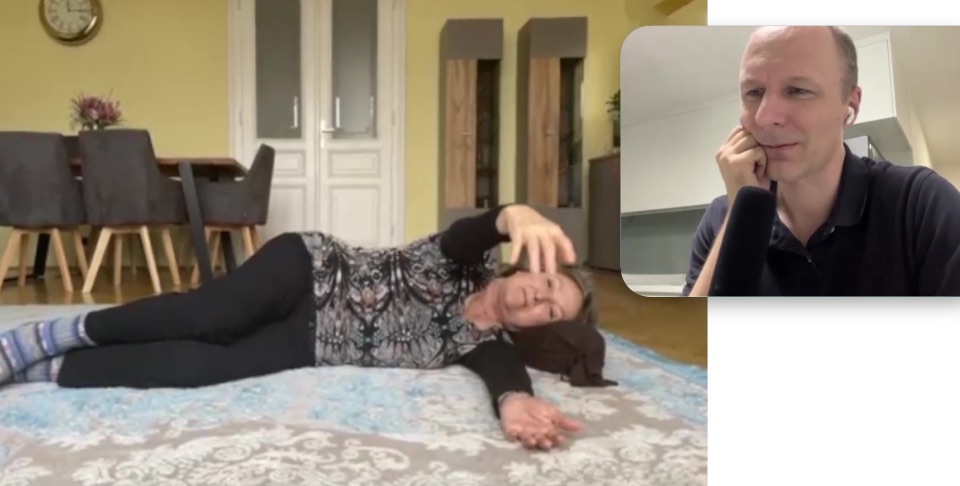
Concerning spoken lessons, I clearly feel that working with a single person – as opposed to a group – somehow feels more immediate, as if there were less joints in between us.

From my teachers point of view, being in a class with one person only, feels like sitting in an agile little canoe, or a rowboat; every little ripple in the sea becomes noticeable, every small bump in the road, every speckle of dust on the bonnet, every flower and tree on the roadside… „Everything is open to view, nothing is hidden”, to quote Ludwig Wittgenstein, the Austrian Philosopher.

A lesson, despite being a series of movement instructions, the movements themselves feel like the chassis, the innermost or lowermost layer of what I am saying. On top of that are a number of layers and linings that respond to the other person’s physical prowess, emotional readiness and composition – and to my own versions thereof. A spoken lesson is like a conversation you would have with someone over a cup of tea or a piece of paper, with movement instructions as the agreed upon elements of scaffolding, woven into the fabric of the many-layered and friendly-natured interaction.

Contrariwise, group lessons feel more like trying to read a paragraph in unison. Do you recall? Two or more people reading the same text out loud is considerably slower and more generic sounding than just one person reading the same text. But oh-my-gosh can a chorus sound well, it’s a whole different experience altogether. The whole is bigger than the sum of its parts. Yet, sudden changes of direction, spontaneous chime-ins, fill-ins and solos, as brilliant as they may be, are not to be taken lightly because they can change the whole song for the better, or can make it fall apart. 
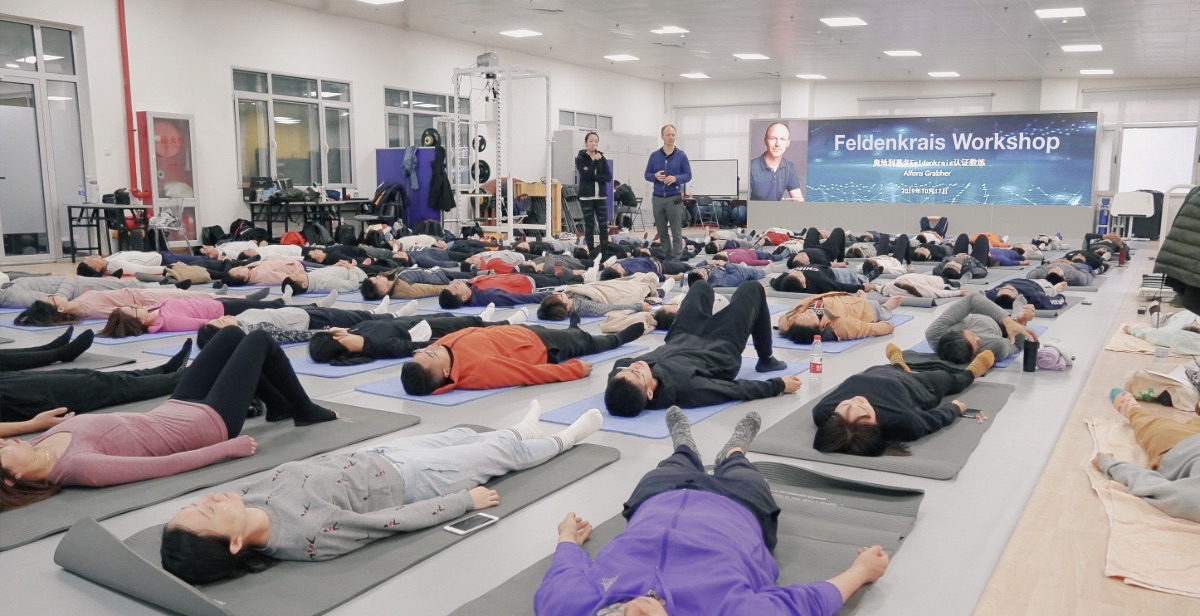
Side-Note: Surprisingly, when turned around and looked at from a students point of view, as I often am a student myself, the difference between me being one-on-one with a teacher, or me being in a group class, is much less pronounced, and in both settings I have the feeling the teacher is talking to me directly. Maybe the biggest difference, for me as a student, is that in a group I have the feeling I can hide better; and it’s more difficult to ask questions. And there’s this whole annoying thing about hierarchy and students who are lying next to me passing gas. But that’s another story and shall be told another time.

When I started out as a teacher I was scared of teaching groups, and loved the confidentiality, the private atmosphere, the immediacy of one-on-ones, which always felt more safe to me. In fact, when I started out as a teacher, for 2-3 years I mostly taught only one-on-ones. Then, at some point, I was hungry for groups, for the challenge, the changed dynamics, the thrill of it, for large rooms filled with students, for students lining up to study with me, for me to learn how to work with many people at the same time, and to experience how it is to walk in a sea of devoted practitioners while talking ourselves through a lesson.

As my practice grew so grew my experience with ever bigger groups. And then, after an interesting one and a half decades, and after having taught groups of 10, 50, 100 people at a time, I have had enough of teaching groups. Now I most enjoy one-on-ones again.
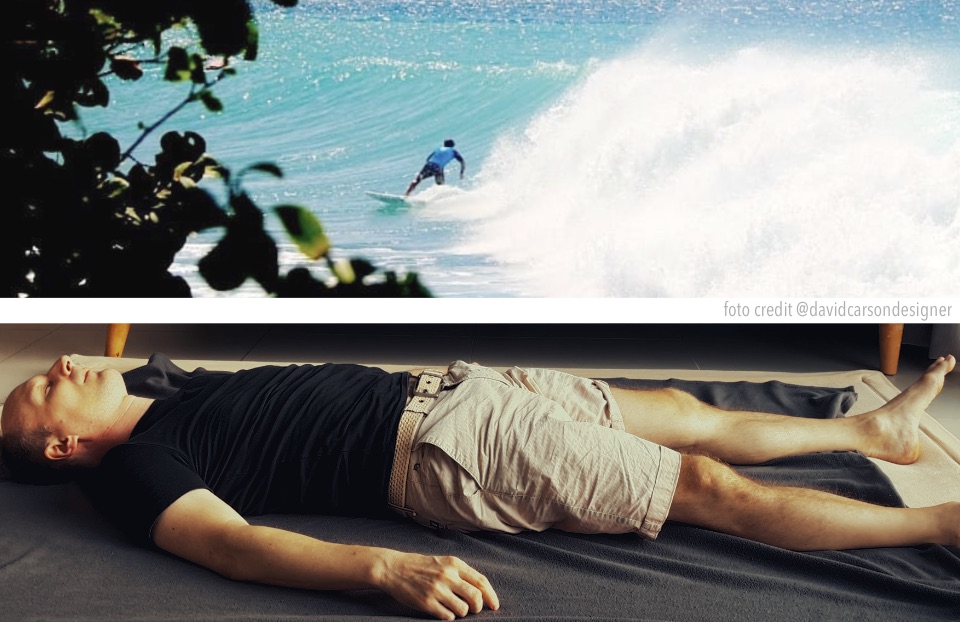
Life is a funny sort of thing. At first we look forward with big appetite and aspiration and hope and fear and there’s so much room for failure, drama, trauma, growth, success, and triumph. But strangely enough, one day there comes a moment for each one of us, there we are, fully present, and give it enough distance (from the start) and closeness (to the end), after the sorrow, the regrets, the exaltation… … …there’s comfort, solace, consolation. And really no matter how good or bad everything went—there’s peace. At last, all is well.
How-to overcome writer’s block (just before dinner)

Never arrive fully fed and with detailed expectations to dinner invitations. Do not pre-load your mind with exact ideas about the evening’s exact looks and tastes, my dear. Such a strategy is not only crappy, but will make both the cook and the host unhappy; and you might not only find yourself well disappointed, but also your good spirits abidingly disjointed.

Instead, arrive with one main thought, or one idea, and with an appetite that wants to be fed, just to be clear. On entrance quickly jot down your idea, like a passing drift, in just a few words, just like you would hand over your dinner party gift, or just like you would drop off your overcoat vest, and then play—with whatever conversations thereinafter manifest.

„But I’m not good at dinner parties.”

„Then your problem isn’t writer’s block. Then it might be the people, the type of parties, the type of place or setting, maybe even the language. How do you feel about going for a walk through a beautiful park?”

So we stumble upon

I find trimming down sentences—for the sole purpose of fitting them into a certain space—extraordinarily draining. But shouldn’t the practice of writing be uplifting, inspiring, invigorating? Therefore, when I started to write out the movements for my next video (From the ground up #3), I decided for expressible sentences, even if they might take up more space. Turns out they don’t even take up that much more space. All good.

Also today:  I’ve stumbled upon two workers who were trimming plants. I took a few pictures because they were doing a whole lot of things I teach in my “From the ground up” series:  kneeling, squatting, sitting on their feet, heels under the pelvis, in many different ways. Much to my delight (and amazement) they were extraordinarily skilful at it. I teach these movements as something special, but for these two men these movements are extraordinarily ordinary. They squat and kneel often, o! so often, minutes at a time, totalling hours per day, day after day. And despite all that kneeling and squatting, whenever they get up they seem to stand up so straight, and stand up at so much ease, that I wonder if I should cry out in delight or envy.

When I was back up in my apartment I was still thinking about these two workers. I was standing in front of my window, which is overlooking the city, and was drowning deeply in my thoughts. I was thinking about how people back home in Austria move. If no one does a certain kind of thing, how can we know of its existence? And likewise, if everyone does a certain kind of thing, how can we become aware of its value?

Finally I pulled myself away from my pondering and concluded: „That’s what poems are for. To capture the essence of things that are remarkable, so they can be passed on.” Turns out—when I was looking at the last sentence of today’s blog post—that today I was able to create something slightly remarkable myself, I wrote a blog post that bore a poem as fruit (for you to pick):

In poems
sentences don’t need to be trimmed.
They need to be seeded;
briefly sprouted at most.