Drawing parallels

„I tell my daughter and architecture students: just don’t stop drawing. You will draw as well as you drew when you stopped drawing. You could be 50. When you stopped drawing at 8, you will still be drawing like an 8 year old.” – Russ Tyson, Whitten Architects in Portland, Maine.

I heard that quote on Youtube [link] yesterday. Like so often recently, I was watching architecture videos as my pastime. Many of them are stunningly well made, beautiful.

Since I was a kid I am thinking about how I would have designed my father’s house. Actually it was „my parents” house, because my mother contributed big amounts of money. But then, in the end she had little to say in the design and construction phase, and worst of all, didn’t even get her name to the house. Which I guess was the cornerstone (so to speak) of my parent’s divorce 20 years later.

I digress. But „side-talking” (as a student once called it) might not only be my flaw, but also my forte. Some students watch my videos especially for the nuggets they will find. I myself, when watching these absolutely stunning architecture videos, I keep on wondering: how did these people afford to pay for all this? How did this project change their relationship to their parents and grandparents, to their spouses even? How’s the daily lives of the families living there—do they even live there?

Back to movement.

I would say that, allow me to make this case, it’s pretty much the same with movement as it is with drawing: just don’t stop moving. You will move as well as you moved when you stopped moving. You could be 50. When you stopped moving at 8, you will still be using the same level of skills you build up until you were 8 years old (which might be quite good actually). Minus impairments from accidents, disease, identity, overuse and ageing.

But what is movement? What is drawing? What parallels could we draw?

And nobody was crying

In the year 2004 I enrolled in a Feldenkrais Professional Training Program for several reasons:

  1. It gave me access to the (strongly guarded and unpublished) work of Moshé Feldenkrais, which was something I wanted to learn more about and understand,
  2. the work of Moshé Feldenkrais was presented in a well structured A‑Z way,
  3. I was ready for something new in my life.

Odd start of my blog post. Not where I wanted to go with this. Let me restart, with this montage of a screenshot:

Oddly enough, these two books were recommended to me today, on Amazon. They were next to each other. I chuckled. I thought, „Now isn’t that something”. My father took me to a 2-day Speed Reading seminar when I was 16. I was probably the only one he could convince to such a workshop. Plus it was a good adventure, father and son.

I can still remember the headache I got after a full day of trying to read with my eyes parallel in soft focus. My father had to get medication in the middle of the night. The headache was still there on the second day, and I felt sorry for the seminar host who was trying to one-on-one coach me during our lunch break. Since then I speed read quite a few books about Speed Reading. And then I was actually speed reading quite a few books. Or at least I did what I could.

And then I started to lose interest in books. And then I gave up on reading books altogether, a good two decades ago. And if you have been following me on my „Movement Based” portion of this blog, you already know that I’ve picked up reading books again this spring.

Now I select my books very carefully. And I don’t speed read. In fact, I despise speed reading and everything that stands for it. I only read books that

  1. I read for meaning, books that actually mean something to me
  2. and are written in a kind of language that I love to read, the wording, the phrasing.

Books that while I am reading them, I can be mind-to-mind, side-by-side, abreast with the authors, and be guided step by step into their world, their life’s Magnum Opus, and their thinking.

So, that’s not so many books. I’ve already looked at I guess well over a hundred books this year, and I finished eight. I read every word out loud in those eight books, and I took my time. Some of them have audio book versions for purchase, I always like to check their length; how long a professional voice needed to read them out loud.  Most times, when the audio book was, say, 4 hours, it took me much more than that, well over 10 hours to read it out loud to myself.

That’s all I have to say about Speed Reading nowadays. And the same goes for Power Napping, High Intensity Interval Training, prolonged water fasts, multiple days of meditation that require some people to take painkillers just to be able to sit motionless in one spot, and everything else in that category.

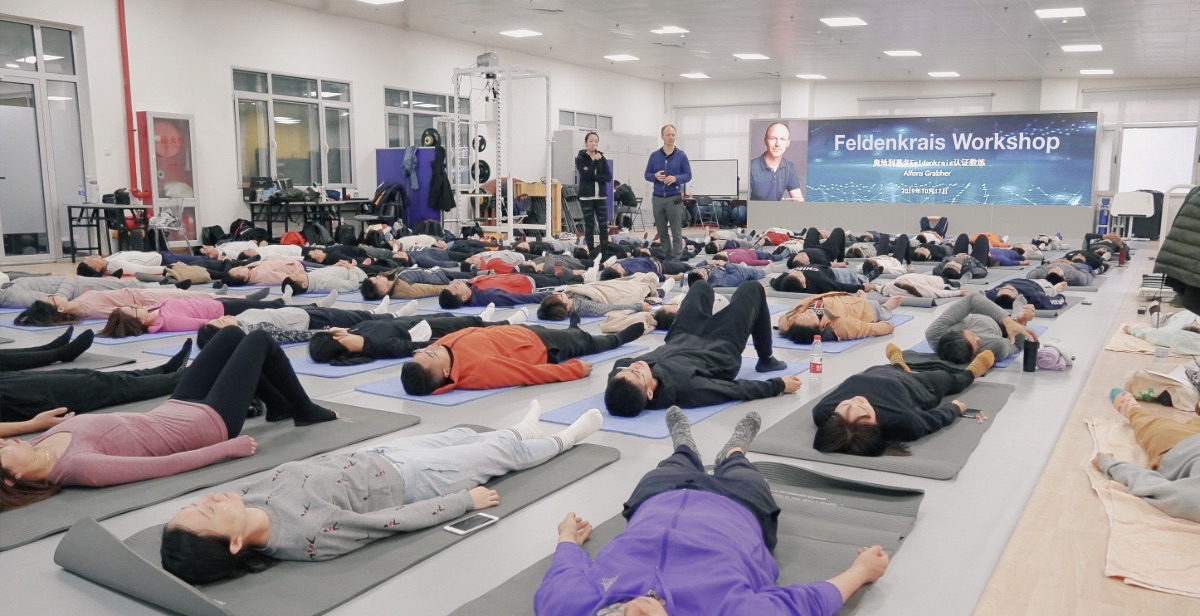
During my FELDENKRAIS® training I’ve seen somebody cry once in a while. Some Feldenkrais teacher would work with a student and that student would then burst out in tears. I observed that some students would cry because they were so moved by the lesson. Sometimes even observers would cry because they were so touched by what they just observed, witnesses to someone having found consolation, finally relief from long standing suffering. Or maybe it was a confirmation to a student, a sign that the treatment worked and the training was worth the time and money. And oddly enough, some of the teachers seemed to carry an odd sense of accomplishment, a certain kind of pride for their ability to move others to tears.

At that time I remembered some of the books I have been speed reading. Namely „Rebirthing in the New Age” by Leonard Orr, and „Holotropic Breathwork” by Stanislav Grof. These books, as far as I remembered, spoke of strong emotional releases from seminar participants, they spoke of pent up emotions, rigid chests, violent outbursts of expressions, screaming, discomfort, fatigue, drowsiness, and catharsis; being under the impression of having resolved all difficulties and problems, at least for the moment.

But back then, I also remembered a book by Bert Hellinger, a commentary on Family Constellations, in which he talked about times when he would not allow seminar participants to cry. When he required them to find a solution without crying, all within their emotional capacity.

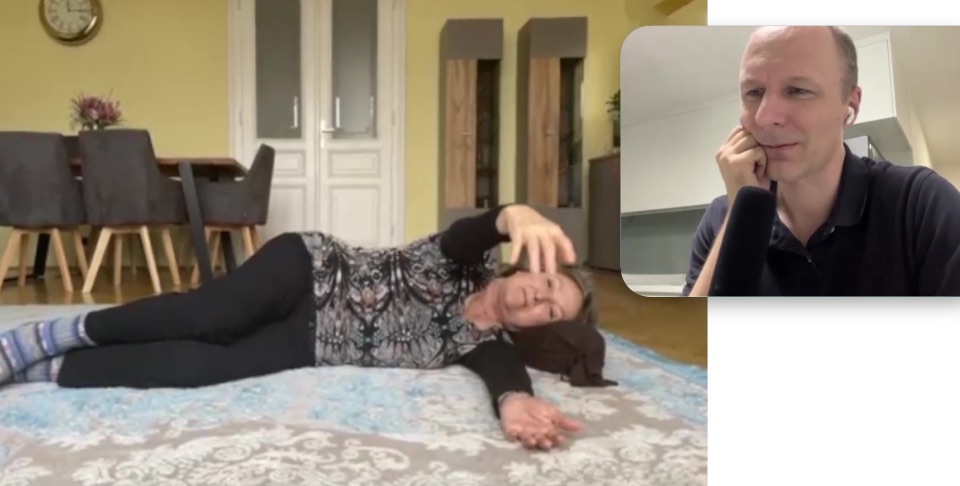
It almost happened to myself, too: One of the teachers, while working with me one-on-one, placed her hands on my back, somewhere between my shoulder blades, and simply held one hand there, with light pressure.  I was in side-lying on a Feldenkrais table, my head supported by a pillow, and a pillow between my legs, nicely padded up. For a while nothing happened. I don’t know how long she held her hand on my back, her fingers pressed against some firm area next to my spine. It might have been several minutes, might have been half an hour.

But then, suddenly, my muscles gave in. Suddenly I felt how stiffly I had been holding myself. I let go of the muscles that held my chest rigid like an iron cage. It felt like as if years and years of burden and difficulty melted away in an instant. As if I dropped a weight as heavy as the world itself, Atlas Shrugged. That moment was indeed overwhelming, to be honest. I almost burst out into tears.

But then, milliseconds before the Niagara Falls would have been released from my eyes, I stopped the tears. And at the very same moment the Feldenkrais teacher moved her hands onwards and continued with her lesson, just like a piece for piano would move onwards to the next section.

Hours later I wondered if I had betrayed myself, if it was wrong of me to stop my catharsis, my big emotional release. I wondered if I should have cried on that table, for my own sake.

I turned to the original transcripts of Moshé Feldenkrais, to see what he was thinking about all this. In the transcript of Amherst, Week 5, 7th of July 1980, Moshé Feldenkrais said:

„That’s again a thing that is not quite obvious to everybody. What you are learning is disturbing because this is the first approximation for you. And it should be disturbing. And disturbing without you crying, which is a little bit different from what other disciplines do in order to teach a new way of finding oneself.”

He also spoke of security, and being able to make oneself feel safe. Not so much as a skill, but as a requirement for learning, and being able to act in this world. In Amherst, Week 3, 25th of June 1980, Moshé Feldenkrais said:

„You can see these are problems that must be clearly conceived and elucidated before you understand what we are doing. So many of you feel disoriented and feel changes and you don’t know whether it is good or bad. Many of you came here complaining that what we do seems to be so innocent, so gentle and yet you have deep emotional changes and some funny dreams and all sorts of things. Well, if it weren’t like that, what’s the use of doing it? The use, the difference, here we do it with a kind of feeling well after the lesson, doing it very slowly, very gently. And we have nobody crying here, or feeling terrible, as I have seen many therapists do that intentionally.”

In that same session Moshé Feldenkrais, a master storyteller, added a short little story:

„One student of mine was a former teacher in Canada. He had a Gestalt session in Esalen, not telling who and how, but the first time he came to my class I saw a miserable little thing, quivering. He cried, and everybody around said to him »Don’t cry. You’re a nice guy. You’re nice.« For two hours. He’s now a Feldenkrais teacher and since then I never saw him crying.”

I liked that. Mind-to-Mind with Moshé Feldenkrais in reading. I like his work, his way of thinking. I took example from him. Since then I have been working with thousands and thousands of clients in person. I could bring many to improve, to resolve longstanding, chronic pain, to feel better, to find a feeling of safety, to reconnect with meaning and purpose, to feel spirited again and to be on top of things again. My classes can be tranquil, sometimes even „mildly funny” (to quote one of my students). Sometimes we laugh. And sometimes someone gets mildly bored, or impatient. But nobody’s crying.

Summer break

South Vietnam. 35 million people in lockdown. The district I live in is called Thao Dien, in Ho Chi Minh City, and here the 4th lockdown started more than two months ago; and is rumoured to continue for another month. The guards gave me a sheet of paper that says that I might step outside Mondays and Thursdays to buy necessities and medicine. I buy rice, potatoes, Cashew nuts, bánh mì, Alluvia dark chocolate, strawberry jam and Vitamin D supplements.

Early last year, when I arrived in South Vietnam, the Air Quality Index was bad. Really bad. Asia is often praised for its holistic, natural therapies, but most of Asia itself has no good concept for balance and nature. The WHO estimates that more than 60,000 deaths in Vietnam each year are linked to air pollution. Climate Central estimates that large parts of South Vietnam will be submerged as soon as 2050, as a result of climate change. Nobody cares. The big dream of owning land and becoming rich turns them blind, deaf and annihilates their sense of smell.

But now, the air is lovely.

The lockdowns grinded the economy to a halt. They bound the people’s hands and feet, took them to the ground, where they struggle in Tetanus like contractions, eagerly awaiting the uncuffing, bending and breaking the lockdown rules wherever possible.

But for now the air is lovely, supremely pleasant for a city of 9 million people. It’s a joy to open the windows and take in the fragrant scents of the Plumeria trees nearby, the river, the wind, the sweet wind. Even the rain smells wonderful again, promising refreshment, clearing away clouds from my brain. I stick my head out of the window when it starts pouring.

It’s quiet outside. The absolutely mental noise of Vietnamese traffic is gone – only now and then a mad driver pushes down hard on his horn to warn others of his speeding and reckless driving.

This week I’ve seen the first mosquito in a year. And a small spider, crawling in plain sight outside over my living room’s window. There’s more insects again. And there’s more birds again. Not many yet, but small flocks of 4 to 6 birds here and there, some fly from tree to tree, and some fly high up in the sky. Nature does have the capacity to recover—if we let her escape the death grip of mankind’s iron hand and iron will.

For now I can feel nature again, her soothing, comforting touch.  I feel like a human again. I sit, I take long breaks, I download books, I look at the beautiful, many-coloured skies through my windows, I cook, I clean, I read, I read the updates on Pfizer and Moderna and what doctors and lawyers make of it, and I enjoy to be in Asia, in the eye of one of the hurricanes of climate change—Last Chance To See.

Then And Now

The sky so blue
I join the clouds
rising above
I am the wind.

I get no views
I stand my ground
there are new rules
that’s what I’ve found.

(Inspired by “The blue sky”, Christy Ann Martine)

When I study art & literature

I choose
what I want when I want,
however much I want,
for how long I want
and even how fast or how slow I want
with
as many breaks as I want
and
what is good »Phaedrus«
and what is not good—
I won’t ask anyone to tell me these things.

Rest and rhyme

Let me find you
in your recliner, relaxed,
or at the start of a nap on your carpet
or slouched on your couch
or in your bed
face up
bottom down.

Let me suggest
to place your right hand on your belly or chest
somewhere fair
where it doesn’t slip away to anywhere,
and you breath
and feel the weight,
and breath
and wait.

Then roll your wrist
where the two bones exist
the ulna at your pinky
and your thumb I think he
is at the side of your radius.
Them rolling
on your belly
slowly
your elbow, the point for your wrist
to start its swivel and twist.

When your hand rolls over its outside edge
over your pinky finger
on your belly
your fingers curl more
if they may
and the tip of your thumb approaches
the tip of your index finger
while they both swing up
and linger.
Feel it
sense it,
check it,
am I right
or not?

Then pilot your wrist down further
to the right
over the bony landmark on your ilium
to your right side
drag and drop and slide
with your soft hand at its end
and further
until your arm stops and rests,
extended way out to the right
the base of your thumb facing the ceiling
what a nice, relaxed feeling,
and your fingers sorted, curled up,
warm and light.

And then,
silence.

And some time later
devine procrastinator
roll them again, like rolling a train,
return them up onto your belly again.
Not everything rhymes,
but everything chimes
together and your wrist may roll
and slide.
You may breath
and sigh
and rest.
If you allow yourself
to be your guest.
Your arms and elbows and
head and chest
and neck and shoulders
and all the rest
all of them
may snooze,
for this delightful moment
if that’s what you choose.

Why not

About 200 years ago in North America
people were avid readers and debaters.
Almost everyone could write and read,
including North Carolina.

In 1835, the English politician Richard Cobden announced that there was six times as much newspaper reading in the United States as in England.
And they are said to have grown
and have learned
from their daily debates at the common breakfast table.

As children of the most literate nation on earth,
they learned to read well, as early as five to eight years old,
and they read what everybody else read,
complex and relevant and allusive, news and novels and poems,
despite a lack of schooling,
despite of working
in the coal mines.

Morn came and went—and came, and brought no day.

In all this hardship and extreme working conditions
they did not lack meaning,
they did not have to choose between a plastic toy and a tablet.
They did not suffer the Imposter Syndrome.

Sam Blumenfeld wrote in his book, The New Illiterates: One day she found her three-year-old working his way through a text alone at the kitchen table, reading S-am, Sam, m-an, man, and so on. »I had just taught him his letter sounds. He picked the rest up and did it himself. That’s how simple it is.« said his mother.

In 1867 an eight-year old girl wrote: »I’m a trapper in the Gamer Pit. I have to trap without a light and I’m scared. I go at four and sometimes half past three in the morning and come out at five and a half past. I never go to sleep. Sometimes I sing when I’ve light, but not in the dark, I dare not sing then.« John Taylor Gatto, New York City Teacher of the Year 1989, 1990 and 1991, commented: »She could write so eloquently with no formal schooling at all.«

Then, during the Second Industrial Revolution
with the advent of forced schooling
all over the world
as a next step
forests became wood yards
and
fish became fish stocks
and
humans became human resources
and
they learned to be perfectly indifferent to all that.

Instead of in the coal mines
they learned to spend their days
in brightly lit pits,
in front of brightly lit panels,
inside ergonomically shaped workstations,
still convinced of what was required,
afar from the rhythms of nature.

They learned to distrust each other,
and were conscientious enough
to give each other good reasons to do so.

They learned to do work that had no meaning to them,
and buy things because someone else said
„I bought that too!”

They lived in an endless search for meaning
and connection
and safety.
But the pain just kept flaring up,
no matter what they tried.

And now
despite all the hard work
and all the discipline
and all those tears
and all those sacrifices
it looks like as if the floods and the wildfires can’t be stopped
and as if the honey bees and the birds and the fish are not making their comebacks
and as if
humans
and most other creatures
might not even survive 50 more years.

Should we go ahead?
Or should we change?
What should we do?
Whom should we ask?

While waiting for an answer, as a next step,
why not allow ourselves to feel again,
to read again,
to love again,
to trust again,
to care for others and help them heal,
as this is the thing we humans can do
just as
honey bees can make honey,
and clams can clean water,
and fish can swim and birds can fly.

Why not
for once
retreat
and start with lying down on the belly.
And roll one leg to draw up its knee,
and let everything else respond
and support,
and take it from there.
A simple, somatic lesson in crawling.

Why not find out
– discover –
that we are not born as blanks,
that we don’t have an empty hard drive for a brain and for a soul
on which just about anyone
can write
just about anything.

With a gentle bend of a knee,
and a roll of the pelvis,
and a push with one hand,
and a turn of the head,
we can reconnect, and recollect
meaning,
and love,
and healing.
We might even allow the fish stocks to grow back,
and the honey bees to be just bees,
and the wildlife to have their mountains and plains and rivers and forests.
It might be as simple as that.