flip flick twist twirl slide push pull dab probe pinch poke scratch rub palpate penetrate
Pops, snaps and crackles
glide
slide
rub
scratch
shave
graze
scrape
grind
rasp
grate
dust
clay
silt
sand
grit
dirt
gravel
pebbles
cobbles
boulders
Culture, pelvic floor and bruxism
John Trust asked, via Youtube: „Do you have anything to recommend that truly relaxes a chronically tense pelvic floor? I get some temporary relief from various hip lessons but i feel like i’m tackling it the wrong way 😁 love your work btw”
A chronically tense pelvic floor can be treated like a chronically tense jaw. In a nutshell, save for the theory behind it, you need to attain full ownership over the movements and tensions of the jaw space (including the tongue et al) and integrate these with the whole body. A client story comes to mind:
She wrote in to make an appointment. When she arrived at my studio she looked perfectly healthy. Slim, sporty, cheerful, in her mid 30ties, mother of two. She told me about her TMJ issues, and her jaw lock, and how it’s destroying her teeth, and giving her tension migraines, and about the many specialists she’s already seen—to no avail.
As a last hope, she told me, she’s visited a holistic dentist just a few days ago. This specialist recommended special dental braces which would realign not only her teeth but her entire posture. She said the dental braces therapy would cost $5000 for a first instalment, and the treatment would take anywhere from 1.5 years onwards, and she wasn’t looking forward to it.
As she was discussing this dilemma with her best friend, her best friend told her about me (I was living in a small town), and that she could try a hands-on session with me as one last thing before deciding for the dental braces. So that’s how she got into my studio.
I think the most difficult part of the story is this: How do we find the shoes that fit? Why do some of us have to search for years, sometimes for decades, for the thing that works?
For example, I had to go trough a lengthy Odyssey and visit many specialists to find a diet that would stop my skin from breaking out. It took more than two decades of trial and error! And in the end the solution was surprisingly simple and inexpensive.
Or another example, my own teeth grinding problem. First and foremost I didn’t know of it. I knew that some of my teeth suffered damage over the years, but it was only because of a comment from a dental assistant, when I was 43yo, that I became fully aware of it. She claimed that my teeth were terribly ground down for my age. I asked my new dentist about this, who then arranged his mirrors so I could see the backside of my teeth for myself, and confirmed. Up to that comment I thought I’m doing mostly all right with my teeth, since I didn’t have any new cavities for three decades.
With that, too, it took me decades to identify the problem. The costly, holistic specialist dentist who „advised” me when I was a child (and who makes most of her big money with dental braces for adults) was wrong in vital aspects. I almost too late dropped the exercises and habits she recommended to me. The damage is done and I have to live with it. It almost seems like as if half of the „experts” out there actively and knowingly create the problems they also happen to provide the solution for.
I’m touching on some bigger topics here. Maybe the biggest topic being culture, and how culture would originally keep us free from harm. For example, if all people of a culture would move in a way that is saving the lower back from lower back injuries, then the children would automatically learn to move like this too, thus there would hardly be any lower back injuries – and the other way round. But where am I going with this blog post?
Let me finish with my client’s TMJ solution: after one hands-on session her jaw lock was greatly relieved, and after three hands-on sessions her tension related problems—including her migraines—were solved.
Before she left I recommended that she talks to her dentist about a night guard (as I have been wearing one myself, for the past two years, even though I myself opted for a self-adjustable one, $12 for 2 on Amazon, instead of a custom made one for $600 from my dentist). And I recommended to do at least one of my shoulder and neck videos on Youtube once per week. Her search for a solution to her specific problem took years, and my professional expertise took even longer to develop, but in the end the solution to her problem was surprisingly simple and inexpensive.
Smooth criminal
It takes only a minute
to bury a bird
say in the backyard
below two trowels of dirt.
My dear cat at the doorstep
sits longer in doubt
considering if
she should stay in or go out.
Syllables 7557, rhyme ABCB, this poem is strongly inspired by Billy Collins, „Predator”.
Child’s play—who has the time?
To improve the knees
we need to work on the hip joints and glutes
and on the pelvic tilt and the pelvic clock
and on the flexibility of the chest
and on how the movements of the chest relate to the pelvis and legs
and how the eyes prevent or further the movements of the chest
and how habitual tension in the hands stiffen the neck and shoulders
and it might just be that
if the toes and ankles can’t respond fully in walking
the knees will not improve…
I mean… …who has time for all that?
Cornflakes or milk first into the bowl?
„Karl Popper says, a law of Nature is not prescriptive but descriptive.” – Hans Selye
When Bert Hellinger first introduced his Family Constellation sessions in Germany, he created quite a big buzz in the by-then already well established order of therapists. If you’ve ever watched a Family Constellation therapy session yourself, you couldn’t help but ask: What am I looking at here? What is happening? How is this even possible? And you probably couldn’t help but shed some tears yourself, and stand in awe for the soothing revelations, mystery, and truth. Finally the order that is healing became visible, literally so.
Bert Hellinger’s work is phenomenological. Instead of a „find a problem fix a problem” approach, he sets up conditions in which we can observe movements and tendencies within families (what he later called Movements Of The Soul) and let them return to their natural order. And from decades of observations, students finally distilled a couple of principles they could usher into manuals and textbooks—which made Family Constellations better accessible, but also more scholarly.
For example: Hellinger™’s first basic principle of life goes like this: „All who belong to a family have the same right to belong.” Which also means that as soon as a member of a family is denied or refused this belonging (by whom?), disorder arises with far-reaching consequences in terms of health, fortune, and life path.
The second basic principle of life is called the order of precedence. It demands that, „Everyone in the family take their rightful place, which is theirs alone.” This order of precedence is a hierarchical order: in the family there are some who come first and others who come after them. The order of precedence is determined by the time of belonging. Thus, the parents come before their children, the first-born child before the second, and so on. „If a person who joined later elevates themselves above someone who was there before them, they violate this order of precedence.” Quotes from hellinger.com
In his seminars Bert Hellinger used to tell stories—concise, beautiful and touching. I myself participated in a Family Constellation seminar (two decades ago), and also watched many such sessions. Furthermore, I bought a couple of his books and fell in love with his stories and way of openness.
Now, this all makes quite a bit of sense in the world of family and therapy. But I can’t help asking:
But does it?
Despite my questioning, there’s a couple of undeniable underpinnings, for example, time provides us with an order: the order of precedence.
My grandparents joined my family before my parents did. I joined next, as my parent’s first son. My brother was born second and therefore joined after me, and third my sister came after him. My sister passed away when she was three years old. Yet, in the ranking and order of things, she keeps her place. This order of precedence is easy to grasp, easy to observe, and easy to follow.
But is it?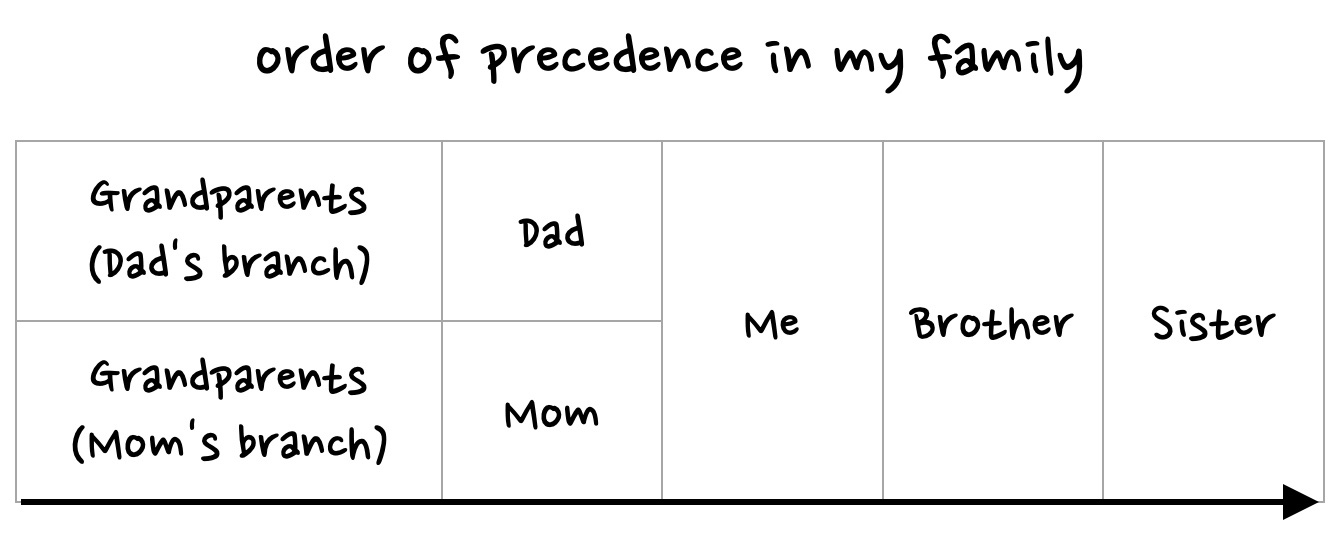
Neither my brother nor I have children. My parents divorced, my mother stayed single, my father re-married immediately. His new wife has a grown-up daughter, and a son who passed away many years ago during her previous marriage. That’s as much as you would need to know to start a session. The plethora of real world problems (financial and personal quarrels, perceived injustices, inheritances, apartments and possessions, addictions, illnesses and deaths, etc.) all are said to arise from the orders of life and its violations, and become visible in such a Family Constellation.
To conclude:
- According to Hellinger™, in every family there is an order of precedence.
- The way to violate that order is through behaviour—if a family member behaves in a way that defies that order of precedence.
- There’s quite a few more phenomenological observations (which were then identified as incidents, principles and ways to violate those principles)
So, to conclude, my question is this: can any of this be adapted or applied to the physical body and movement learning? Does the physical body, too, have such an order of precedence? Could physical health (and growing ability) be as simple as finding and restoring such order?
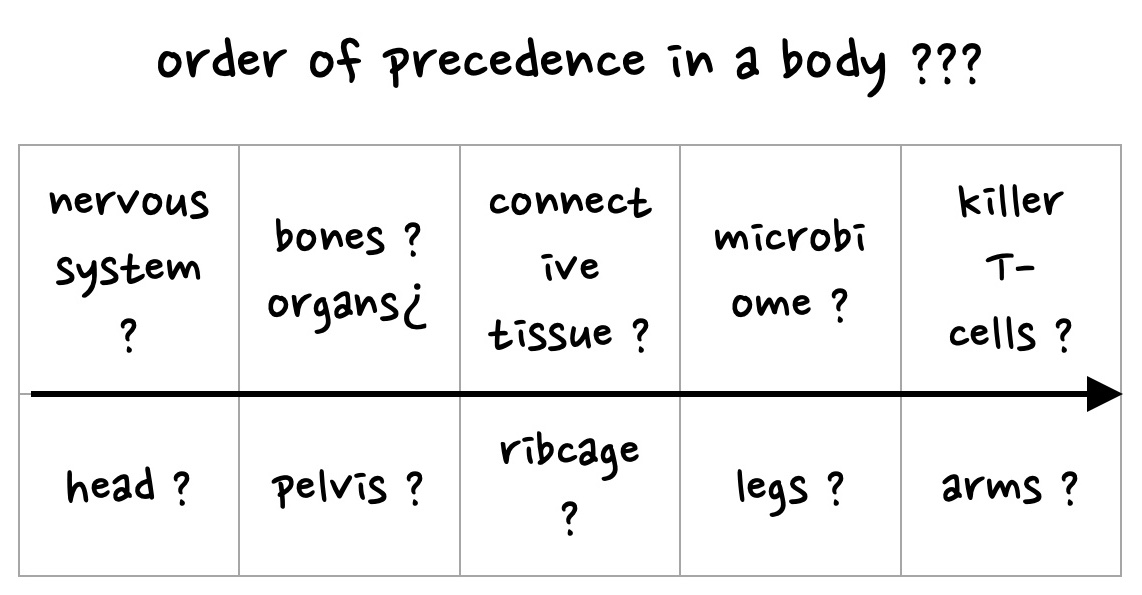
Can we prioritise one body part over the other by the point in time the parts came into being, as we grew from a two-cell’er into a full grown human?
It seems like as if the mighty greek titan Cronus, the god of time, did not give the human body an equally easy to observe order of precedence as he gave to families.
In order to make sense, and to find order in chaos, Andrew Biel wrote in his famous and industry defining anatomy book, „Trail Guide To The Body”:
„Wherever possible, a region’s bony landmarks have been strung together to form a trail. These trails are designed to help you understand the connections between structures. Without a path to follow, you, the traveler, would be lost in a jungle of flesh and bones with no idea of your trail’s location.”
Anatomy emperor Thomas W. Myers took this idea even further. In his landmark book „Anatomy Trains” he wrote:
„The absolute dominance of the isolated muscle presentation as the first and last word in muscular anatomy leaves the current generation of therapists unlikely to think in any other way. This form of seeing and defining muscles, however, is simply an artifact of our method of dissection – with a knife in hand, the individual muscles are easy to separate from surrounding fascial planes. This does not mean, however, that this is how the body is biologically assembled. One may question whether a muscle is even a useful division to the body’s own kinesiology.”
But, is it enough to identify parts and string them together? String them together by what means? Weight, density, function, the amount of force it can produce? By some sort of internal value system maybe? What is the body’s order? And what does violate that order?
This was a long post in order to arrive at these questions. And maybe one last question: does any of this matter?
The blessings of Openness
Last Sunday I had tea with my neighbour, Trang. We were talking about meditation practices and language. I was trying to make a point that language abilities increase with age, which she didn’t seem to buy at face value. Therefore I tried to quote a thing (or two), to add substance to my argument, and recalled that there’s a page in Thomas Hanna’s book „Somatics” in which he made a good point. But I couldn’t recall the details and my argument fell flat on its face. Nevertheless, we had a stimulating talk and for the next week agreed to go for a walk.
I read up on the details today:
In his book „Somatics” (1988) Thomas Hanna states that the 21-year Seattle longitudinal study of adult psychological development by K. Warner Schaie „is the backbone of this book.” Which I found surprising, since I always thought Moshé Feldenkrais’s movement based lessons and Hans Selye’s work on stress were the backbone of this book. Thomas Hanna quotes the Seattle longitudinal study like this:
„Different intellectual abilities took different lengths of time to mature. For example, the ability to think with numbers does not reach its peak until age 32; reasoning ability peaks at 39; speech and word fluency do not hit their peaks until age 46; and comprehension of verbal meaning does not reach its stride until 53 years.”
That’s what I wanted to quote to Trang. But that chance is missed, and now I’m curious of how to use this quote to make some improvements to my own intellectual abilities.
Both Thomas Hanna and Warner Schaie were looking for explanations why the fore-mentioned intellectual abilities mature in some people and not in others. While Thomas Hanna merely added two more paragraphs to his book’s chapter, Warner Schaie seemed to have added two more decades of research.
Schaie’s original assertions, „a favorable, less stressful personal situation; and freedom from arthritis and cardiovascular disease” still seem to be valid today. However, in 2010 he added „Midlife openness to experience is associated with midlife memory and executive ability change.”
(Richards, A. L., Madhyastha, T. M., Borghesani, P. R., Schaie, K. W., & Willis, S. L., 2010, April. Improvement in cognitive abilities is related to openness to experience.)
So, yes, then, how about a few positive affirmations toward greater openness? Let me first make sure we’re talking about the same thing. The Seattle Longitudinal Study uses The NEO Personality Inventory to describe openness:
„Openness (O) Open individuals are curious, willing to entertain novel ideas and unconventional values. They experience positive and negative emotions more intensely than do closed individuals.”
Having this definition secured, let’s write down some positive affirmations, shall we?

🙌 I am open to entertain novel ideas and unconventional values. ❤️
🙌 I am open to experience all emotions, positive and negative. ❤️
🙌 I feel safe to encounter the new and unknown. ❤️
🙌 I always find back to good balance. It’s easy. ❤️
🙌 I am open to enjoy warm and loving relationships with the people around me. ❤️
🙌 I am open to appreciate the fullness of life. ❤️
So, what do you think about that?
