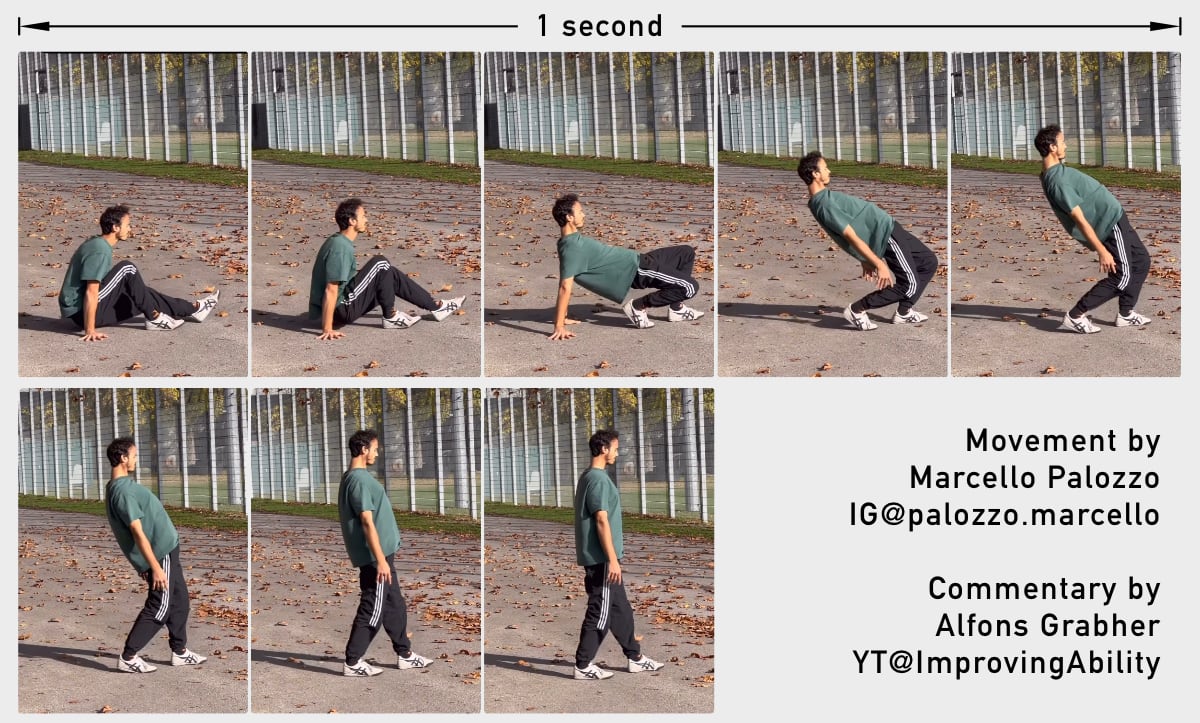
Arms that swing more joyfully and a chest that can breath more freely

When I first began studying the movement lessons of Moshé Feldenkrais (in the year 2004) I was extremely spirited. I purchased all the class recordings I could get my hands on—which wasn’t nearly enough to satisfy my large appetite. I also exchanged hundreds of “Private Library” class recordings with fellow students. And of course, eventually I also stumbled upon openatm.org (founded by Falk Feddersen) and practiced my way through most of the recordings there.

The recordings that stood out to me most where those of Sharon Moyano (now Sharon Starika). They were in strong contrast to the slow, deep movement explorations I experienced in Feldenkrais professional trainings. To me Sharon’s class recordings appeared to be fast paced, bare bones; only the essentials. One movement—bam!—then the next—bam! To me it was almost brutal, but not as brutal as the movements in the recordings of, for example, Franz Wurm. Sharon’s movement instructions were concise, crystal clear, challenging, and Oh! so good.

In a workshop advertisement (from long ago) teacher Victoria Worsley wrote about Sharon Starika: “The most extraordinary running and Feldenkrais story I have heard is about a professional American triathlete called Sharon Moyano who was hit on her bicycle by a semi. She had nine operations, broke a huge list of bones and lost 3 muscle groups. She was told she’d be lucky to run again and would certainly never race again. For two years she worked intensely with the Feldenkrais Method, doing both classes and one-to-one hands-on sessions. Two years later she beat her own personal best in a marathon by 20 minutes.”

Three days ago I re-visited one of Sharon’s class recordings, 1998/03/10 Elbow Circles Holding the Chin, and had the same feeling again: bare bones, only the essentials, almost brutal, but Oh! so good. Of course- I felt inspired. The lesson improved my breathing as well as the mobility of my chest. It improved my ability to bring my arms overhead and it got me into being more aware of my arms (and upper chest) in walking. It actually got me so excited about my upper limbs that I started a practice of throwing tennis balls against a wall; which I enjoy greatly. If only I had discovered this as a teenager I might have enjoyed playing tennis later on.

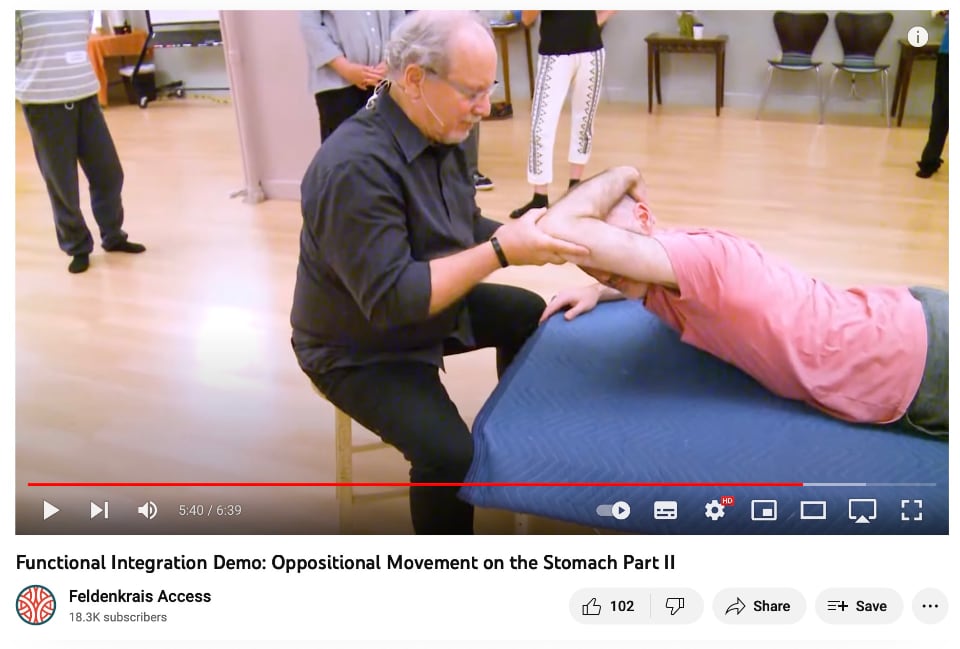
However, I wouldn’t dare to teach Sharon’s movement sequence to a general audience via recorded video. I would worry over Youtube viewers at home trying such a video with frozen shoulders, or a shoulder impingement, or being post shoulder surgery (or any other condition a doctor would have a name for). To teach this lesson myself I would need to make some changes, make it suitable for a general audience. But first I would need to put Sharon’s lesson to the knife and sample the key strategies:

The lesson starts with a reference movement. How well do your arms extend overhead to rest on the floor?

The first movement is to pull on a wrist (or fist), with your hands behind your head. One side first, then the other.

You then push one foot against the floor to roll into side-lying, and continue the same pulling on one wrist in side-lying. Your head rests on the floor (on its temple) in front of the arm that touches the floor, and you pull that arm’s elbow up towards the ceiling.

Next you sit cross legged. Your hands are behind your head, and with your left hand you pull on your right wrist to get hold of your chin on the left side of your face. Only now we get the cue to focus on the elbows and how we move them through space in relation to… well, there’s like 6 or so variations of this.

The last strategy is on the belly, in prone position. The hands—first one by one and then in unison—slide down the neck, over the shoulder blades, towards the lower back. May the elbows touch together?

Ok- my surgical dissection of Sharon’s lesson is done. I hope now you too can see the lesson clearly. The strategies, the positions and the reasons for the various positions, the constraints and possibilities. How a glued up shoulder and upper chest is invited into movement without the use of classic stretching, elastic bands and kettle-bells. And how the movements of the shoulders are brought into relation to the rest of the body. I would think that for many people these movements are difficult, hard to do, but nevertheless it’s a wonderful, quite intriguing sequence.

I was riding my 🛵 to a ☕️ shop, where I now sit and write this blog post. While driving I was thinking that a very flexible person might look at these movements and say, “So what, I can easily do all of these.” Probably a quite stupid, imaginary conversation with myself in my head. But there I was, searching for a metaphor in the crypts of my brain… that’s like someone picking up a book, for example Harry Potter Volume 1, and saying: “So what, I can easily read all of that.”

Here’s the adaptions I would introduce:

I would change the reference movement, to turning the head. And how well that movement is connected to the chest, and how (and if) the chest moves at all while turning the head. A side-bending, a twist, a shortening and lengthening, maybe the pelvis tilts sideways, maybe the even the legs move? And I would ask about the breathing in the upper part of the chest. I might keep the arms-over-head as a test, but wouldn’t make it the main reference movement, the main point of the lesson.

I would have the hands relaxed, and pull on a wrist rather than a fist. I would cue to focus on the movements and trajectories of the elbows already, and not wait until later in the lesson. I would start into the first movement with approximations: the hands in-front of the chest. I would allow the head to follow, to react, to roll. I would observe the movements of the chest and my breathing. With each pull I would bring my wrists further up in-front of my face, and then over head, and only eventually behind my head. Only then I would lift my head, and it will stop rolling, because it’s now lifted, the neck and chest under tension like a hoisted sail on a sail boat.

I would use more time for the rolling into side-lying. I would bring attention to how my head is carried over—or even lifted over—the arm that’s on the floor. How the lifting of my head will lengthen the side that’s pressing against the floor, and at the same time shorten the side that’s facing the ceiling. And how I would press my side against the floor to lift my head.

I would think about the elbows again. How my elbows can move my upper chest, neck and head in lines and circles. How my head can push my arm around (the arm that’s on the floor), backwards. How my whole body extends and flexes and twists and moves to point my elbow.

I would start holding my chin in lying on the back, and not in sitting. In this way it’s easier to get the whole chest to move, instead of risking the movement being done mostly in the neck only. The middle of my back presses against the floor, my pelvis can tilt backwards, my right elbow can point towards the right foot (or the left, etc.) After all, in Youtube videos I cannot see my students and this progression is safer for both, my student’s necks and my teaching goals.

For the part that’s done in sitting, I would not guide students through all 6-or-so variations. I think it’s just too much. I would introduce some ideas and leave it up to the students what they do with it. Keep it simple, and allow time and space for their own discoveries and explorations. Maybe someone will turn it into a rolling lesson, so be it, great fun!

Lastly, before wrapping things up, again I would start with a lose lifting of the elbow, borrowing parts of that classic Feldenkrais extension lesson, to ease into sliding the hand down the neck and over the shoulder blade towards the lower back. With a mode of easiness. Instead of focusing on the actual movements, I might try to drive students towards observing their movement learning and their building-up of consciousness.

Ok- that’s all I have for today. A demonstration of how I would listen to another practitioner’s teaching; of how I would analyse, modify and adapt a movement sequence for myself and for my own teaching.

The act of participation

Alternative titles: The movements and being in movement. The WHAT and the HOW. Ideas and execution. The rules and the actual game. A thought and the spoken word, the pen and the sword. The mind and the body. Making something imagined become real.

In the springtime of 2019 I assisted in a Feldenkrais professional training program in the south of China. In the role of a teacher I tried to learn about the students. How are they doing? How are they learning? What are their strategies, what are their ways of participation?

For example, there was this one student, a famous Pilates teacher and personal trainer (from and) in China. He was obsessed with understanding and writing down the movements. Instead of deeply engaging in a conversation with the movements, in movement, after each and every instruction he would reach for his phone and type down the instruction, thus building his own database for his own teaching. This movement does this, that movement does that, he wrote. All the while knowing perfectly well, that all lessons are recorded in both video and audio, and that he will receive the recordings at no extra costs after the training. Since he didn’t fully invest himself, I asked him “Don’t you have the feeling you’re missing out?” To which he replied, “Not at all. I’m just using my time more efficiently than the others.” I didn’t argue with him, I merely liked to learn about his thinking and approach.

Contrariwise, I found the following comment on one of my videos just yesterday. Comment by Sylvia Bahr, on the video “Learn how to roll easier | Rolling into deep”, youtube.com/watch?v=u3hRUgd7_q0

“For me, the degree of ease of rolling movement was a direct result of the relaxation session in the first part of the video. If the quiet time was shortened, then I think that my movements would have been impeded. This is now one of my favorites. Thank you for your patience with making videos.”

Sylvia invested herself fully. She accepted my pacing of the lesson and instead of skipping forwards or taking notes she practiced. Instead of just shortly assessing the movements, instead of looking at them with mostly her intellect, she immersed herself, applied herself, allowed herself to move, rest, to experience the movements fully. Maybe that’s why some Feldenkrais people like to call themselves practitioners, rather than teachers.

Of course- the movement instructions are important. They are the pieces in the game. But how we move, how we apply ourselves, to observe how we learn, how we are making progress, how we are conscious… to become more conscious, to accumulate consciousness so the speak (or maybe not), and all that, et cetera, is just as important. These things are not something reserved for the grand masters of the Game of Chess (or Mahjong in China), or something for the fans to observe and rave about. These things are just as important, they make up the game: the actual practice, the act of participation, the practice of being alive.

Stuck shoulders may be predictors of back pain

For quite a few years now I had the suspicion that tight shoulders, and a lack of mobility in the upper chest may lead to a specific type back pain. I always wondered if this is set into motion (or lack thereof) in young age already, through coercing children into carrying hard back packs to school, and have them sit on chairs; motionless to useless tasks for 6+ hours a day for 12+ years. My argument is this:

When the upper back is stiffer than the lower back, then the lower back starts to compete with the upper back in terms of stiffness. The lower back always tries to be stiffer than the upper back. However, when the lower back is overly tight for extensive periods of time then this can lead to pain as well as injury and disability. Likewise, if the lower back is forced into being less stiff than the upper back, for example by way of mobility drills and exercises, then the lower back might be at risk for injury and disability.

That’s why I think that my shoulder mobility exercises are so important in addressing this type of lower back pain, where the lower back competes with the upper back in terms of stiffness. I write “my” because my exercises are inspired by some of the movement sequences by Moshé Feldenkrais, and these kind of exercises are entirely different to what a fitness influencer or classically trained therapist would consider to be mobility drills and exercises for the shoulders and upper/mid back.

Note: I put some of my neck mobility exercises in my Youtube video series, also available as a paid download here “Tight neck? Here’s help!” [link]

Today I wondered what I could find with Google and Brave in this regard. Turns out, I didn’t find anything. Therefore I looked at the two science books about Back Pain that I own, and leastways found some hints. Here’s the quotes:

Finally, detailed examination of the fascial connections reveals force transmission among the shoulder musculature, the spine, and the abdominal muscles, justifying exercises incorporating larger movement patterns [..] (Page 59, LBD)

Studies of weightlifters have shown those with more flexibility tend to be the better performers but this is specific to the shoulders and hips – not the back. (Page 24, UBFAP)

Olympic weightlifters have proven they are functional using minimal spine motion when setting world records! However, they have wonderful range of motion ability in the shoulders, hips, knees and ankles which they can control with incredible strength. (Page 25, UBFAP)

Our data shows that walking results in very tolerable spine loads, and gentle disc motion which they thrive upon. The data also shows how swinging the arms from the shoulders (not the elbows) also reduces spine loading (Callaghan et aI., 1999). In fact, we have observed up to 10% reduction in spine loads from arm swinging in some individuals. (Page 102, UBFAP)

LBD: Low Back Disorders, 2nd edition UBFAP: Ultimate Back Fitness and Performance, 4th edition, both by S. McGill.

I learned to disagree

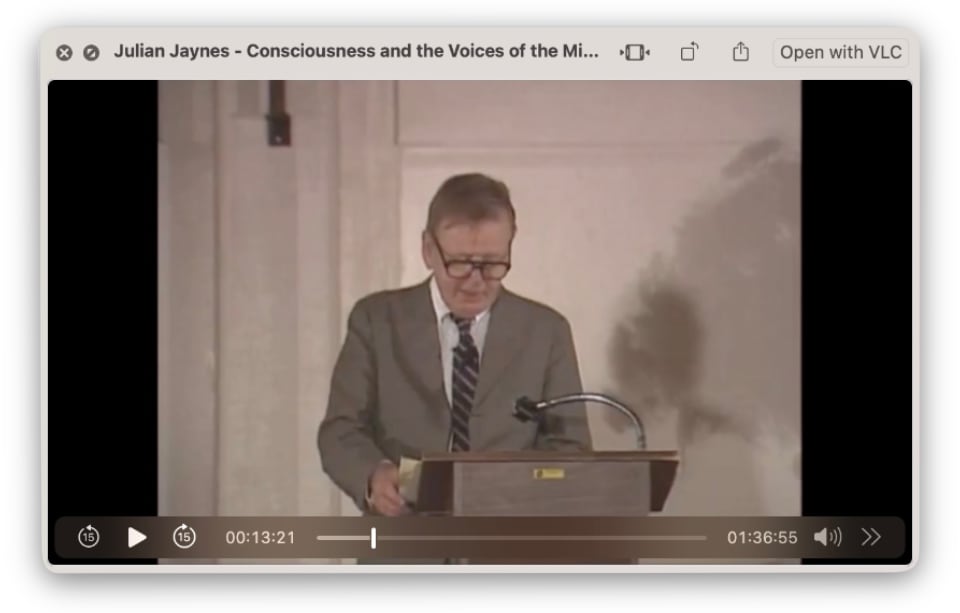
“When asked the question, what is consciousness? we become conscious of consciousness.” Says the first sentence of chapter one of the book The Origin of Consciousness in the Breakdown of the Bicameral Mind by Julian Jaynes.

I disagree. Now that’s fun. I reclaimed my ability to say «No» and «I disagree». This is something I have learned, consciously so. I saw it, copied the technique, refined it, calibrated it. I saw it in my accounting class teacher I was coerced to listen to, in one of the schools I had to attend all the way back when I was a teenager. That old, grumpy, bolding teacher with his overly bushy, black eyebrows and deeply sun-tanned, leathery skin always disagreed with everyone and never showed any signs of excitement towards anything. I didn’t learn accounting in his class, not even accountability, but I learned to look at things with scepticism.

“This book is a mirror. When a monkey looks in, no apostle looks out.” Says a paragraph in the book The Principia Discordia by Greg Hill. Now- who’s the monkey, Julian? Who is the monkey?

Not conscious of the presence of monkeys, Julian Jaynes continued to build his argument. On page 33 he wrote: “In the learning of skills, consciousness is indeed like a helpless spectator, having little to do. Consciousness takes you into the task, giving you the goal to be reached. But from then on, it is as if the learning is done for you. Let the learning go on without your being too conscious of it, and it is all done more smoothly and efficiently.”

Julian Jaynes really seemed to like his point, and where he was about to locate (store) his attempt of a definition of consciousness. Thousands of years have passed, and humans have not nailed down a definition of consciousness just yet. Julian Jaynes wrote his book in the 1970ties, therefore the argument he hammered down next must have been considered a big one (back then):

“The Zen exercise of learning archery is extremely explicit on this, advising the archer not to think of himself as drawing the bow and releasing the arrow, but releasing himself from the consciousness of what he is doing by letting the bow stretch itself and the arrow release itself from the fingers at the proper time.”

I disagree! I disagree! I argue that the Zen archers would have made more progress, faster progress, all and everything would have been better for them, if they had applied the principles of learning consciously, in the way Moshé Feldenkrais has found. But then again, Zen archery is a complex topic, and money, politics, paying the rent and bills are part of that complexity. So- maybe it was indeed better for them to release themselves from consciousness in order to have good social standing, food, a bed, and a roof over their heads.

What I did learn from chapter one of Julian Jaynes’s book though, is that learning can be done two ways:

  1. through rote drills, by releasing oneself from consciousness,
  2. through becoming more conscious, by improving ability in the way Moshé Feldenkrais demonstrated through teaching movement sequences.

But what are those movement sequences? Is it enough to say that they are the movement-based counterpart to essays in writing? Do we need to define the principles, tactics, techniques, sentiments? I might end this blog post by stepping in line with all humanity (so far) and by saying, “I haven’t nailed down a definition just yet.” But I think I’m not too far from one, I have a feeling that I’m holding the cat by its scruff. Would you agree?

Whatever rocks your boat

For a week now, every time I opened Youtube, a video titled “Could MrBeast Be the First YouTuber Billionaire? | Forbes” was shoved into my face. I clicked on “Not interested” on my MacBook, but the video stuck to my Youtube feed on Apple TV and iPhone. “Like that stain on my white sneakers that I can’t wipe off” thought I.

During the interview MrBeast was sitting on a chair. To me, he looked quite genuine and likeable. He talked about how he is obsessed with growing his Youtube channel, how he’s always been. How he spends every waking minute thinking about how to grow even more. How to find what people like to watch and get them to watch more. How he re-invests all of his hundreds of millions of dollars he earns through Youtube and related businesses, in order to grow his Youtube channel even more. He said that the Youtube algorithm can’t be tricked, and shows you exactly the videos you’re going to like and watch.

After having watched this video, as suggested by Youtube, finally that stain’s gone. Now my Youtube feed, once again, is mostly filled with random videos I don’t care about and don’t want to watch. Nothing sticks out. MrBeast and his 100+ million people audience seem to live in a parallel universe next to mine.

This morning, while taking the elevator down to G floor, to walk over to the coffee shop to write this blog post, I was thinking “I was also obsessed. Have always been. For almost two decades now I’ve been obsessed with how to teach Feldenkrais lessons. How to structure them, phrase them, present them.” I was obsessed with turning and optimising every detail, so that my students can have the most benefit from every word spoken, every move, every lesson. I spent most of my waking minutes pondering how I can improve my language, my teaching, my presentations.

But when I look at my Youtube stats, there’s no millions and billions. I survive just fine with a little bit more than what the Austrian government considers minimum wage. Instead of millions and billions, Rutger Hauer comes to mind. “Tears in the rain,” a 42-word monologue. The last words of the character Roy Batty, portrayed by Rutger Hauer, in the 1982 Ridley Scott film Blade Runner. “I’ve seen things you people wouldn’t believe… Attack ships on fire off the shoulder of Orion… I watched C-beams glitter in the dark near the Tannhäuser Gate.” I imagine these words are the equivalent to seeing my students learn and improve. What a sight! It’s like looking straight into the elusive eyes of the magnificent universe. The stars, the planets, the vast space in between.

One of the main reasons I make Youtube videos is to preserve my work, to document my perseverance, to make sure my work is in the public domain, something Moshé Feldenkrais failed to do. Most of his life’s work is lost, hidden from the public in private collections. Contrariwise, mine will live on as long as there’s electricity. All those moments will be lost in time, for sure. But not now.

Now you can experience the beauty of yourself, your physicality and learning, with a step as simple as clicking on one of my Youtube videos and listening to my voice, rolling about a little bit, your head left and right, and your shoulders… of the Orion…

There’s no substitute for human conversation

Sometime earlier this week I’ve been in a three hour video chat with a native English speaker. It was about work and a possible cooperation. It quite drained my brain’s battery. At some point I was wondering “Why is this so exhausting?” A host of missing words bothered me, those darn soldiers of mind escaped my command. Why are there empty lots instead of words, when in German language, my native tongue, talking is as easy as water is flowing down the mountainside?

I’ve just completed 4,400 pages of reading in English language. Extensive reading practice, as recommended by researcher and neurolinguist Stephen Krashen. While it improved my reading speed and listening comprehension, this massive effort seems to have left my speaking skills untouched.

I wonder, is it because I’ve never lived in an English speaking country? For most of my life most people around me—if they spoke English at all—they spoke English as a second language. Germans, Swiss, Italians, South Americans, Chinese, Hongkongese, Taiwanese, Vietnamese. It’s fun to listen to the French pressing English vocabulary into French grammatical structures and metaphors. And I enjoy the efficiency of Asians when they remove articles and tenses. They seem to be so confident with their shortcuts and adaptions. But when I open my mouth… it feels like walking on a cane. It’s ok, but it hardly feels quick or smooth. More often than not, it feels far from being on top of my thoughts.

“You speak slowly but are actually highly intelligent,” the native English speaker shared his observation at about two hours into the video chat. I was not sure if I should have an emotional reaction to that. My mind drifted off and for a brief moment I recalled a scene from a movie where a kid grew up in isolation, but always had a thesaurus with him. That kid was able to recite definitions and synonyms for any word thrown at him. I wondered if this approach could help me become more fluent. Effortless like water dripping down the needle-like leaves of fir trees in the Canadian Cascades.

The next day, when I browsed the latest in body work and fitness trends on Instagram, I saw a professional footballer doing leg drills. Super fit guy. I guessed that he trains 6+ hours per day. “He’s that good for a reason” I thought. I glanced at the app icon of the thesaurus I have on my phone. Would that it were so simple.

What’s an essay?

I’m tryin’ to nail down a definition of what’s an essay. I click the first link on Google, Wikipedia. The beginning of the first sentence reads:

An essay is a piece of writing that gives the author’s own argument [..]

This raises more questions than it answers: (1) What is an argument? (2) Why does it say “the author’s own” argument—is an essay strictly one’s own, personal point of view? And (3), does an essay need to be a piece of writing, or could it be a piece of music as well?

Probably my own mistake, I shot in my own foot so-to-speak, why do I even use Wikipedia to look things up?

“An argument is a statement or group of statements called »premises« intended to determine the degree of truth or acceptability of another statement called conclusion,” says Wikipedia.

“PHRASE. Shoot yourself in the foot. INFORMAL. Cause yourself trouble by being stupid,” says Macmillan thesaurus dotcom.

Yesterday—all day long—I complained to my informal girlfriend how tired I am, and that I should go to bed earlier. She told me that I’m going to go to bed early today. She came into my bedroom at midnight, to check on my sleeping.

“It is a vulgar error to suppose that you have tasted huckleberries who never plucked them. A huckleberry never reaches Boston; they have not been known there since they grew on her three hills. The ambrosial and essential part of the fruit is lost with the bloom which is rubbed off in the market cart, and they become mere provender. As long as Eternal Justice reigns, not one innocent huckleberry can be transported thither from the country’s hills.”

She pulled away the blanket I was hiding under. “Why!” she exclaimed. “You’re still playing with your phone! Sleep now!” she commanded. I put my phone with my copy of Walden, a series of 18 essays by Henry David Thoreau, into airplane mode, set it down on the floor. How I would like to taste such huckleberries! What an essay!

“Essays can be formal—serious purpose, logical organisation—and informal—the personal element, humour, graceful style,” says Wikipedia. I notice the “and”, formal AND informal, so it can be both, I guess.

Wikipedia lists non-literary types of essays: Film, Music, Photography, Visual Arts. I would call The Moldau by Bedřich Smetana an essay in music. However, the Encyclopædia Britannica classifies it as symphonic poem. “The characteristic single-movement symphonic poem evolved from the concert-overture, an overture not attached to an opera or play yet suggestive of a literary or natural sequence of events,” says Encyclopædia Britannica. And then there’s this big pop-up on their website, right in my face, “TRUST THE FACTS” it says. Well, if it says so, who am I to question this great institution of definitional truth?

What’s an essay? What’s not an essay? What’s a good essay? Good for what? Good in doing what, good for serving what purpose? Ah yes, I recall Wikipedia, “to give my own argument”. Ah yes, the argument, supposedly a statement or group of statements that make my own conclusion more “acceptable”, more palatable, according to whoever edited Wikipedia last.

I need to work. I want to upload a second version of my latest video, the one titled “MOVE and THINK: An Essay in Movement”, circles with the lower arms, but with a different introduction. I need to film the introduction. And I need to write—to write an essay for my patrons. Been looking forward to this all month. So- let’s get to the filming first.