
Thesis: Movement instructions differ not only in wording but in the granularity of motor planning they evoke; compression (e.g., “tabletop”, “down dog”) triggers schema retrieval, while decomposition triggers active schema construction.
In cooking, two dishes may look nearly identical, yet the culinary experience can be markedly different. The same goes for movement instructions:
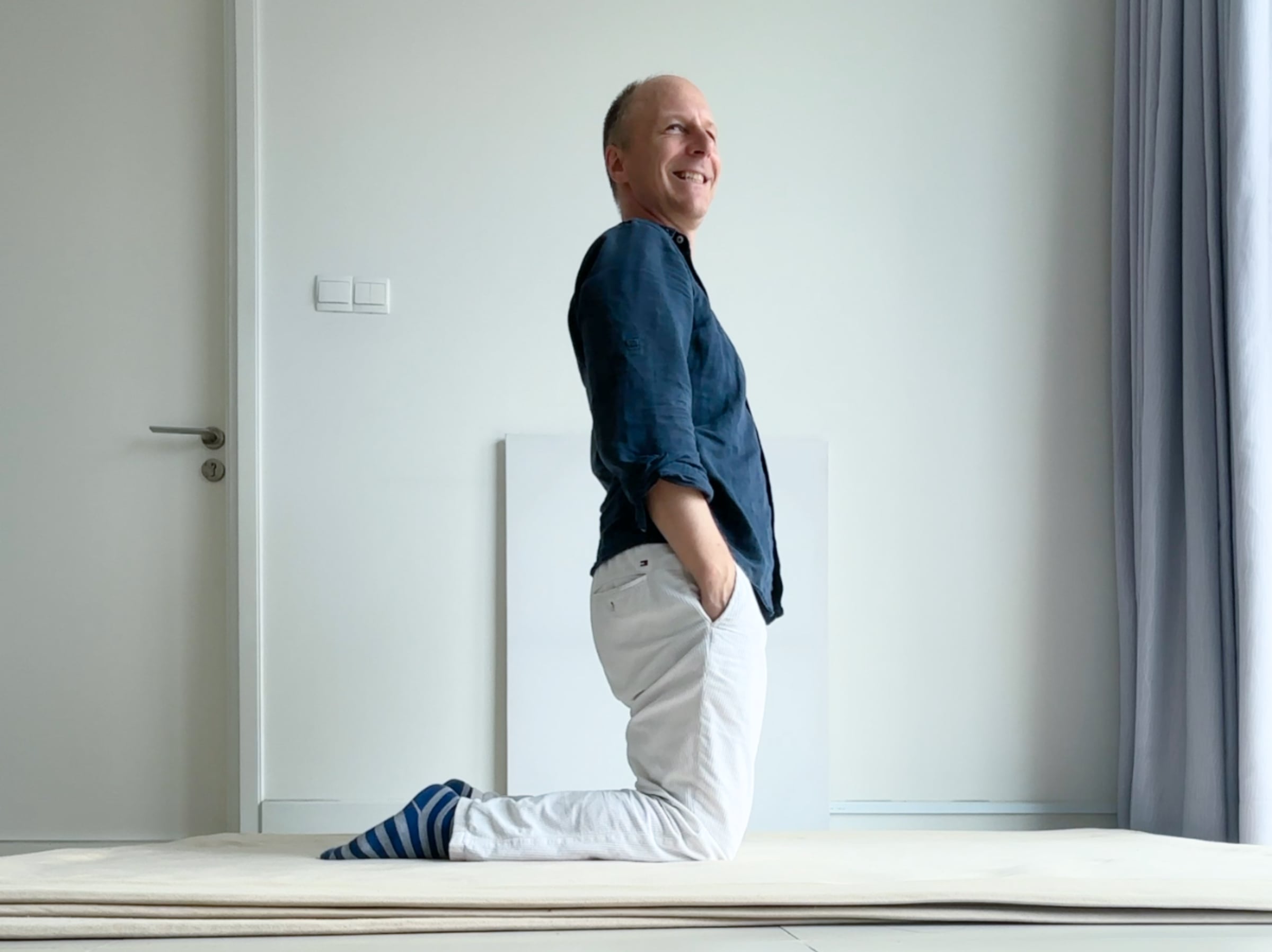
Example: Kneeling position
❖ “Please come onto your knees.”
Here, the focus is on arriving in a kneeling position. You come from whatever position you have been in, and arrive onto your knees.
Which may sound like a very simple thing, but if you think of how many billions of dollars and how much engineering talent is needed to teach such a simple thing to humanoid robots, it’s not that simple at all. What are your steps to do that? What will you do first? And a philosophical question: how do we humans turn a spoken sentence into a body posture?
❖ “Please stand on your knees.”
“Oh, that’s right. I can indeed stand on my knees,” you might think to yourself while assuming the position. Maybe the teacher wanted to direct your attention to this kind of bodily organization and understanding.
You lean on your knees. Your body weight is supported by your knees. You need to extend your hip joints, straighten the entire anterior chain of the body. You can definitely feel that kind of standing. How do you balance? As kids, didn’t we have to walk on our knees, and fall over many times, before we were even able to finally stand still on our knees?
Usually we think of our feet as the point of contact with the floor, when we think of “standing.” But what is a handstand then? And what walks on four legs in the morning, two at noon, and three in the evening?
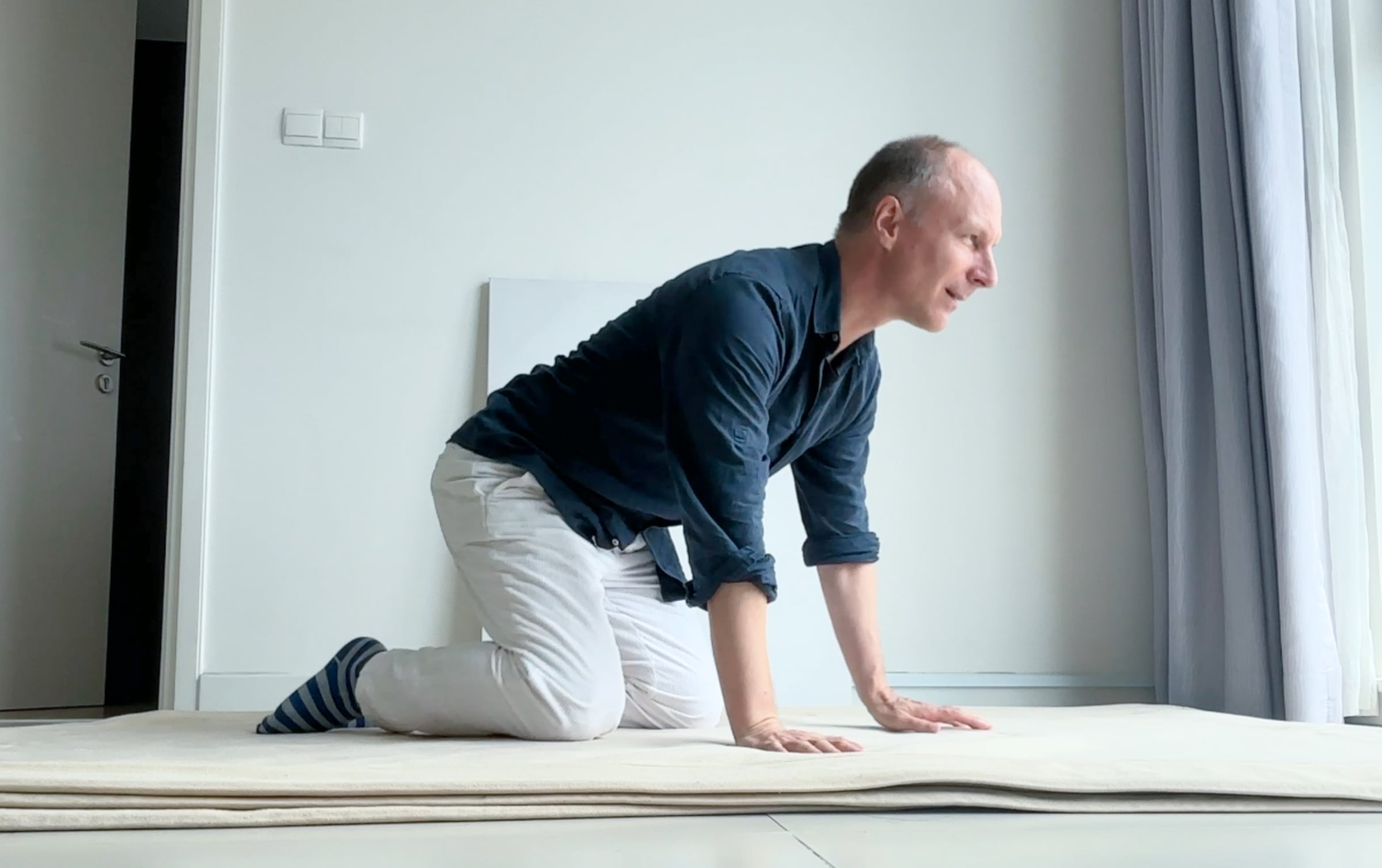
Example: Foot position in kneeling or tabletop
❖ “Point your feet behind you.”
“The teacher probably wants the feet arranged in a particular way,” you might think to yourself. Or what do we make of such an instruction? Is there anything useful to the image of pointing?
Maybe “pointing” directs attention toward lengthening through the front of the legs? Or perhaps it evokes an image of reaching through the toes?
In teaching, every word serves a purpose. “The dog chases the cat up a tree”, and “the dog chases the cat down a tree” are not the same. In arithmetic, 2 times 3 is the same as 3 times 2. But again, in spoken language, “the dog chases the cat”, and “the cat chases the dog” are not the same at all.
❖ “Extend your ankles so the tops of your feet rest on the floor, or come as close as is comfortable.”
Contrary to “pointing,” this instruction directs attention toward joint organization. The ankle is extended, we call this plantarflexion. This instruction does not involve tensioning or intentional stabilization of a joint.
And then there’s the distance between the instep and the floor: if the gap is particularly wide you will have noticed already. If there never was a gap for you, you might wonder what the teacher is talking about.
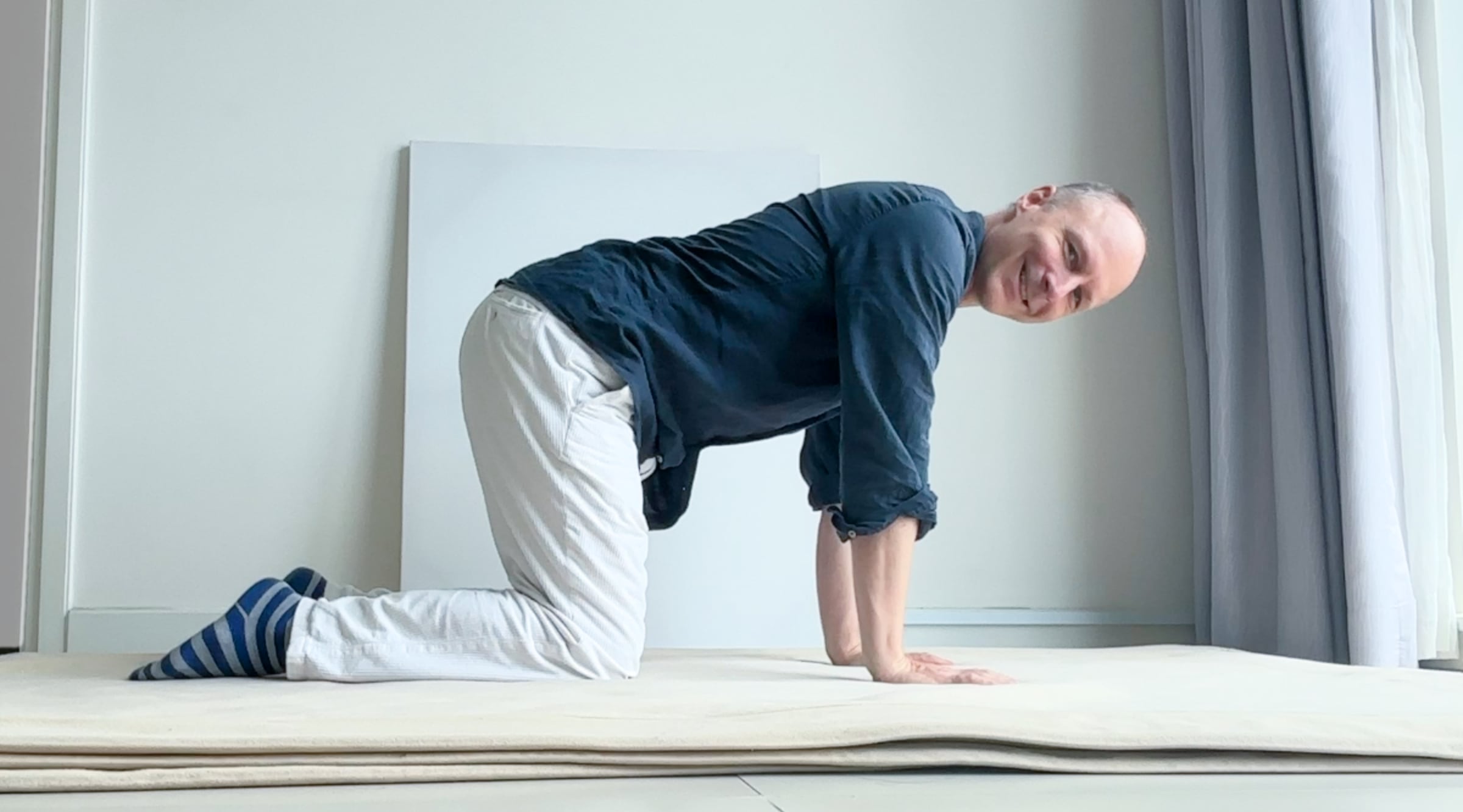
Example: Building a position
1. “Come to tabletop.”
2. ”Please stand on all fours, on your hands and knees.”
3. “Please stand on your knees. Extend your ankles so the tops of your feet rest on the floor, or come as close as is comfortable. Now lean on your hands, in front of you.”
So what’s the difference between those three instructions, despite being vastly different in length? (Instruction #3 is nearly ten times longer than instruction #1)
While the first instruction gets students into the same position quickly, it misses “building” the position, building awareness for the details of the position. It might not set up students for learning as well as the third instruction. But then again, it really depends on what we ultimately want to achieve.
The words and metaphors we use support the goals of a lesson and the learning we hope to facilitate. By making conscious choices about how we phrase our instructions, we may become aware of certain things, which may lead students not only to have more embodied awareness, but also to have more choices, which may lead to better decisions, and ultimately better lesson outcomes.
Keep an eye on my Patreon channel. Later this month, I’ll post a movement lesson exploring these ideas in practice.
www.patreon.com/StudyWithAlfons
