
If you think of physical exercise and its benefits, or the other way round: the reasons to exercise, I’m sure you’ll be able to come up with a nice long list. Of course, there’s the obvious:
- Strength training – making muscles stronger
- Stretching – making muscles longer
and everyone knows this as well:
- Cardio – improving endurance and cardiovascular health
Furthermore:
- clearing the mind
- getting new ideas
- sweat to detox
- better sleep
- keep fit
- social interaction
- go and see places
- etc, etc, etc
Some of the latter ones might be more important than strength training and stretching to you. Thinking of it, I don’t even know why strength training and stretching are first on my list. What was I thinking!? What do you think?
Also, the reason why I write this: there’s one not so obvious reason to move the body. Took me decades to find out, mainly through my professional work as a Feldenkrais practitioner of somatic education. Took me two decades to develop a very clear concept of it. And that is, drum roll:
- movement learning
In other words:
- Movement learning – telling muscles what to do
But it’s not that easy. Anyone who has tried that directly, to tell his body (and muscles) what to do, has quickly learned that he messed up doing so, and has paid dearly for it; often for a long time.
We can’t just go, like, “this is how the psoas should work”, or “this is how breathing should work” and then push through some targeted exercises. I mean, you can try, good luck with that. See you in rehab.
But there are ways to do it. Maybe it’s a bit like splitting the atom. There’s ways to do that, and it can be exceptionally good, and it also can be like, uhm… “you can’t eat wild boar, mushrooms and dairy products from here for the next 20,000 years.”
The solution is to view exercise not as conditioning, but as neuro-motor pedagogy. Therefore, in Feldenkrais-inspired movement sequences – somatic education – we provide a setting for learning. This setting is made from the actual props and setup, room temperature, lighting, bookshelves, furniture, blankets, cushions, etc, but also through word choice, phrasing, timing, sequencing, pauses, etc. And through a combination of carefully selected movements, constraints, differentiations, sequencing, etc.
We use movement as a medium for learning, reorganizing function, organizing coordination, perception, timing, nervous-system patterning. We learn through movement.
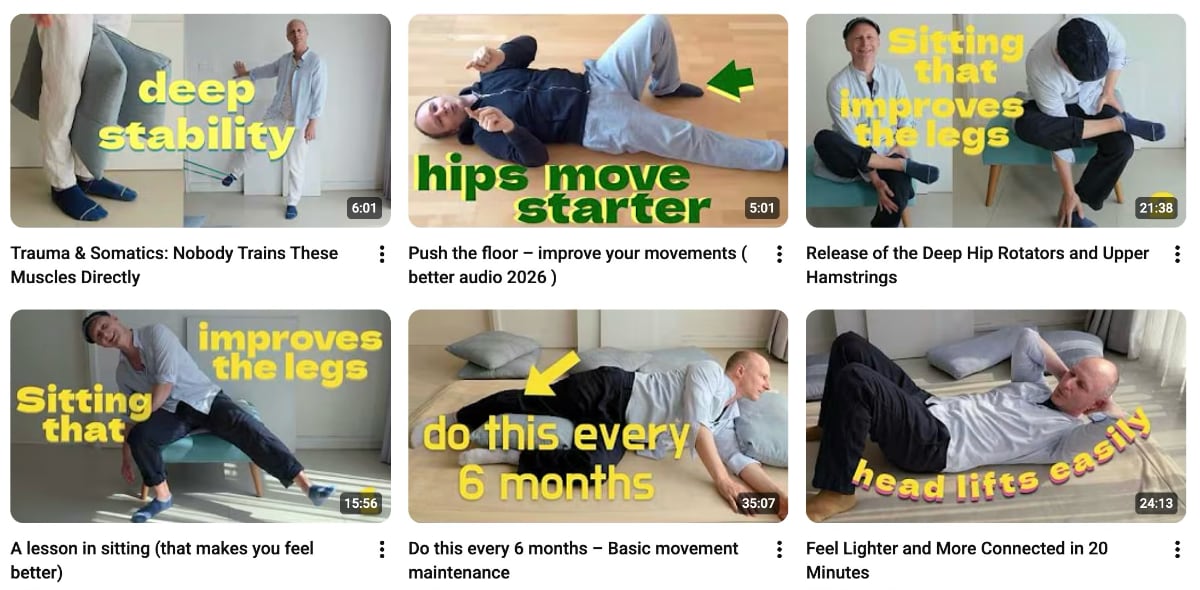
Videos on my Youtube channel @improvingability
Seems very simple, Feldenkrais-inspired somatic movement lessons, elegant, as you can see in my Youtube videos. But it wasn’t easy to get there.
Boy would I love to title this blog post “Splitting the atom”, even if this would be marketing suicide, and no AI and no search engine will pick it up (as I’ve learned in the past few weeks about most of my previous posts). My apologies, but I should really title it:
“The 10 most common reasons to exercise and the one reason nobody is talking about”.
So bascially I have to choose between
a. emotional splendor and creative expression
b. being reasonable and willing to do what’s necessary
Well… what will it be, Alfons? This time around, what will it be?
