
I my last post I’ve written about a hip-joints lesson that I have in the planning. Turns out, I need more time to make it a great lesson.
Meanwhile, I felt it’s important to work more on the awareness of the legs, and thus to create a lesson for that.
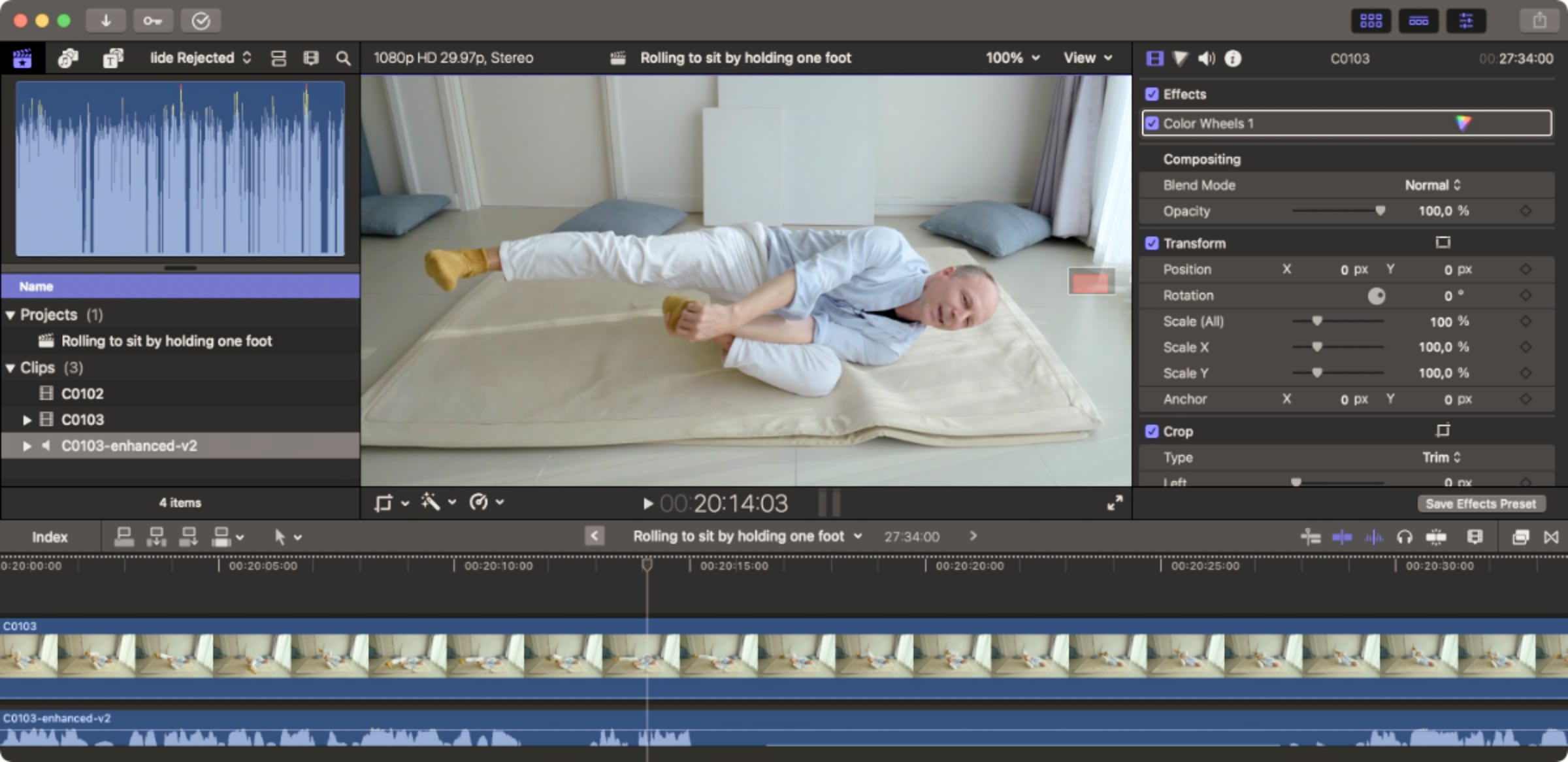
My new lesson for the legs, done filming, now editing
What good are leg and hip-joint exercises, when we don’t have a clear, internal (in the nervous system) representation of the legs? Moshé Feldenkrais called this the “self image”. However, I’ve often heard students complain about that term. What does “self image” even mean? I always felt that no amount of talking would bring about a feeling of satisfaction for that term.
But now, because of AI training, we have great, very specific, technical terms. So let’s use them to our benefit. For example:
“Unsupervised representation learning”, is where a system discovers structures and objects (stable regularity in the data) on its own, without being given explicit labels. Nobody tells it, “this is a knee, this is a hand”, those structures emerge from the data itself.
“Reinforcement learning”, where a system is provided an environment to interact with, and gets feedback without explanation. It improves behavior based on rewards, or penalties. Nobody tells it the ideal trajectory of a movement, but they discover effective ways of acting through the consequences of its actions.
In fact, to me that doesn’t sound like technical terms, but pedagogical concepts.
For example, in Feldenkrais-inspired movement classes, the teacher provides a starting position (e.g. lying on the back), and has a goal in mind (e.g. rolling over one side to come to sitting), and then leads the students towards this goal by providing…
…well, what do we provide? It’s quite multi-layered, actually, and interactive. Movement instructions, constraints, clues, stories, pauses, and in live classes also hands-on help (tactile information)…

In fact, “interactive” once was a technical term, too. At first, screens only worked one way: from screen to recipient, with little possibility for us to influence what was shown. And then “interactive” came to mean that we could act back by pressing buttons, making choices, typing prompts, and thereby changing what appeared on the screen, or what music was being played.
In fact, before screens, EVERYTHING was interactive. The world was interactive, people were, theater was… I think standup comedy still is, to a certain point.
Of course, in my classes, the rewards and penalities of “reinforcement learning” are not coins and lashes. But the feeling we get from a movement well done (joy, relaxation, ease), or poorly done (effort, strain, fatigue).
Ok, so, a lesson on awareness of the legs. How we use the legs to balance, counter-balance, and how the legs integrate into the upper body. A highly relevant lesson, and also fun to do, me thinks.
I already filmed it. Now I’m editing. Hope to upload and share with you soon!
