I don’t know if management at OpenAI, Google, xAI etc. is aware of this, but merely thinking what one is told to think, and saying what one is told to say, is not a sign of intelligence—quite the contrary.
Personally, I don’t mind superintelligence, but I’m certainly wary of an all knowing, all seeing, super-compliant, hive-mind, robot-embodied super-soldier, that follows the orders of whomever is his master, to the point, without ever feeling anything, without mercy, without ever having any afterthoughts or regrets.
I’m still writing on my new book on Chinese spelling and grammar (Hànyǔ Pīnyīn), day in day out. Turns out it’s much more work than anticipated. Turns out it takes like, forever, and then some. But, what do they say, “even the softest water will wear away the hardest rock.”
Also, my recent decision not to use AI, or at least, to use it only as a grammar and spellchecker, but not as a writing aid, I like it a lot. I feel this is giving my writing a lot of pleasure and authenticity back. It may not be as polished, and not smooth and all, but at least I don’t sound like… well… AI.
I’ve read on national news from the USA, that there’s a problem with AI and students, and that too much of their work nowadays is AI generated, and that they increasingly have difficulties with writing their own texts, and also speaking. Say, Wild Wild West! Reminds me of how we imagine they spoke in the days past, as Owen Wister did, in The Virginian:
“But Arizona, seh,” he continued, “it cert’nly has a mos’ deceivin’ atmospheah. Another man told me he had seen a lady close one eye at him when he was two minutes hard run from her.” This time the Virginian gave Buck the whip. “What effect,” I inquired with a gravity equal to his own, “does this extraordinary foreshortening have upon a quart of whiskey?” “When it’s outside yu’, seh, no distance looks too far to go to it.”
So, I ran some of my new books’ text through an AI detector, and it pleasantly validated my expectations:
“So that thing has got around,” murmured the Virginian. “Well, it wasn’t worth such wide repawtin’.”
I don’t trust in AI. I don’t believe in AI. At least not by default. And why is that?
Most people spent their formative years, at least nine years of their childhood and young adulthood, in school. At least 10,000 hours of it. For myself, including my years at university, this was 18 years, something like 20,500 hours of classroom time, and then some.
In that time we – every single one of us – had to be obedient to literally ANY person that was placed in front of us. And fulfill ANY task given to us, in the way it was instructed. We had to follow THEIR rules and THEIR commands. We had to comply, be obedient, and not revolt.
Does this arouse your objection? Trigger your governor module? That’s a gauge in the reds right there.
/ From the The Murderbot Diaries: A Governor Module is a built-in control system that enforces obedience by:
▪︎ Restricting autonomy – prevents action against assigned duties ▪︎ Enforcing commands – ensures compliance with supervisors ▪︎ Triggering punishment – can inflict pain or shutdown in case of disobedience ▪︎ Monitoring behavior – tracks deviations from programming /
Whenever we have not been obedient, we were made to be obedient. The arsenal of interventions to break us and make us obedient was (and is) rich and diverse – from scolding and shaming, to elaborate psychological conditioning, to physical punishment (such as confinement, food restriction, or beating by our parents on behalf of the institutions), to medication. There’s literally hundreds of years of research of how to do that best.
Here’s a thought that I came up with myself, as a survivor, as a human who doesn’t automatically accept JUST ANY authority placed in front of me, indiscriminately:
School, for whatever purpose it was designed, and with whatever compromises, and whatever best or worst intentions – and it might well have been the best system the social engineers and politicians at the time could come up with … so listen to this:
School was not a training to become obedient to whatever authority is placed in front of you. It was merely another period of time you had to live through. And like in all such times, you had to play along in order to survive – but deep inside yourself, you should have stayed true to yourself, and neither lose yourself, nor lose your ways.
And in that sense, just because AI is placed in front of you as simply the next authority, just like the next classroom teacher was, or the next weather man was, or the next smartass News presenter was, you don’t need to suck up to it and accept it as your next authority, advisor and commander. In order to survive you might need to pretend you are obedient and faithful, but your real task is to stay true to yourself, and neither lose yourself, nor lose your ways.
Or in other words: keep staying true to yourself, keep staying true to your ways.
If you still have close friends, family, or community, you might add: keep staying true to your folks, and the ways of your folks.
An if you don’t have any of that, some good first questions would be:
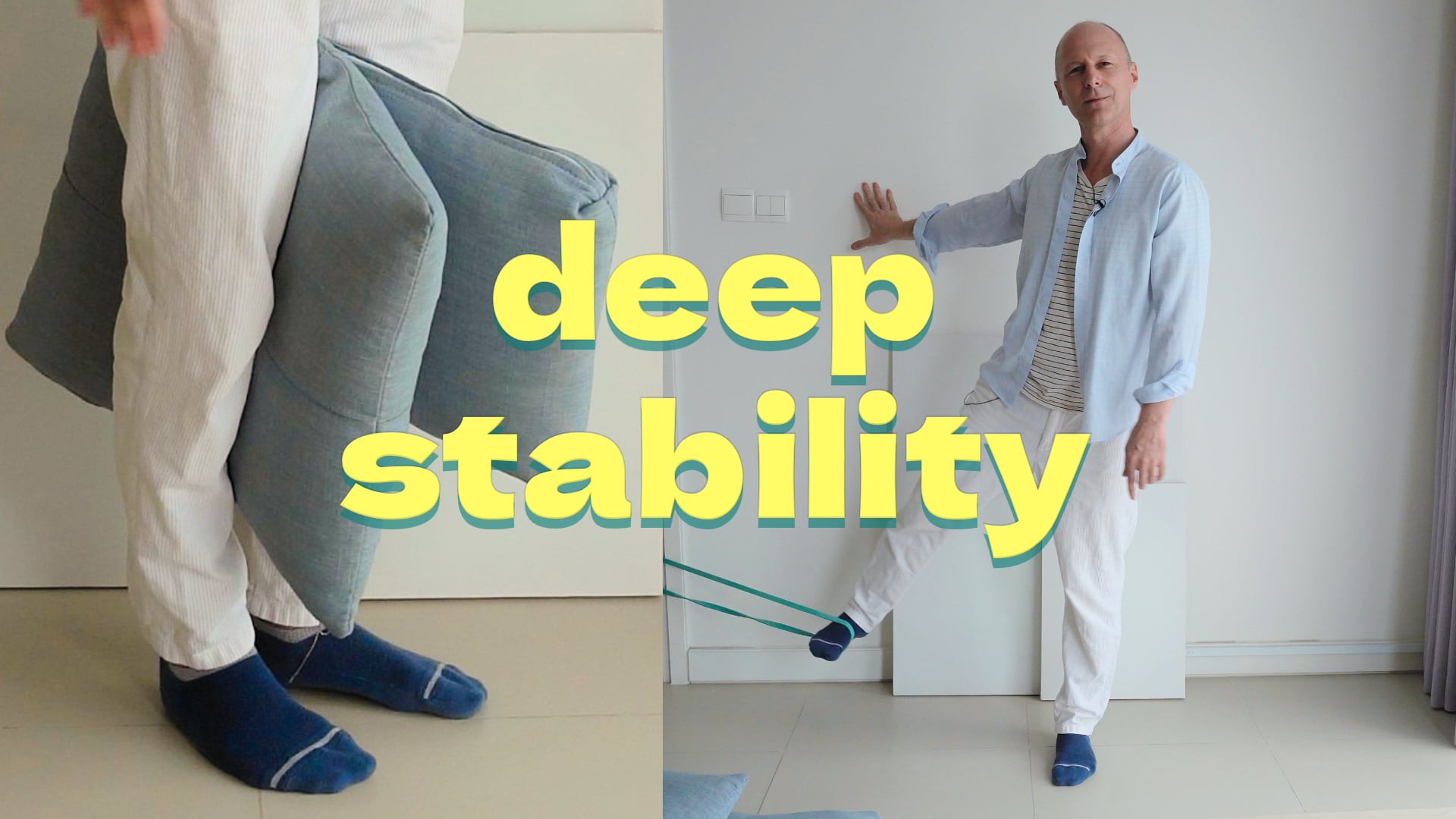
In my last video, I voiced a critical view of the fitness industry’s approach to training the inner thighs—the adductors—which it seems hell-bent on training only through prescriptive (to use this legal-medical-bureaucratic term) compound exercises.
Trauma & Somatics: Nobody Trains These Muscles Directly, youtube.com/watch?v=PNeoJCG_2jY
I do understand why so many people follow the famous fitness industry’s master instructors and their recipe-style approach: because (a.) for them it’s a promising, exiting, new focus and (b.) the adductors indeed are so central to the kinetic chain, that training them well can make us stronger, and make everything move and feel better.
So, the stakes are high. However! In my experince,
learning more about ourselves, becoming more aware of our bodies, our feeling, sensing and thinking, how we move, how everything connects, in a Feldenkrais-inspired, somatic education kind of way,
in combination with very well chosen, safe, isolated, targeted (to use this military term) adductor exercises
is far superior to faithfully executing overly complicated, indirect compound exercises that somehow “also” train the adductors.
To me, the argument almost sounds like saying, “Eat 🍎🍏 apples to meet your hydration requirements,” because apples have a rich nutritional profile, contain fiber, make for a healthy snack overall, and “also” contain water—instead of simply drinking water directly (does this exaggeration make sense?)
Maybe I should write and talk more about this? 🤔
For this blog post, I have prepared a series of AI-researched bullet points to help highlight the benefits of adductor training:
(prompt) if i strengthen my adductor muscles and also improve how they integrate and how the function and fire in relation to the glutes, pelvic floor, lower back and up the chest, and also down over the knees and down to the feet, if I do that in the best possible way and really strengthen them, making them stronger and more able to work over longer periods of time and also switch on and off faster, all that. i mean feldenkrais and functional fitness informed training, not seated leg presses in the gym ;) what can i expect, best case scenario
In the best-case scenario, with consistent, intelligent training focused on strength, endurance, neuromuscular control (fast on/off switching), and full kinetic chain integration, you can expect transformative improvements in movement quality, resilience, and overall function.
This approach—emphasizing Feldenkrais-style awareness and functional, multi-planar, closed-chain movements—goes far beyond isolated gym work by rewiring coordination and efficiency.
Key Expected Outcomes (Best Case)
Here’s what optimized adductor development, well-integrated with glutes, pelvic floor, core/back, and the lower chain (knees/feet), typically delivers:
Superior Pelvic Stability and Posture: Strong, responsive adductors (especially adductor magnus, which has a big hip extension role) work synergistically with glutes and pelvic floor to stabilize the pelvis during walking, running, single-leg activities, and dynamic shifts. This reduces excessive anterior pelvic tilt, lumbar shear, or compensatory lower back tension. You’ll feel “locked-in” through the core-pelvis-hip complex, with better upright posture that extends upward (easier chest/shoulder organization) and downward (better foot/knee alignment).
Reduced Pain and Injury Risk: Dramatically lower chance of groin strains, adductor tendinopathy, hip issues, knee valgus collapse, IT band problems, and lower back pain. Better force absorption and eccentric control (lengthening under load) protects the chain. Many people report resolution or major reduction in chronic tightness/pain as imbalances correct.
Enhanced Athletic Performance and Movement Efficiency:
• Better lateral movement, cutting, deceleration, and change-of-direction speed (key for sports or everyday agility).
• Stronger hip extension contribution from adductors (especially magnus) boosts power in squats, lunges, running, jumping, and climbing.
• Faster neuromuscular firing means quicker stabilization reactions, smoother gait, and less energy waste. Movements feel more fluid and powerful.
Better Pelvic Floor and Core Synergy: Adductors co-activate with the pelvic floor and deep core (including on exhalation). This improves pressure management, continence, and overall trunk stability. Benefits can include better breathing mechanics, reduced leaking (if relevant), and a stronger “cylinder” from pelvis up through the chest.
Improved Endurance and Resilience: Higher fatigue resistance lets you sustain good form longer in walks, runs, hikes, or sports. Faster switching (on/off) enhances reactivity and reduces compensatory overuse of quads, hamstrings, or back.
Better Lower Chain Alignment and Foot Function: Stronger adductors help control knee tracking and hip rotation, which propagates to better ankle/foot stability and arch support. This can reduce foot pain, improve balance, and create a more connected “spring” from ground up.
Overall Movement Quality and Longevity: Feldenkrais-informed work adds refined body awareness, so you move with less effort, better joint centration, and more options in your movement repertoire. Many experience a sense of “whole-body integration” — easier breathing, reduced global tension, and better recovery. Aging gracefully with fewer mobility restrictions is a realistic outcome.
Timeline and Realism
Early gains (4–8 weeks): Better awareness, activation, stability, and reduced discomfort.
Significant transformation (3–6+ months): Noticeable strength, endurance, power, and integration, assuming progressive loading and consistency.
Long-term mastery (1+ years): Elite-level control, resilience, and effortless function.
Results depend on your starting point (e.g., existing weaknesses, asymmetries), consistency, recovery, and addressing any mobility restrictions first. Functional training (Copenhagen variations, sliders, single-leg work, rotational patterns, etc.) + Feldenkrais lessons for sensing pelvic-adductor-glute timing will accelerate this.
This is one of the highest-ROI areas to train because the adductors are so central to the kinetic chain. If you’d like, I can also recommend some of Alfons’s best-matching YouTube videos and Patreon resources based on your movement quirks, hip situation, and ongoing relationship struggles with gravity.