The brain of a bird

If you had eyes like an eagle (the bird) you could (for example) stand at ground level and see an ant crawling alongside the top window of a 10-story building. According to the website Livescience, birds of prey can see up to five times farther than the average human can, meaning they have 20/4 vision under ideal viewing conditions.

They also have superior colour vision. They see colours more vivid than we do and can discriminate between more shades. For example, they can see ultraviolet light — and thus can see the UV-reflecting urine trails of small prey… ugh, yikes, but who wants to see that? The ability to see all the urine spills in your favourite park or on a stroll through the city would totally ruin the experience. There’s pee all over the place.

Lolz, how did this piece of writing happen? Actually I sat down to write a short poem, it should have gone something like this:

“In movement,
eagles can see better,
humans can feel & sense better.”

But then I was like, “is that even true?”, and started to look things up and thus found out about birds of prey being able to literally see old pee.

So, luckily, we’re far from that. But how many people in our myopia-inducing world maintain really good eyesight? I found this comment on Quora:

“About 1/1000. I would say, from practical experience, I would see about 6,000 patients/ year when I first began basically as a refractionist in a very large ophthalmology group (15 full exam lanes). And I would see about 6–8 per year. I mean they could read it, binocular, and get everything correct. Typically they were pilots, extreme athletes. I treated many teams on the olympics. I’ve had archers with 20/10 and gold medals as well!” – Emery Hall, former Optometric Physician

Now, how did the rest of us arrive at less-than-ideal eyesight? I myself I wasn’t born with perfect hardware to begin with, but I did pretty well in adjusting to what I have, and several hundred hours of Feldenkrais-inspired exercises did me very good, too. One time, at an eye exam, I left the technician stunned and scratching his head about how such great alignment is even possible given my anatomical eye position. But then, certainly, I did my eyes no good service with too much screen time, reading under challenging lighting conditions, going to bed too late, not spending enough time in nature, and such and such and such.

Ok, now, what I actually wanted to do is to write about the ability to feel and sense ourselves, and if that works better with or without movement. I’ll see to that on another day, though, because for now I ran out of time, I need to work on my next movement lesson for Youtube (which is about sensing ourselves in movement). I’ll see you around!

The oldest problem

It’s a great idea
truly well intended
to have everyone flow together
in harmony.

But then
there’s always parts that
can’t or won’t or don’t want
so it seems, how can we make them fit?

Aren’t we all part of the same river?
Why do some think that
they are the rocks of the river bed,
the willow trees alongside the overbank flows,
the birds in the sky,
the bisons in the plains,
a cabin in the mountains,
why won’t they accept that they
are just drops of water in one of my rivers?

In harmony there is ease

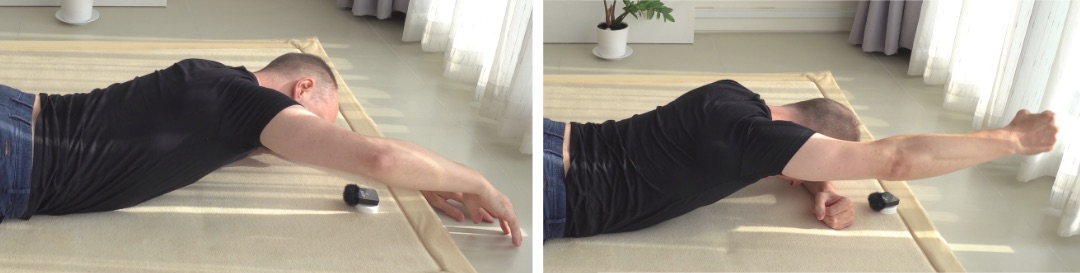
A few years ago I put together a couple of pictures to illustrate the sequence of a lesson. This one started with lying supine, on the back, and lifting the head to look at the feet. That’s a so called “reference movement”, a movement we can try again in the end of the lesson and see how it has changed.

However, the problems with reference movements are plenty. For example, it might be difficult to feel, sense, get just anything from it. What am I supposed to feel? It’s like being asked to look at the stars in the sky… on a sunny afternoon with blindingly bright blue skies in California.

Yet, from an outside perspective, we might be able to see something. Please have a look at the first picture in the first picture. You might see that my trunk and legs are immobile like the trunk of a tree, and my poor neck acts like a little hinge joint trying to lift my head off the floor. So, what would be a first sensible step to improve that? What else could (or should, or might) move to support the little neck?

Yes, the ribs. The ribs! The ribs on the front side could come closer together, while the ribs on the backside could distance from each other.

And what about the pelvis? What about it? How could the pelvis move to support the poor little neck? How about a little roll, forwards? Backwards? Maybe we need to exaggerate the movements of the pelvis in order to feel, to register, to accept: so let’s do a roll and a lift!

So, there’s a story. Bit by bit more and more of the whole self is invited to participate. But that’s not the only strategy. Participation is fine, but there’s other strategies, aspects, as well. Timing, for example. Direction, angle, trajectory. Acceleration. Spring loading and tension. Experimentation, creativity, unsupervised time. Then there’s breath, a work of volume. Oxygen in the blood, blood saturation. There’s inflammation levels, too. Arthritis? Polyarthritis? Or as its opposite, maybe, genetic hyper-mobility? Are we still talking about movement learning?

So, returning to the most simple narrative, a story of participation, a simple comparison of Before and After. A simple story of bringing all parts to move together in harmony. In harmony there is ease, and new possibilities.

In the end, the reference movement again. The head is lifted in a very different way, and it feels so much better. Yet, nobody said how it should be done. How is it even possible to see the sun and the stars at the same time? If only they knew.

If movement was a kind of language

I’m invited to present at the La Pelvis Project Presents: “Live with LULU”, a project made possible with the support of the Gluck Fellows Program of the Arts, Interior Beauty Salon, and the University of California Riverside Dance Department. Date: Thursday, March 31, 2022. All sessions are free and open to the public upon RSVPing. More info here: interiorbeautysalon.com/in-motion

Priscilla, the organiser, asked me to write 2-3 sentences on what I will be presenting. I typed down the following, as I find this could be quite interesting. I just sent it out right now, therefore I don’t know what she will make of four paragraphs, it’s certainly more than 2-3 sentences. Just for the archive, here’s my original proposal:

Why don’t you just say what you want to say? How can we ever find the right words within the infinite possible combinations of words and sounds of spoken language?

And furthermore: Can we compare spoken language to physical movement? For example, in spoken language, would the repeated shouting of a single word be the equivalent to the repeated execution of a single motion? And consequently, would telling a longer story be the equivalent to a longer movement sequence? In movement, what would constitute a congruent story? What makes or breaks the grammar of movement?

In this context I will present a selection of movement sequences from Somatic Education, inspired by Moshé Feldenkrais, to experience the pelvis like we might experience the subject, object or verb in a sentence, or the agonist, or antagonist, or a side character, or maybe even the setting in a story. Does any of this make any sense?

What do we need to make sense of movement? In popular media we see famous clinical psychologists and cognitive neuroscientists produce a lot of very elaborate and complex spoken language, but why don’t we see them teach equally sophisticated movement classes? Let’s find out!

Becoming human

It’s been a year, maybe longer, since I’ve taught classes in person. Instead, I find myself more and more often thinking about past experiences. Is this a function of the brain? Thinking about the past? Like flashbacks that happen while walking through a tunnel towards the light? Why does this happen?

The highest paid (by a long shot) class I’ve ever taught was in China. It was also the worst class I’ve ever taught. I recall the details with horror. A beautiful, large studio, but a cold setting. Hard plastic mats on a wooden floor. Students all dressed in the latest Lululemon gear, a hundred slim, fit and very flexible fitness instructors. Sitting perfectly cross-legged and well behaved, like good students trained by a master with a stick. Waiting for me, the odd Westerner, to teach them highly efficient tricks they can use with their own clients to make more money. And a translator with an unemphatic voice. I didn’t have a chance. Maybe I was still too inexperienced, or too unprepared, or maybe I was not strong enough mentally or not strong enough with my framing, or maybe I lacked the intellectual tools, maybe I should have gone full extremist myself, into my direction not theirs. Maybe that would have taught them something. It was a painful 6 hours. Now, that’s all in the past, and the money’s gone, too. I think I spent it on expensive food, luxury hotels and shady massages. Yet, the memories still haunt me.

When I think of fitness classes, or maybe even some Feldenkrais classes, I also think of John Taylor Gatto’s essay, The Seven Lesson Schoolteacher. An essay on meta-themes, about the structure of classes. He describes what students learn through the setting, through how a school (or class) is set up and what students acquire through the social dynamics and rules, rather than the content. Gatto brings attention to the fact that it’s not just the content that is taught in schools, but that the setting is the teaching as well.

For example, Gatto writes, “by stars and red checks, smiles and frowns, prizes, honors and disgraces I teach kids to surrender their will to the predestined chain of command. Rights may be granted or withheld by any authority without appeal, because rights do not exist inside a school [..] children sneak away for a private moment in the toilet on the pretext of moving their bowels, or they steal a private instant in the hallway on the grounds they need water. I know they don’t, but I allow them to deceive me because this conditions them to depend on my favors.”

That day in China, maybe it was a low-point in my career. To be perfectly honest, I was greatly dismayed by the view of a hundred perfectly trained, perfectly dressed, perfectly seated fitness instructors. Those expensive, same color-theme Lululemon clothes were not mere clothes, they were a uniform. And those perfectly toned muscles, the flexible bodies, those were not free people, those were soldiers. They were a combat division of the fitness industry.

I said, “Please come to rest on your backs, stand your feet, put your right hand behind your head, catch and hold your left knee with your left hand, bring your right elbow and your left knee towards each other. And they all followed as if I had typed that into Microsoft Visual Code Studio and ran my commands like a computer code.”

I said, “Ok, forget about that, please come to lie on your front side”, and I started again there, and then re-started again, and again, and after two hours I’ve cut through their great walls and I had them act like humans. And I could see that they would feel, sense, ask questions. And I think I achieved something in terms of helping them connect with themselves on an emotional level, to bring some life and love into their bones, to allow them to feel… but there were no happy faces. The organiser explained to me later on, “That’s not what they were looking for. Most of them were not here for themselves.” They wanted to learn some well defined routines, and some new tricks they could use with their own clients to make more money. They wanted to learn how to fix knee pain faster, or back pain, or become more flexible faster, anything that helps with the business.

In a recent Youtube comment Amurg Codru asked, “Trauma.. complex things. Could this be solved entirely through Feldenkrais?” It’s an interesting question, I have not answered, yet. Maybe one would need to define the scope of the term Trauma first. But generally speaking, I don’t think so. For example, in regard to the atrocities committed in compulsory schooling, when I look at my fellow certified FELDENKRAIS® colleagues, the teachers, many don’t seem to have resolved their own trauma… despite the hundreds (if not thousands) of hours they’ve studied Feldenkrais lessons themselves. In and through their classes, many of them seem to recreate the very conditions needed to not only uphold, but to create trauma. So, there’s the reason I didn’t pursue a career as Feldenkrais Trainer in Feldenkrais Professional Training Programs. The mere thought of having to submit to the stern rules and regulations of that system of indoctrination is driving me away. How could I teach in a setting that by its definition is a place of authoritarian discipline, class position, emotional, intellectual and brand-license dependency, and many more such monstrosities?

What is »human«? What does it take to become human? Maybe compassion would be a good start. Are there any efforts to create Artificial Compassion parallel to Artificial Intelligence? Because I don’t think that intelligence is the defining trait here. But in order to feel compassionate, one would need to be able to feel first. And who will grant permission for that, if not each person themselves? And who will catch you when you encounter what you will find? Whom will you share your horrors with, as well as your joys and triumphs? Who will listen compassionately? Who will help to make things better? Who will understand?

The value of a teacher

When we grew up, my mother always found it important to have a piano in the house. Therefore we always had a piano sitting in a corner, mostly unused.

From time to time my mother would tell me how adorable I was as a preschooler, when I took piano lessons with that Japanese teacher in Vienna. She said I was hitting the keys already quite joyfully, and that I loved the classes so much. They were all about exploration, being playful, and enjoying getting to know music, and at the same time making progress and learning something.

My mom’s story about me taking piano lessons ends with what happened next: we moved to the other side of Austria and my new teacher unfortunately was no good, he killed any interest I had in music. She always adds that she didn’t know at the time, and that she’s sorry for that poor choice of a teacher.

I’m now grown up, 47 years old. In a recent videocall with my mom we talked about her newfound joy for playing the piano herself, and she said that if I would like to pick up learning piano again, too, and therefore needed a piano, she would like to invite me to one. I just need to chose the one I like best, she’d send me the money, her treat. I didn’t accept, yet, but it’s safe to say that this was the most adorable offer. We all like to grow and unfold, heal and progress. I love my mom so much.

I’m a rebel

I sit pretty
like I was told
with my feet down on the floor
under the table.

But sometimes
I round my back
and slouch a bit forwards
and lean my elbows on the table
and roll my hands into fists
and point my fork and my knife
towards the ceiling
and I make a grim face
to show how angry I am
inside.

That’s already more than
most other kids dare to do.
I’m a rebel.