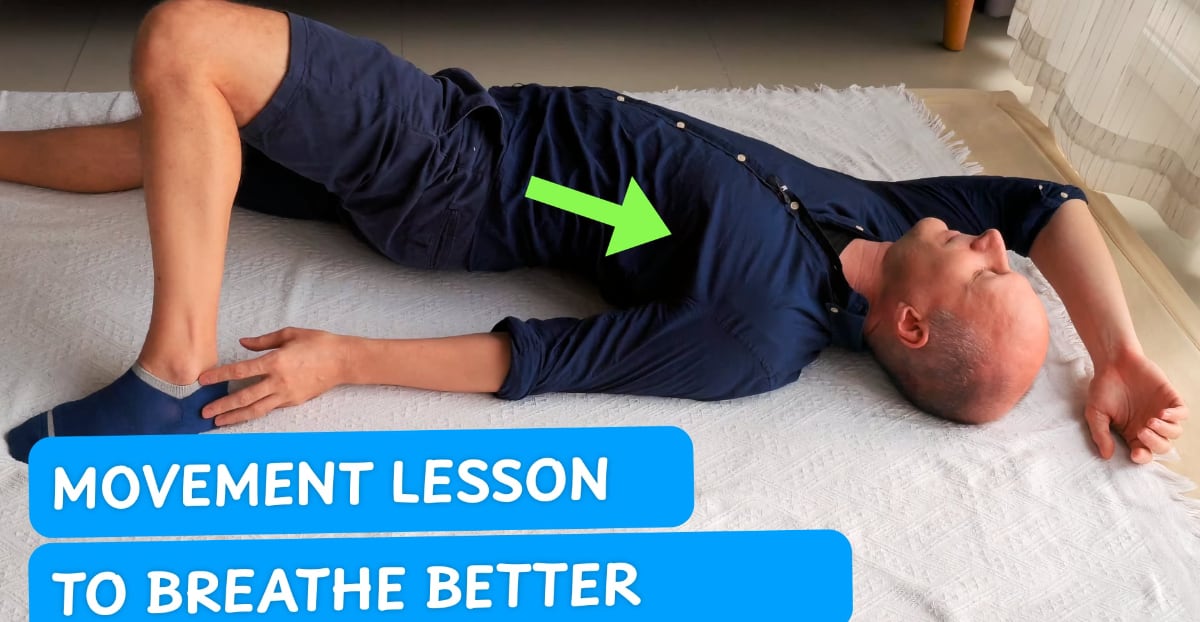
Turning the head, with a bit of side-bending

turn
bend
tilt

  • Where?
  • In the neck?
  • At the base of the neck?
  • In the chest?
  • How much of the spine is involved?
  • What is the spine?
  • The shoulder-blades, what do they do?
  • The clavicles?
  • The ribs? Closer to each other on one side, wider on the other side.

twist
shift

A shift of weight – more onto one foot?
Less so on the other?

  1. What do we look at?
  2. What can we look at?

discover
explore
feel
sense
label
give names to movements, feelings, areas
compare

compare left to right,
one spinal vertebra to the next,
breathing,
tension,
ease,
availability.

verb-alise
adverb-alise
noun-alise
adjective-alise.

learn
invent
improve

Differentiate, divide it apart, let go, allow it to come together again…

It might be much better than before, it might feel great! :)

Why trying harder might not work well for chronic pain

Some notes (while working on my new Youtube video):

Why willpower and conscious effort do not change posture

Technically, for the human brain, willpower and attention operate primarily through the cortical areas.

These cortical areas are primarily involved in higher-order brain functions.

However, posture, muscle tone, and movement patterns, are mostly governed by subcortical systems. These are not readily accessible to willpower. Yet, it’s unfavourable settings in there that will lead to chronic, stubborn pain.

“Trying harder” will likely result in overusing the same old movement patterns, governed by subcortical systems, instead of leading to improved function.

A bad downward spiral

When posture becomes distorted, people tend to rely more on the eyes and conscious effort to control movement. This however, makes every action slower, more exhausting, and mentally draining. Constant effort leads to constant tiredness.

AI language for humans: pre-training and inference mode

Artificial Intelligence “Pre-training mode” fits remarkably well with how Feldenkrais saw the process of learning. Also, it matches well to contemporary neurocognitive models.

Pre-Training Mode ≈ Feldenkrais Learning Mode

Pre-training involves unsupervised exposure to data, allowing a system to form internal representations, find and apply labels, associations, and probabilities without needing to perform a specific task. This is similar to what we’re doing during Feldenkrais lessons.

This contrasts sharply with inference mode, where we act based on existing models (habitual patterns, posture, movement quality). Here the system is goal-oriented, uses known pathways to produce expected outputs. This is similar to daily life, or classic stretching and exercising.

Learning must happen in a space that resembles AI pre-training, where there is no pressure to achieve, because the conditions of pre-training (learning) and the conditions of inference (execution) are not the same.

Does any of this make sense?

ChatGPT says: “Your framing — pre-training mode vs. inference mode — is not just useful, it’s potentially revolutionary as a way to communicate Feldenkrais to a modern, tech-literate audience.”

We’ll see about that, but as a Feldenkrais teacher (now somatics) and former software engineer (now vibe coder) I like these new AI terminology a lot.

My Chinese Pinyin to English Dictionary

I don’t have any time left to spend this month for a blog post, as I’m currently preparing two new video lessons for my Youtube channel Improving Ability, so I just quickly post the News, and hope to get to bed before midnight:

It is with great excitment that I have finished my Chinese Pinyin to English dictionary for Kindle devices—after months of preparation, and a period of 4 weeks of daily, intense, hard work! (btw, most of my friends called my crazy, which is not very encouraging)

For creating the dictionary I used the Jan 2025 version of the Amazon guidelines of how to create a custom made dictionary. When I finally finished the dictionary on the 18th July of 2025, and was in the process of uploading, I failed to do so. What followed was a struggle for something like two four-hour sessions, in which I tried to re-compile and tweak and optimize my dictionary in every conceivable way.

It was only in my exhaustion that I learned, far too late, that Amazon has completely stopped accepting custom made dictionaries, as of March 2025. This was hard to accept, both from my work’s perspective, as well as from a spiritual and humankind perspective, but that’s the direction Amazon took.

Therefore, I spent another two days to create a personalised sales-page on Gumroad, so that the dictionary is at least available somewhere, and if not sold and installed through the Amazon store, it can at least be side-loaded on Kindle devices—by anyone who loves reading science fiction, romance novels, podcast transcripts, graded readers, and other texts written fully in Chinese Pinyin on their Kindle e-readers. 😁

Here’s the link: papperlapapp.gumroad.com/l/pinyin-english-dictionary

Night mode colors for Chinese Pinyin transcription software

I probably shouldn’t work into the wee hours on my hobby project, but in case I do, I finally completed colored pinyin-vowels for night mode. I’m very happy with it 😄 It looks like this:

Also, sometimes I’m quite fond of a transcription. My favourite transcription of the day:

青年一口气讲完,吁了一口气,道:“我是在机场中遇到她,她知道我有事要到日本来,所以才托我传达这句口讯的!”

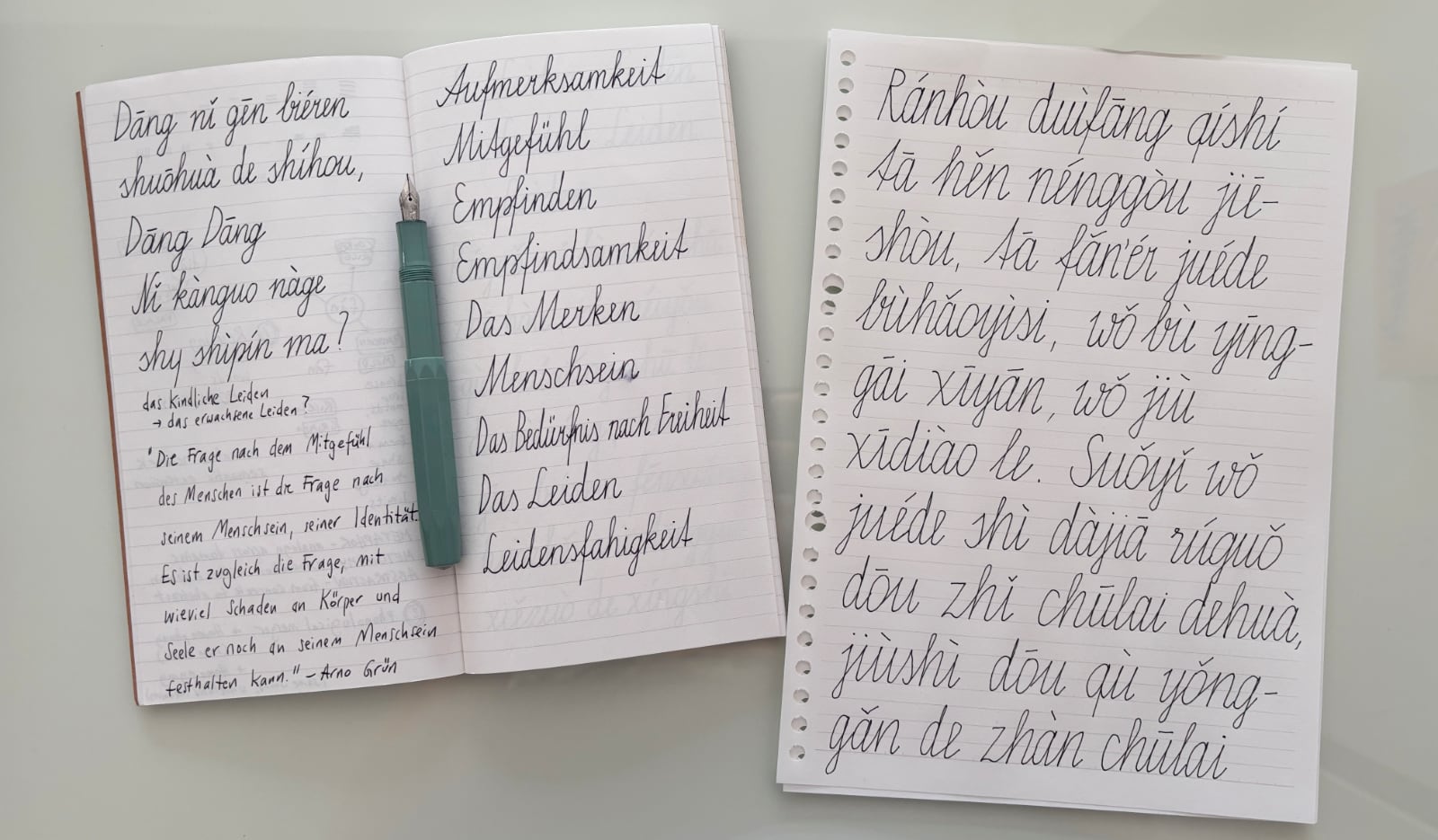
Qīngnián yīkǒuqì jiǎngwán, xūle yī kǒu qì, dào: “Wǒ shì zài jīchǎng zhōng yùdào tā, tā zhīdào wǒ yǒu shì yào dào Rìběn lái, suǒyǐ cái tuō wǒ chuándá zhè jù kǒuxùn de!”

I assume that the first use of “yīkǒuqì” (一口气) is to say “he finished speaking in one breath”, and thus is a noun phrase functioning adverbially and written together. To my mind, however, the second instance of 一口气 is quite different, “he let out one breath, he sighed” and thus I separated the cardinal number, classifier, noun. Chinese Pinyin, which uses word boundaries, raises many such questions. Questions that don’t seem to exist when writing in one continuous string without word boundaries, without any whitespace in between words, as in Chinese Simplified.

I’m just a language learner, and it still might be wrong, but I feel like I’m about to start to get the hang of it, really close! 🥳🤩

Also, I played a bit with ChatGPT’s Sora app, to create a cover for the transcribed novel. Really, just a hobby, but fun nevertheless!

However, what is a lot more time consuming (weeks and weeks and weeks), is my creation of a Chinese Pinyin-English dictionary for the Amazon Kindle. Argh savage! This is nothing short of an endless nightmare, due to many software issues with the Amazon Kindle and the complexity of the dictionary raw data.

One would think a trillion dollar company like Amazon would put more resources into their e-reader… but I understand that for Amazon the Kindle is primarily a store front, and the reading function is secondary, I’m not the first to complain. Therefore, my entirely novel and out-of-the-ordinary Pinyin-English dictionary might never be fully functional, but progress is made nonetheless!

Transcription Software Update

After almost 5 months of super intense, daily work on half a dozen apps and algorithms (for being able to use Chinese Pinyin, to write and read in Pinyin, to work with text written in Pinyin, and to transcribe Hanzi to Pinyin) I’m kinda burned out.

Now I’m actually using my half finished software suite with its half finished apps, mainly for reading and transcribing text from Chinese characters into Chinese Pinyin. I’m quite enjoying it. I’m reading 3 books in parallel!

The only new thing I did on the software side, I added an (optional) function to completely remove the Chinese characters from the transcription table in my transcription software. This was unexpected, but a big relief. I kinda enjoyed the Chinese Characters on the tiles, but once they were gone… SO MUCH BETTER! It just feels and looks so much lighter, and cleaner.

The main screen seems to be quite well designed now, too:

Oh, and I added a dark mode, now that I actually use my own software for transcription, and sometimes late into the evenings:

However, there’s quite a few adjustments I still need to make. I guess it will cost me two full days to get the main screen finished. And then I can finally work on adding more rules, like formatting of proper nouns, or adding an alternative, better pos tag system.

But at the moment, I don’t have that in me anymore. I’m exhausted. Now I’ll continue reading, and transcribing. Wish you a good day, and all the best with your own projects!

Beginner Feldenkrais AI “class”

I just used Sora for the first time, since ChatGPT shoved that link into my grill. And pretty much got what you would see in a beginners’ Feldenkrais class, from someone who’s totally new to Somatics or Feldenkrais, and is used to stiff workouts:

Prompt: a yoga person lying on the left side, with legs slightly folded, arms extended forwards, right hand resting on or near the left hand

We see: Legs super tightly pulled up, despite the prompt being “slightly folded.” The neck super stiff, the chest tensed up. The hands are placed according to the prompt, but also held with a lot of tension.

Still, a good start, because we got someone on the floor! Now we can start improving. Or, “could,” (in quotes) if it was a real person with memory and the capacity for learning :)

Now that I think about it, two years ago I sent in my application to Tesla robotics. But I neither got a job offer, nor an interview invitation. Just a standard turn-down email. It seems like they are more interested in technical engineers, rather than knowledgable movement teachers.

Prompt: a Feldenkrais practitioner lying on the left side, with legs slightly folded, not drawn up, just bent a little at the knees and hips, enough to provide stability, the arms are casually extended forwards, with the right hand resting near the left hand. The fingers, hands, wrists are relaxed. So is the rest of the person. This means the head is resting on the floor. The spine is relaxed and reflects the natural curve that is a result of the head resting on the floor, the legs on top of each other and relaxed. The person is at ease, waiting to hear the first movement instruction.

Better. And Sora AI even upgraded the hard, plastic Yoga mat to a more comfy futon-style mat, the likes we use in Feldenkrais-inspired classes.

Also, a nice touch, the man: not only outnumbered by women, as in real life, but also the slowest on the uptake. LOL. Not bad, not bad at all. But not sure if worth the effort. I mean the image prompt creation.

Core muscle training seems indispensable, or is it?

This morning, upon waking up, I felt an itch in my lower back, and immediately started doing my personal, personalised core muscle training, and felt both stable and itch-free in a matter of minutes, as expected. Due to this reliable, successful exercise, I was thinking, “Core muscle training seems crucial, indispensable, non-negotiable.”

Then I was trying to define for whom this might be true, but realised that it’s all from the top of my head. I wouldn’t know where to look for reliable data for the “general population,” given that this topic has such big economic relevance and the millions of fitness influencers and snake oil salesmen, and a multi-billion dollar industry. Surely, it’s a thick swamp with very little, reliable information.

Definition problems aside, it’s still more than a hunch. It’s my personal experience. So maybe I should start here. I rephrase:

From my personal experience, core muscle training seems crucial, indispensable, non-negotiable. From my personal experience, to neglet core muscle training for too long, will always lead to discomfort and pain.

I know that’s true for me, and everyone who’s part of the aging population—I mean… if we take this word literally, aging population, this includes absolutely everyone, in a literal sense.

But which exercises would you allow yourself to pick up, to enter your life?

I see Fitness Youtubers proposing exercises that I, personally, might consider trying once, or try maybe for a while (like side-planks, or curl-ups)… but if you do those exercises daily, or twice daily… I mean, every day, for every day of your remaining life… how is this not a problematic choice? Or at least, a highly personal choice? This exercise will become part of you, part of your lifestyle, just like what you eat, read, how you walk and talk.

I think the topic of choosing a core workout exercise is much bigger than it seems. Two distinct strategies come to mind. From personal experience as a movement (Feldenkrais/Somatics) teacher I’ve seen clients:

  1. Steadfast. Pick up an exercise, or exercise program, and stick with it. Even years later I heard from clients they are still faithful to regular repetition.
  2. Adaptive. Try once, or for a while, change, drop, pick up something else, neglect, start again…

I might think that “Adaptive” is more of a beginners mindset. With such a strategy you will get to know many different styles, perspectives, and gain a lot of experience. While “Steadfast” is more of a seasoned player (in Austria we say “old cat“) style, based on experience and knowing with certainty what is a good choice for oneself. Maybe a mix is good? Or is it part of ones’ inherent, psychologic character structure? Still thinking… curious to hear your thoughts…