
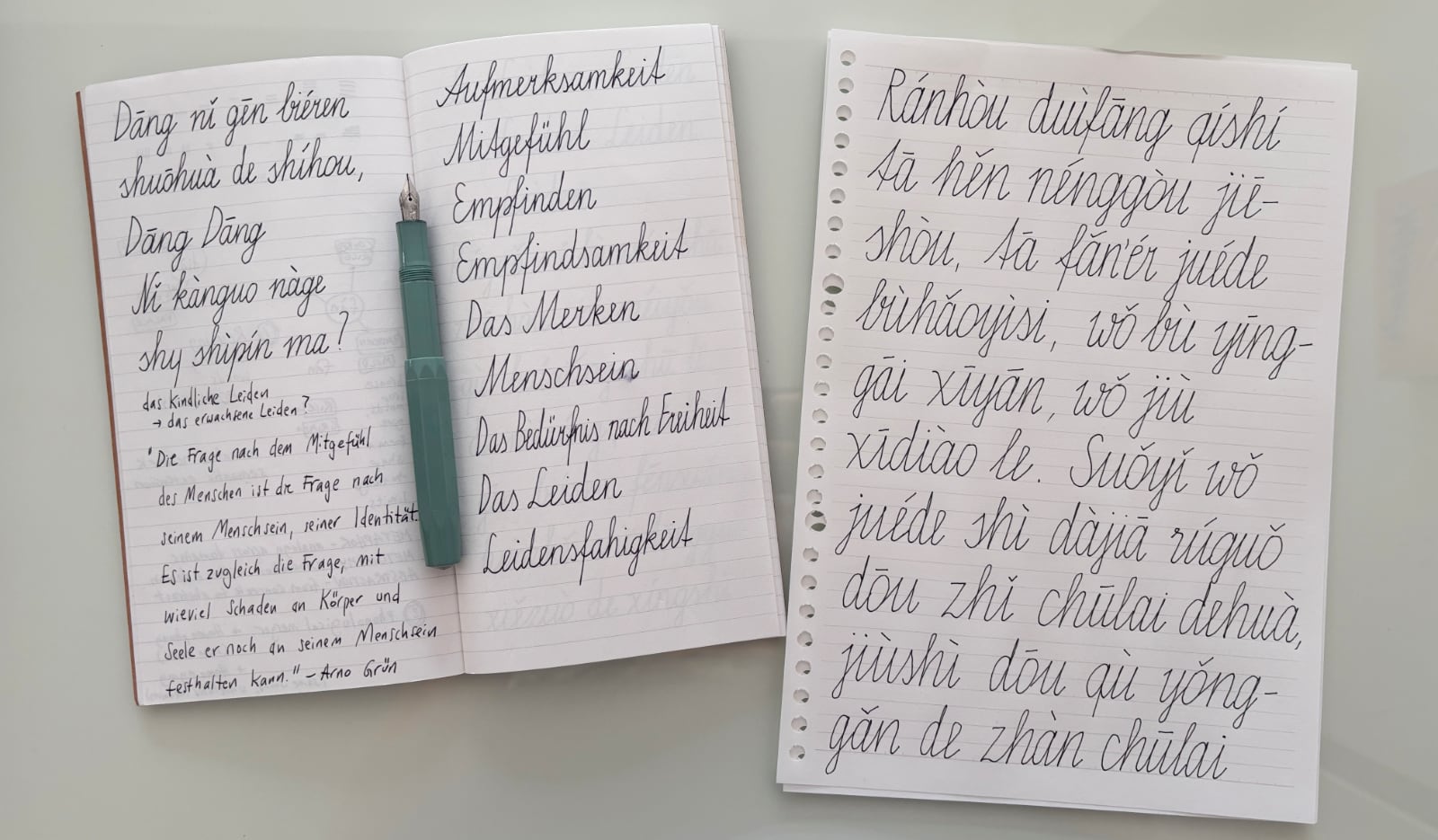
Alfons’s handwriting samples, German and Chinese, on attention, sensation and sensitivity
Oh my god, end of the month, too much to do, too much to do, I have no time, but there is time for a coffee, and a blog post, quick quick quick, just a short one, I type, I type, it is me, Alfons, I type:
I’ve just spent a few wonderful days in Taiwan, in Kaohsiung, the big South port city, with friends. I gave a few Feldenkrais one-on-one lessons, which were awesome, which was awesome, I keep surprising myself, and my clients.
One of my clients had a motorbike accident, his tibial head was scattered, now features 12 screws and 2 plates. No ligaments were torn, lucky him. His leg did heal up, but is quite stiff, before the lesson – and much more flexible afterwards. After my, our, lesson he could roll over his foot again, his ankle was flexible again, he was so happy, and surprised, “How did you know my main problem is my ankle? I didn’t mention anything about that.” He said my lesson was gentle, enjoyable, interesting, and painless, as opposed to the very painful physical therapy sessions, which he grew to be afraid of. He asked, “How is his possible?” I shrugged, “20 years of experience,” and I was thinking, “Oh wow, I’ve been doing this for a while now.”
I enjoyed the walkable city, driving around with their public, electrical YouBike bicycles, soaked in the harbor wind and scent of the ocean, and the very laid back, aging population. I discovered some great little shops, book stores, and had most touching, inspiring conversations about Feldenkrais, and Tolstoy, and Dostoevsky, Hermann Hesse, Hannah Arendt, the Alp rollout of Tucker Carlson and the talking style of Tim Dillon.
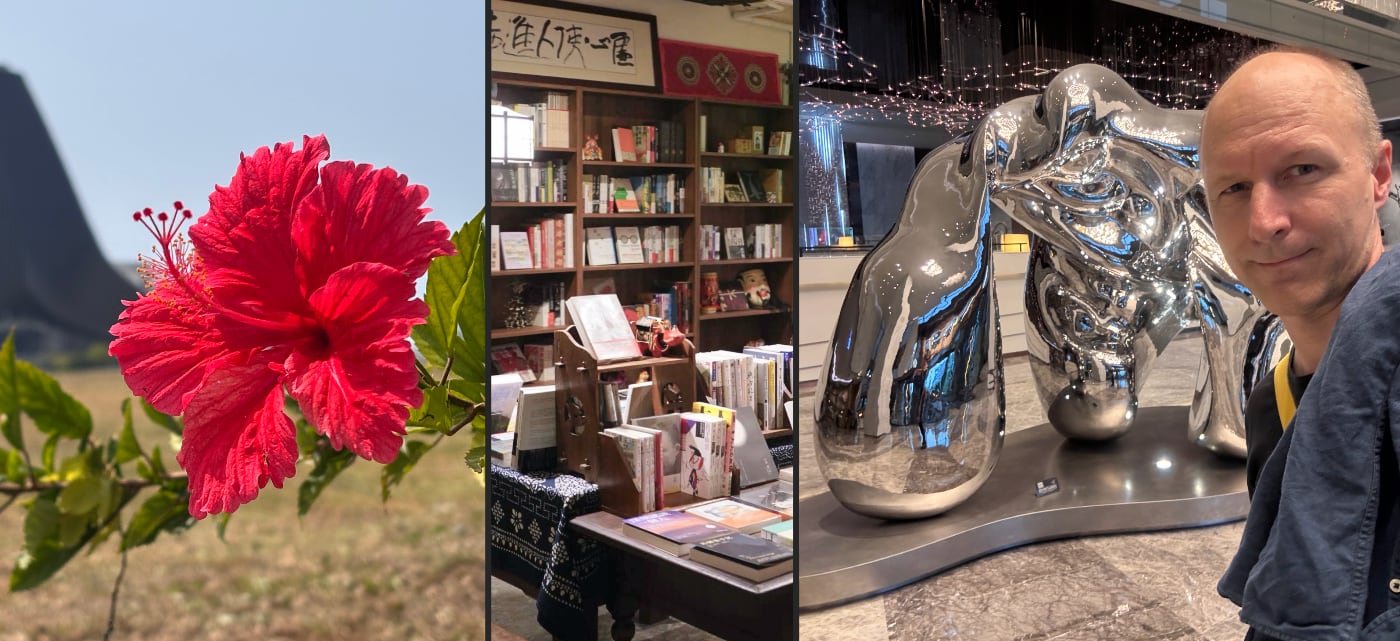
Fotos from Taiwan, left to right: 1) a Hibiscus flower in the wind, in front of Kaohsiung Cruise Terminal, 2) 蟬雨越讀 bookstore 3) a statue by A Kassen, Pour (2019) – I imagine that’s how AI robots will look like
Taiwan could be a new home for me. However, I might dearly miss the young, fresh, joyful, optimistic beauty of Vietnam’s youth. But then, Taiwan Employment Gold Card for the win, a mature, well read society, less pollution and chaos than Vietnam, less NGO and extreme government overreach than Austria/EU, nature, walkable cities, mountain trails, a real home.
One friend said, “It’s good to have options.” And I was thinking, “I like your positive phrasing, I should learn from that.”
It was back in 2008, also in Taiwan, where I found great inspiration for my first book, My Feldenkrais Book. And suddenly, again, last week, I found joy in handwriting again.
Is that one word? Handwriting. Or two? Hand writing. To hand write. To handwrite.
Yeah, I’m not going to open THAT window on my computer. But I can tell you this:
I LOVE LOVE LOVE, the feeling, the sensation of pulling the steel tip of my pen down the paper, that short stroke, 6 mm, 12, 18. It’s 18 mm (0.71 in, according to my calculator), if I spawn the downstroke, the stem of a capital letter across 3 lines.
Then a little hook. Not too eager, it shall not bend the downstroke. The downstroke must be straight, all the way down to the hook. Patience, patience my friend, patience. There you go: hook, upwards stroke, loop, down again. Lift the tip off the paper. Great purchase, great paper, love it. 230 NTD well spent. Adjust the grip. Put the pen to paper, then the slanted oval.
OOOOO so wonderful!
Moshé Feldenkrais is often said to have talked about handwriting. They said, “he said,” “You learn the official handwriting first, and then you will develop your own handwriting.” I think it was a metaphor for his own teaching, the group class instructions, Awareness Through Movement, as his publisher called it. “What he really meant“, I imagine, he was talking about the very structured, generic Feldenkrais group classes for large groups. And how to adapt those sequences for yourself, and for your own clients.
OK, it took me 20 years to figure that out.
Because in America, there is no official handwriting. And most of my Feldenkrais teachers were American, or were parroting the Americans. Therefore, I had no idea what they were talking about, and I was too afraid to ask.
However, two years ago I found out that we Austrian’s are actually blessed with a great, albeit impossible to write, official handwriting style. I say impossible, because it’s based on perfect ellipses and straight lines, which humans are largely incapable to produce.

In Austria, the Österreichische Schulschrift 1995 is the official government-standardized, cursive script issued by the Ministry of Education. I believe the main contributors were Hadmar Lichtenwallner, Brigitta Scheiber, under secretary Dr. Rudolf Scholten – from what I could find in the National Library in Vienna. It’s a distinctively beautiful, stylised, almost mathematical handwriting form – that nobody is teaching; because it’s too difficult to learn, for teachers and students alike. Teachers are extremely outspoken about that, they parrot, “It’s just a model! Don’t try to copy the original!!” Instead, everyone is teaching a bastardized, inconsistent, unsightly, unsound, dummbed down, flawed, straight out ugly version, that some unknown, unqualified and unskilled person produced from the official script, everyone keeps copying that one. The collective incompetence, ignorance, and unwillingness to improve is just mindboggling. For the past decades they didn’t even show the handwritten handwriting model anymore, but instead just a half-broken computer font, like this:

In contrast, the United States has no official handwriting script. Handwriting instruction is decided at the local level, and schools typically choose from private company’s programs such as Zaner-Bloser, D’Nealian, or Handwriting Without Tears. Even historical styles like Spencerian or Palmer were never federally designed, nor rolled out nationwide.
In short, 20 years ago I didn’t know any of that, and thus the stories about Moshé Feldenkrais and handwriting didn’t make sense to me.
Also, it was only last year that I truly understood that Moshé Feldenkrais did not attend public schooling in his early, formative years. He was homeschooled. I have no idea which handwriting model he was taught. But this discovery explains a lot.
Where was I… sorry to bother you with this free-flow form of blog post writing.
Ah yes… the joy of feeling, and perceiving, of how the tip of the steel pen glides on paper.
They joy of feeling movement, of feeling oneself, and the immediate environment we’re touching.
The joy of movement.
I think I can attribute much of my appreciation for the ability to acknowledge and appreciate these joys to Moshé Feldenkrais’s lessons, to my own learning with them, my practice with clients, and my teaching. It’s a wonderful thing. Being able to find joy, acknowledgment and appreciation in our ability to feel, sense, think and act, might be the thing that will save us, spiritually and physically. Or at least, all of “us” who found these ways. Or similar ways.
Now one last thing for today:
Enjoy your rolling today! Enjoy your moving, feeling, sensing and thinking today! I wish you the best, wonderful, wonderful experience of yourself and everything you’re touching.
Now off to editing! See you in my next video!
